
Cryptocurrencies have come a long way over the last few years, so much so that their market capitalization is now above the $2 trillion mark, and large businesses including Tesla and MicroStrategy have invested billions in Bitcoin (BTC).
While institutional investments in crypto assets have been growing over the last few years, discussion on how retail investors should approach cryptocurrency investments has dominated social media. While some advocate for all-or-nothing bets on small-cap altcoins, more conservative approaches include investing only in Bitcoin or gaining exposure via indexes.
Younger generations are more prone to investing in cryptocurrency, with surveys showing that 83% of millennial millionaires now own crypto. But, what about those who aren’t millionaires and are making average salaries? Should cryptocurrencies even be considered at all?
Cointelegraph reached out to various experts to find out how they believe someone with an average American salary of between $45,000 to $50,000 a year should approach cryptocurrency investing.
Paying yourself first
Traditional personal finance wisdom suggests that before creating a portfolio, investors should accumulate a few months’ worth of living expenses in cash to prepare for a rainy day. How those funds should be saved varies depending on who’s giving the advice, but one common theme is paying yourself first.
Speaking to Cointelegraph, Bill Barhydt, CEO of cryptocurrency investment app Abra, echoed this sentiment saying retail investors “should always pay themselves first.” To him, however, paying themselves first “means keeping savings in crypto for the long term, especially Bitcoin and Ether.”
Barhydt added he keeps the majority of his wealth in cryptocurrencies “along with some cash in high-yield interest accounts.” During market crashes, he allocates 10% to 25% of his savings to stocks, he said.
To Barhydt, cryptocurrency investments should be a part of a retail investor’s portfolio, while he himself questions the “balanced portfolio concept.” He added that “balanced portfolios are for lazy people who don’t do research, understand markets or can’t stomach short-term losses.”
Instead, Barhydt believes wealthy investors “know that concentrating investments based on their own convictions and homework, plus the ability to deal with losses, is their key to success.”
Speaking to Cointelegraph, Stephen Stonberg, CEO of cryptocurrency exchange Bittrex Global, noted that for retail investors with small amounts to invest or limited access to portfolio strategies, “crypto investments may not make the most sense on a large scale — but that doesn’t mean they shouldn’t invest.”
Stonberg said investing in crypto is being equated to investing in the internet in 1993 — ahead of the dot-com bubble — and, as such, the “best approach would be to look at making investments in more established coins such as Bitcoin and Ether” as these have strong use cases and established communities. He added:
“Crypto should be a part of a more balanced portfolio and investors should be careful to do their own research. Diversification is a tried and trusted portfolio model and has shown to be defensive against waves of turmoil.”
Caleb Silver, editor-in-chief of investing and finance website Investopedia, was more conservative, saying that cryptocurrencies are “highly volatile and speculative investments and should be handled as such.”
To Silver, cryptocurrencies “should not be considered elements to balance a portfolio.” Given the performance of “many of the largest cryptocurrencies,” investors could consider limited exposure to the asset class but “should not depend on it to balance their portfolios.”
Thomas Perfumo, head of business operations and strategy at cryptocurrency exchange Kraken, told Cointelegraph the exchange “cannot provide recommendations on what people should do with their money” but showed excitement over “the ability to earn rewards through staking.”
As to how much should be allocated to a portfolio, most experts responded, “it depends,” with any actual figures always being below 10% of a portfolio.
Crypto, funds or indexes?
In early 2021, strategists at Wall Street banking giant JPMorgan suggested a 1% portfolio allocation to BTC could serve as a hedge against fluctuations in traditional asset classes such as stocks, bonds, and commodities. In January 2022, billionaire Ray Dalio recommended a 1–2% allocation for the flagship cryptocurrency as an inflation hedge.
Speaking to Cointelegraph, Bittrex Global’s Stonberg advanced that a relatively “safe” allocation would be at 5%, enough to be considered low-risk while also allowing for “marginal return.” Silver echoed Stonberg’s figure, adding that investors should allocate the 5% with “complete awareness that they could lose it all quickly.”
Silver said that cryptocurrency index funds, futures exchange-traded funds (ETFs) or other diversified investments could be less risky while also producing “far less upside than individual tokens.” He added an alternative would be companies and ETFs around the blockchain space.
Stonberg, on the other hand, pointed out the “most economical choice is to purchase cryptocurrencies directly rather than hold an index,” as there is no reason to cover an index’s custody and marketing costs if investors can just pick cryptocurrencies directly.
Johnny Lyu, CEO of cryptocurrency exchange KuCoin, did not specify any type of allocation. He, instead, noted that specific recommendations depend on several factors including investors’ financial and technical literacy, their goals, strategies and risk appetite.
To Lyu, more crypto-savvy investors should allocate more to crypto than those who are just curious about the space. He added:
“No matter how much you invest in crypto, it gives you some advantages in terms of personal, financial and career advancement if you just understand how digital money works.”
Lyu also said that a golden rule for any investment is diversification. An ideal crypto portfolio consists of “coins of different categories such as top crypto assets, stablecoins, nonfungible tokens, decentralized finance instruments etc.” Such a portfolio, he said, should be part of a larger one with non-crypto assets.
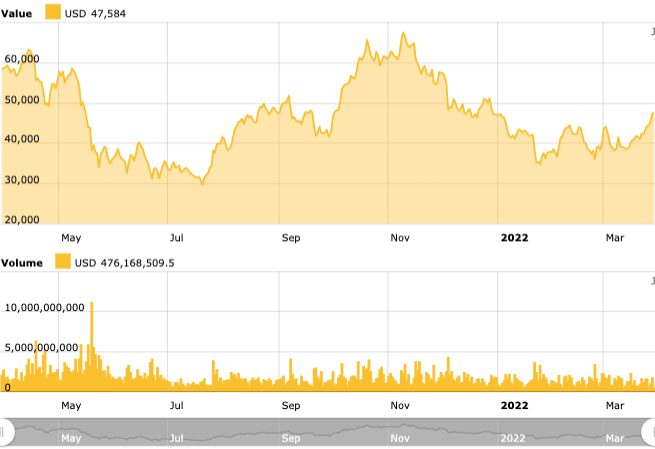
Investing only what investors can afford to lose is a typical disclaimer in the space, but what if investors aren’t able to stomach the losses that may come? In 2017, BTC rallied to a high near $20,000 before plunging. By late 2018, it was trading at little over $3,000, having shaken off thousands of investors.
Crypto investing boils down to risk tolerance
Those with the stomach to stick to their strategy likely benefited, as in late 2021 when Bitcoin hit a new high near $69,000. Those who didn’t, watched the rollercoaster unfold in disbelief. Stonberg offered a solution to the problem:
“A good way to approach crypto is to first determine your risk tolerance: The amount of investment capital you have to work with and your ideal amount of exposure while factoring risk.”
Even if some investors put in their hard-earned money while understanding that their investment may lose all of its value, it’s clear that cryptocurrencies and their innovations are here to stay. So much so that BTC is now being compared to a digital version of gold.
Stonberg concluded by saying he is “convinced that crypto investing will become a regular point of conversation for a family in the next year or two” as cryptocurrencies become mainstream. Silver agreed, saying that the crypto space is “where finance, investing and payments are moving. The more we talk and learn about these themes, the smarter we will be as consumers and investors.”
Barhydt suggested that cryptocurrency investments should be a secondary investment discussion to be had, with the first one being “how are families going to guarantee that they can pay themselves first.”
At the end of the day, it’s important first to analyze the purpose of cryptocurrency investments. If investors are picking up BTC because of its resistance to censorship, they can easily stomach short-term price fluctuations. If their goal is to retire early and live on an island, bear markets may become a nightmare regardless of the chosen investment vehicle.
The views and opinions expressed here do not necessarily reflect the views of Cointelegraph.com. Every investment and trading move involves risk, you should conduct your own research when making a decision.


