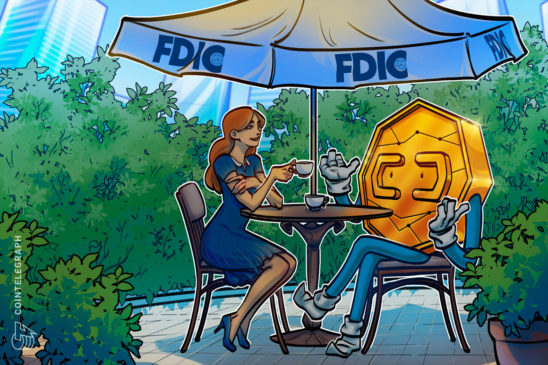
Over the years, several cryptocurrency companies have claimed that deposits with them were insured by the United States Federal Reserve and the Federal Deposit Insurance Corporation (FDIC) as if they were regular savings accounts. While so far, no crypto firm has been able to offer depositors this type of insurance, some speculate it could be the key to mass adoption.
The most notable case is that of bankrupt lender Voyager Digital, which saw regulators instruct it to remove “false and misleading statements” regarding FDIC insurance. Crypto exchange FTX has been a beacon of hope looking to backstop contagion in the cryptocurrency industry, but it received a cease-and-desist letter from the FDIC to stop suggesting user funds on the platform were insured.
As it stands, even major players in the cryptocurrency space aren’t FDIC-insured. Coinbase, for example, details on its pages that it carries insurance against losses from theft but is not an FDIC-insured bank and that cryptocurrency is “not insured or guaranteed by or subject to the protections” of the FDIC or Securities Investor Protection Corporation (SIPC).
The exchange, however, points out that “to the extent U.S. customer funds are held as cash, they are maintained in pooled custodial accounts at one or more banks insured by the FDIC.” Speaking to Cointelegraph on the subject, a Coinbase spokesperson only said she can confirm “that Coinbase is aligned with the latest FDIC guidance.”
So what is FDIC insurance, why is it so sought-after in the cryptocurrency industry and why does it remain so elusive?
What is FDIC insurance?
The FDIC itself was created amid the Great Depression in 1933 to boost the financial system’s stability following a wave of bank failures during the 1920s and has managed to protect depositors ever since.
FDIC insurance refers to the insurance provided by this agency that safeguards customer deposits in the event of bank failures. Cal Evans, managing associate at blockchain legal services firm Gresham International, told Cointelegraph:
“FDIC insurance is basically a layer of protection that covers one individual for up to $250,000 and its a backing that’s given by the United States government. It says ‘look, if this company goes bankrupt, we will guarantee your account to the value of $250,000 per person, per company.’”
So, if an FDIC-insured financial institution fails to meet its obligations to customers, the FDIC pays these amounts to depositors up to the assured amount while assuming the bank and selling its assets to pay off owed debt. It is worth noting that FDIC insurance does not cover investments like mutual funds.
Other countries have similar schemes, with deposits in the European Union being guaranteed up to $98,000 (100,000 euros) to protect against bank failures, for example. These schemes improve confidence in the financial system.
Speaking to Cointelegraph, Noah Buxton, a partner and practice leader for blockchain and digital assets at consulting firm Armanino, said, “No customer’s crypto holdings are FDIC-insured today,” but added that crypto platforms often hold customers’ dollar balances in financial institutions that are FDIC-insured.
There is a distinct difference between users having their funds insured, and the impact of a cryptocurrency firm having FDIC insurance — even for only United States dollar deposits — is hard to estimate.
The potential impact on crypto
If the FDIC were to insure deposits at a cryptocurrency platform, it would likely gain an advantage over other U.S.-based cryptocurrency platforms, as the perceived security of that platform would gain a huge boost, especially as it would be seen as a green flag from regulators as well.
Recent: Tech’s good intentions and why Satoshi’s new ‘social order’ foundered
Evans said that the FDIC would give the retail market “a lot more confidence because if FDIC insurance does happen and does apply to these companies, that means it’s going to massively, massively encourage people who are in the United States to put their money in crypto because it’s as secure as putting dollars at a bank,” adding:
“It’s going to massively help adoption, because it’s going to encourage the retail market to see companies like this at a parallel, in term of safety, with banks that people know.”
Mila Wild, marketing manager at cryptocurrency exchange ChangeHero, told Cointelegraph that one of the biggest problems the cryptocurrency sector faces is a lack of regulation and supervision, especially after the collapse of the Terra ecosystem “undermined the confidence of many investors.”
Per Wild, the FDIC doesn’t just insure customer deposits, as it also “conducts constant monitoring of financial institutions for security and compliance with consumer protection requirements.”
Dion Guillaume, global head of PR and communication at crypto exchange Gate.io, told Cointelegraph that a “friendly crypto regulatory environment would be critical for adoption,” as “blind regulatory sanctions” do not help. Guillaume added that insuring digital assets can be very different and several factors need to be carefully considered.
How hard is it to get FDIC insured?
As the FDIC could significantly boost confidence in the industry and several large exchanges have shown interest in getting it, it’s important to look at how hard it is for a cryptocurrency-native firm to actually become FDIC-insured.
Evans told Cointelegraph that it’s “actually relatively straightforward to get” as long as specific criteria are met by the organization looking to get it. The organization needs to make necessary applications and prove requisite liquidity and could potentially have to detail its management structure.
To Evans, FDIC insurance would “massively give companies operating in the United States a huge, huge benefit over foreign firms,” as U.S. residents who open accounts with insured firms would have a major incentive not to use decentralized exchanges or other peer-to-peer platforms.
Wild had a more negative stance, saying it’s “not possible to get FDIC insurance,” as it only covers “deposits held in insured banks and savings associations and protects against losses caused by the bankruptcy of these insured deposit institutions.” Wild added:
“Even if we imagine that crypto projects will be able to have FDIC insurance someday, it means sacrificing decentralization as one of the core crypto values.”
She further claimed that the FDIC’s statements on dealings with crypto firms are “trying to infringe on crypto companies and emphasize their perceived negative impact on society.” Wild concluded that the FDIC telling crypto projects not to suggest they’re insured “could further lower” trust in cryptocurrencies.
To Wild, cryptocurrencies will remain a riskier asset for the time being, as users won’t have any type of government protection. As a result, crypto users should “stay vigilant about their assets.” This does not mean fiat savings are safer, she said, as increasing inflation is eating those away.
Noah Buxton, a partner at consulting firm Armanino, went into more detail on the process, telling Cointelegraph that platforms attaining FDIC insurance would “require a modified underwriting regime, the creation of which has many significant hurdles.”
He said the FDIC would need to figure out how to take possession of crypto assets, how to value them and how to distribute them to the customers of failed crypto platforms, adding:
“While this is possible and may happen, we are more likely to see private insurance and reinsurance vehicles fill the void for the foreseeable future. This is a necessary component of any market and the broader coverage availability and competitive set of insurance options will benefit crypto holders.”
Is the insurance worth chasing?
If users are, in the future, able to get insurance through other sources — such as private company solutions or decentralized protocols — it’s worth questioning whether FDIC insurance is worth it in the long run. Insurance from the FDIC could be a significant centralizing factor, as most would likely move to a platform that has its backing.
Evans said he believes FDIC insurance “is not necessarily wanted or needed,” as wherever there’s more protection, “there happens to be more oversight and regulation,” which would mean insured companies would be “very secure and very regulated.”
These regulations could further restrict those who are able to create accounts with these companies, which would add to the question of centralization that the crypto insurance industry already faces.
Bitcoin Foundation chairman Brock Pierce told Cointelegraph that the crypto industry will nevertheless “see more companies try to get it” after the recent wave of crypto lenders going under, which will make it “even harder for them now.”
Pierce did not expect FDIC insurance to “be a big deal or matter much with regards to overall crypto adoption.” Whether it impacts cryptocurrency adoption at all may only be clear once/if the FDIC does insure cryptocurrency deposits.
Recent: ‘The social benefits are huge’: Web3 gaming to shift digital ownership
It’s worth noting that FDIC insurance may bring in a false sense of security. While no bank depositor has lost their funds since the FDIC was launched, its reserve fund isn’t fully funded. The FDIC, according to Investopedia, is “normally short of its total insurance exposure by more than 99%.”
The FDIC has, at times, borrowed money from the U.S. Treasury in the form of short-term loans. Self-custody may, for the experienced cryptocurrency investor, continue being a viable option, even if a crypto firm is one day FDIC insured.


