
In this exploration, we tackle the critical question: Will Ethereum recover? We’ll look at Ethereums future and analyze ETH’s present market status, potential for resurgence, the anticipated impact of the progress on Ethereum 2.0, and share expert price predictions.
Will Ethereum Recover? Analysis
The question “Will Ethereum recover?” depends on numerous factors. As of November 2023, Ethereum has shown signs of rebounding from its 2022 lows, suggesting a potential bottoming out. Key developments like the transition to Proof-of-Stake and the introduction of EIP (Ethereum Improvement Proposal) 1559, launched all the way back in August 2021, which brings deflationary pressure on Ethereum’s supply, making it a more attractive investment.
Additionally, Layer 2 (L2) technologies are enhancing Ethereum’s scalability, addressing previous challenges of high transaction fees and slow speeds. Ethereum’s dominance in the smart contracts sector and its substantial role in the decentralized finance ecosystem further strengthen its recovery prospects. However, predicting the exact trajectory of Ethereum’s recovery remains complex, with varying forecasts suggesting both potential ups and downs in the near future.
Ethereums Future: Top-10 Factors Impacting ETH Price
These ten factors could be crucial for answering the question “Will Ethereum recover?“:
#1 Future Upgrades:
Ethereum’s development roadmap includes significant upgrades like Proto-Danksharding, also known as EIP-4844, and Full Danksharding, which could greatly impact its scalability and functionality. The successful implementation of these upgrades can boost confidence in the network and the Ethereums future price.
#2 Regulatory Approvals:
Regulatory decisions, such as the approval of a spot Ethereum Exchange Traded Fund (ETF) in the United States by the Securities and Exchange Commission (SEC), can have a substantial impact on Ethereum’s status as a digital asset. BlackRock filed for a spot ETH ETF in mid-November 2023.
#3 Overall Crypto Market Trends:
Ethereum’s performance is closely tied to the broader cryptocurrency market. A general uptrend in the crypto market, catalyzed by events like the Bitcoin halving, can positively influence Ethereum’s price.
#4 ETH Burn Rate:
Ethereum’s transition to a proof-of-stake (PoS) consensus mechanism includes a mechanism called EIP-1559, which introduces a fee-burning mechanism. The more ETH is burned in transactions, the scarcer it becomes, potentially increasing its value.
#5 Layer-2 Solutions:
The adoption and success of Ethereum layer-2 scaling solutions, such as Optimistic Rollups and zk-Rollups, can significantly improve the network’s scalability and reduce transaction fees. This could attract more users and developers.
#6 DeFi And NFT Activity:
Ethereum’s ecosystem heavily relies on DeFi (Decentralized Finance) and NFT (Non-Fungible Token) applications. Increased adoption and activity in these sectors can drive demand for ETH and positively impact its price.
#7 Competition:
Ethereum faces competition from other blockchain platforms like Solana and Cardano. The success or failure of these competitors can affect Ethereum’s market position.
#8 Macroeconomic Factors:
Economic events, such as inflation, monetary policy decisions, and global financial crises, can influence investors’ choices. Cryptocurrencies like Ethereum are sometimes seen as a hedge against traditional financial instability.
#9 Network Security:
The security of the Ethereum network is crucial. High-profile hacks or vulnerabilities can undermine trust in the platform and lead to price declines.
#10 Ecosystem Development:
The growth of the Ethereum ecosystem, including the number of dApps, users, and developers, can affect its adoption and value.
EIP-1559: Understanding The Ethereum Burn Rate
Ethereum’s burn rate is a key aspect of its economics, influencing both its supply dynamics and long-term valuation. To grasp the Ethereum burn introduced with EIP-1559, examining the latest data and understanding how this mechanism operates within the Ethereum ecosystem is crucial.
Ethereum Is “Ultra Sound Money”
EIP-1559 was a proposal that fundamentally restructured Ethereum’s fee market. Before this proposal, miners received the entire transaction fee. With activation on August 5, 2021, EIP-1559 introduced a base fee for transactions, which is burned (permanently removed from circulation), and only an optional tip is given to miners. This mechanism aims to make transaction fees more predictable and the network more efficient.
The “ultra sound money” meme emerged from the community in response to EIP-1559. It plays on the concept of “sound money,” a term traditionally used to describe money that is not prone to depreciation and is a reliable store of value, like gold.
With EIP-1559, Ethereum’s supply becomes more predictable and potentially deflationary—if the amount of ETH burned exceeds the new ETH issued, the total supply will decrease over time, hence the term “ultra sound money.” This is seen as an enhancement over “sound money,” with Ethereum not just maintaining its value but potentially increasing it due to the decreasing supply.
Ethereum Burn Rate Projections
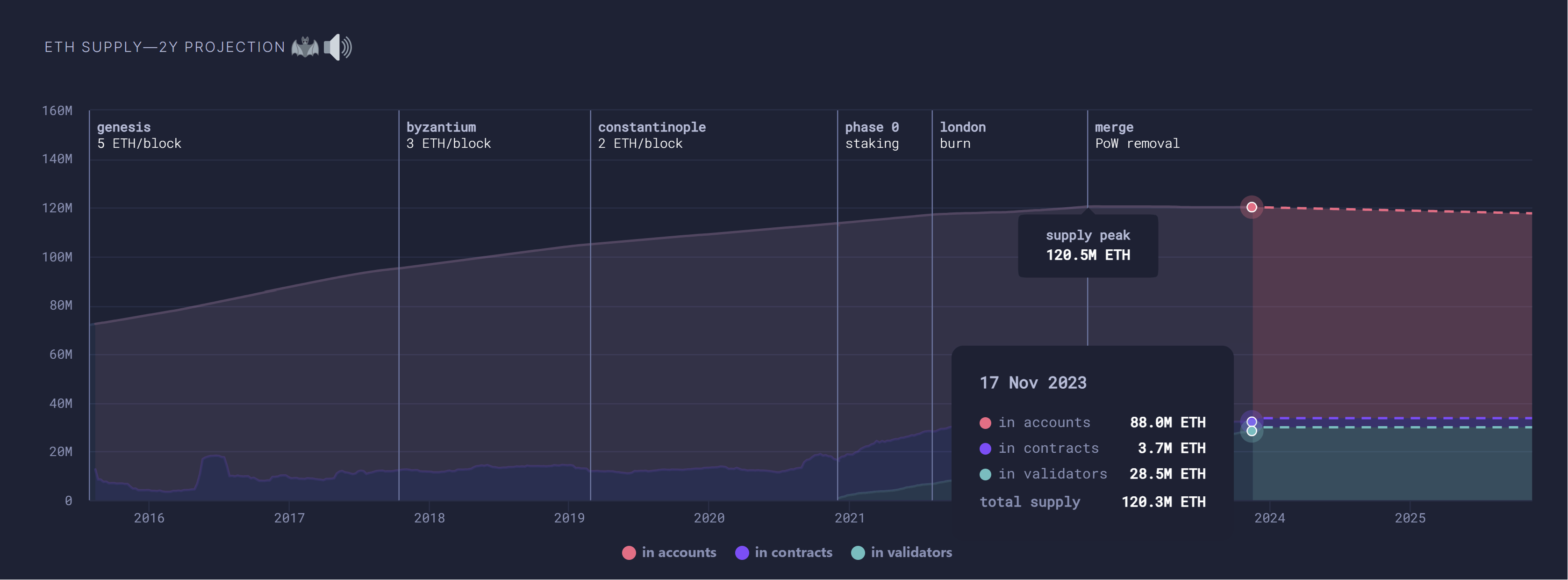
The attached chart underscores the impact of these changes on Ethereum’s supply, especially post-EIP-1559, where the supply curve starts to flatten, suggesting a reduction in the growth of Ethereum’s total supply. This aligns with the concept of Ethereum becoming a deflationary asset post-EIP-1559, contributing to the narrative that Ethereum’s future could be as an “ultra sound” form of money.
On November 17, 2023, the Ethereum supply stood at 88 million ETH in accounts, 3.7 million ETH in contracts, and 28.5 million ETH in validators, totaling 120.3 million ETH. The dotted line indicates Ethereums future decrease in total supply due to the burning of ETH and the issuance changes post-Merge. The chart projects that the ETH supply will shrink to 117.7 million ETH in November 2025.
Ethereum’s Future: Will Ethereum Go Back Up?
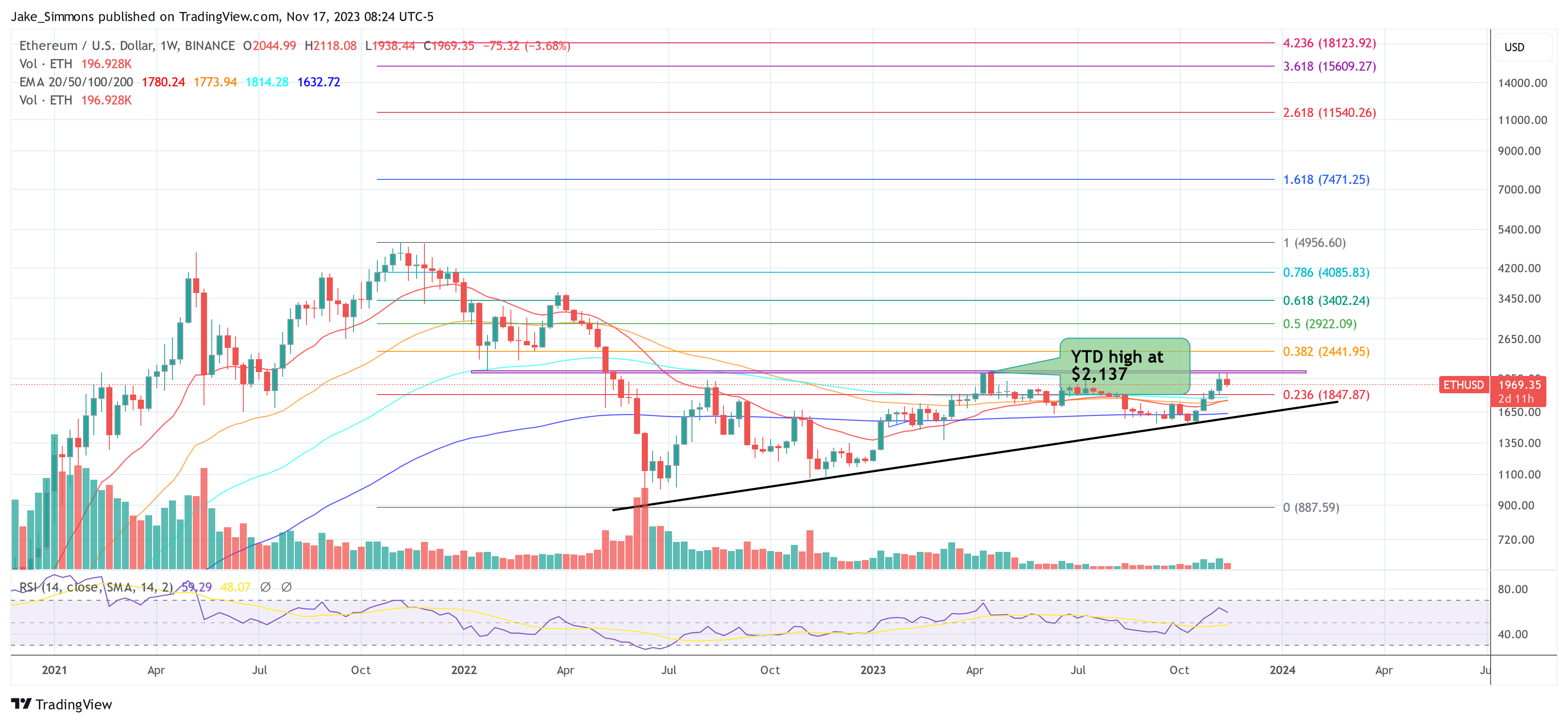
In the realm of cryptocurrency, technical analysis serves as a navigational tool to gauge market sentiment and potential price movements. Examining the 1-week ETH/USD chart provides insight into Ethereum’s price action and helps address the burning question: “will Ethereum recover?”
Fibonacci Levels And Price Targets
The chart showcases several Fibonacci retracement levels, which are crucial in identifying potential support and resistance zones based on previous price movements. Here are the key Fibonacci retracement levels highlighted:
- 0.236: At $1,847, this level acts as a potential support zone.
- 0.382: $2,441 is the next key Fib level, displaying the next resistance.
- 0.5: The $2,922 level represents a psychological midpoint.
- 0.618: At $3,402, this level is often considered the ‘golden ratio,’ a significant reversal point.
- 0.786: $4,085 is a deeper retracement level that can signal strength in the prevailing trend.
- 1: The full retracement level at $4,956 marks a complete return to all-time high.
- 1.618: At $7,471, this extended Fib level could be the first long-term bullish target.
- 2.618: $11,540 represents an optimistic projection in a strong Ethereum bull run.
- 3.618: This level at $15,609 would be an extraordinary target for a sustained bull run.
- 4.236: The $18,123 Fib level is the highest projected target on the chart, indicating an extreme bull case scenario.
Trend Lines, Resistance Zones And RSI
The chart shows a black ascending trend line, tracing the lows and signifying a potential area of support that Ethereum’s price could respect. If the price maintains above this line, it may indicate continued bullish sentiment.
The red box, or resistance zone, around the Year-To-Date (YTD) high at $2,137 underscores a region where sellers have previously entered the market. Overcoming this zone is critical for Ethereum to continue its upward trajectory.
The Relative Strength Index (RSI), sitting at 48.07, shows Ethereum is neither in the overbought nor oversold territory. This indicates a neutral momentum, which could precede a move in either direction.
Conclusion: Will Ethereum Recover?
While the chart presents strong arguments for an Ethereum bull run, with ETH price sustaining above critical support levels and challenging notable resistance zones, the future price action will depend on how the market interacts with these technical indicators. If Ethereum can break through the resistance encapsulated by the YTD high, we could see an affirmative answer to “Will Ethereum recover?” However, it is imperative for investors to monitor these levels closely, as they serve as a roadmap, not a crystal ball.
Ethereum Price Prediction By NewsBTC’s Head Of Research
Tony “The Bull” Severino, NewsBTC’s Head of Research, has provided an in-depth analysis of Ethereum’s market behavior in his latest edition of Coin Chartist. He observes, “Ethereum has yet to begin trending with a reading above 20 on the ADX, nor has it broken above the upper Bollinger Band. But these signals are likely coming soon.” This suggests Ethereum’s significant uptrend might be on the horizon.
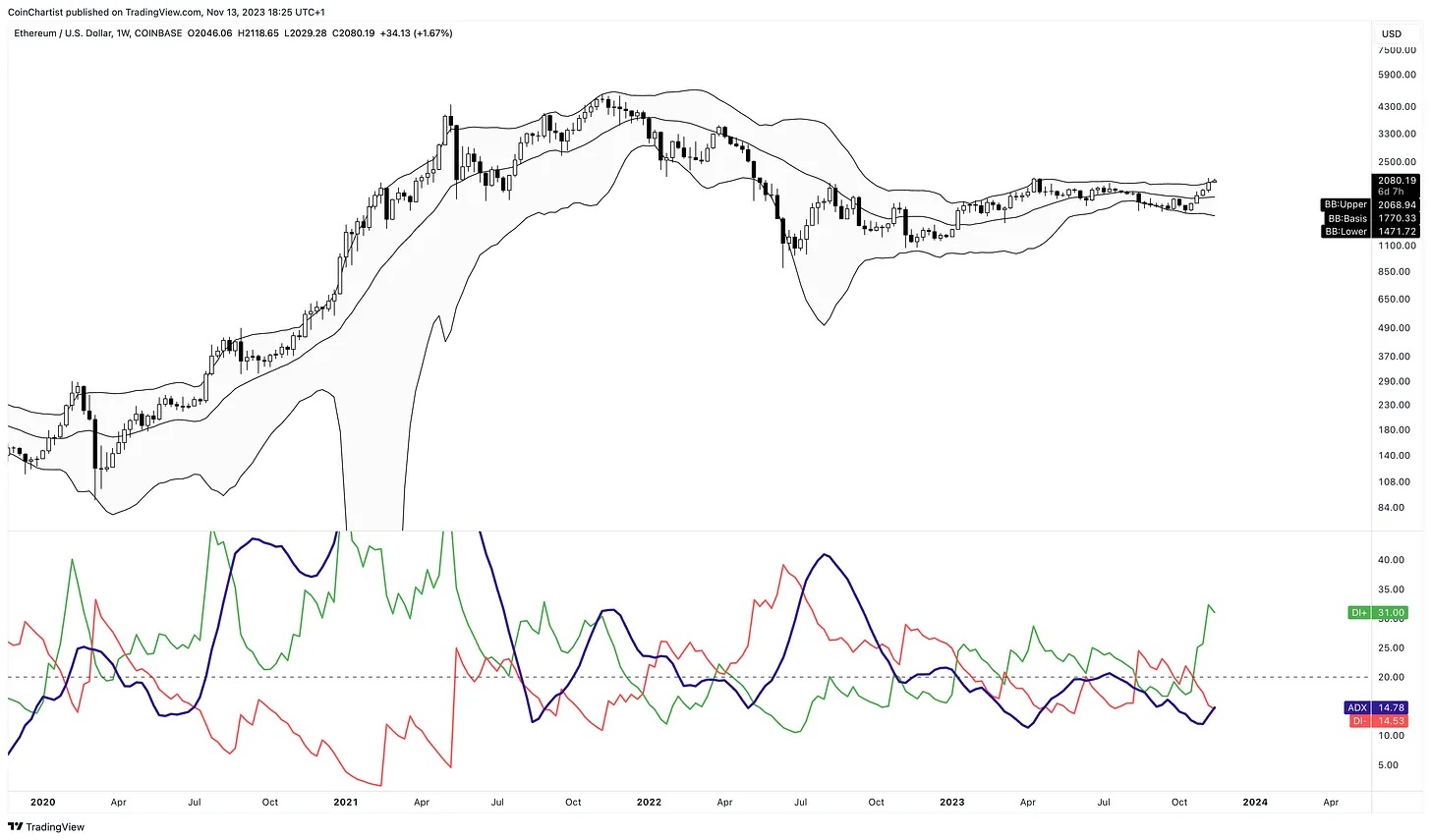
Comparing Ethereum with Bitcoin, Severino notes, “ETHUSD is much lower within the Ichimoku Cloud than BTCUSD,” indicating Ethereum is currently lagging behind Bitcoin. However, he anticipates Ethereum will soon “switch to over-performance.”
Highlighting a positive development, Severino states, “ETHUSD 1W was finally able to crack above its TDST downtrend resistance.” Yet, Ethereum needs to form a perfected TD9 series for further bullish confirmation. On the monthly chart, Ethereum’s overbought status on the Stochastic indicator suggests a strong trend, as Severino points out, “Each time the Stochastic has confirmed a 1M above 80 on the Stock, there was a massive push higher.”
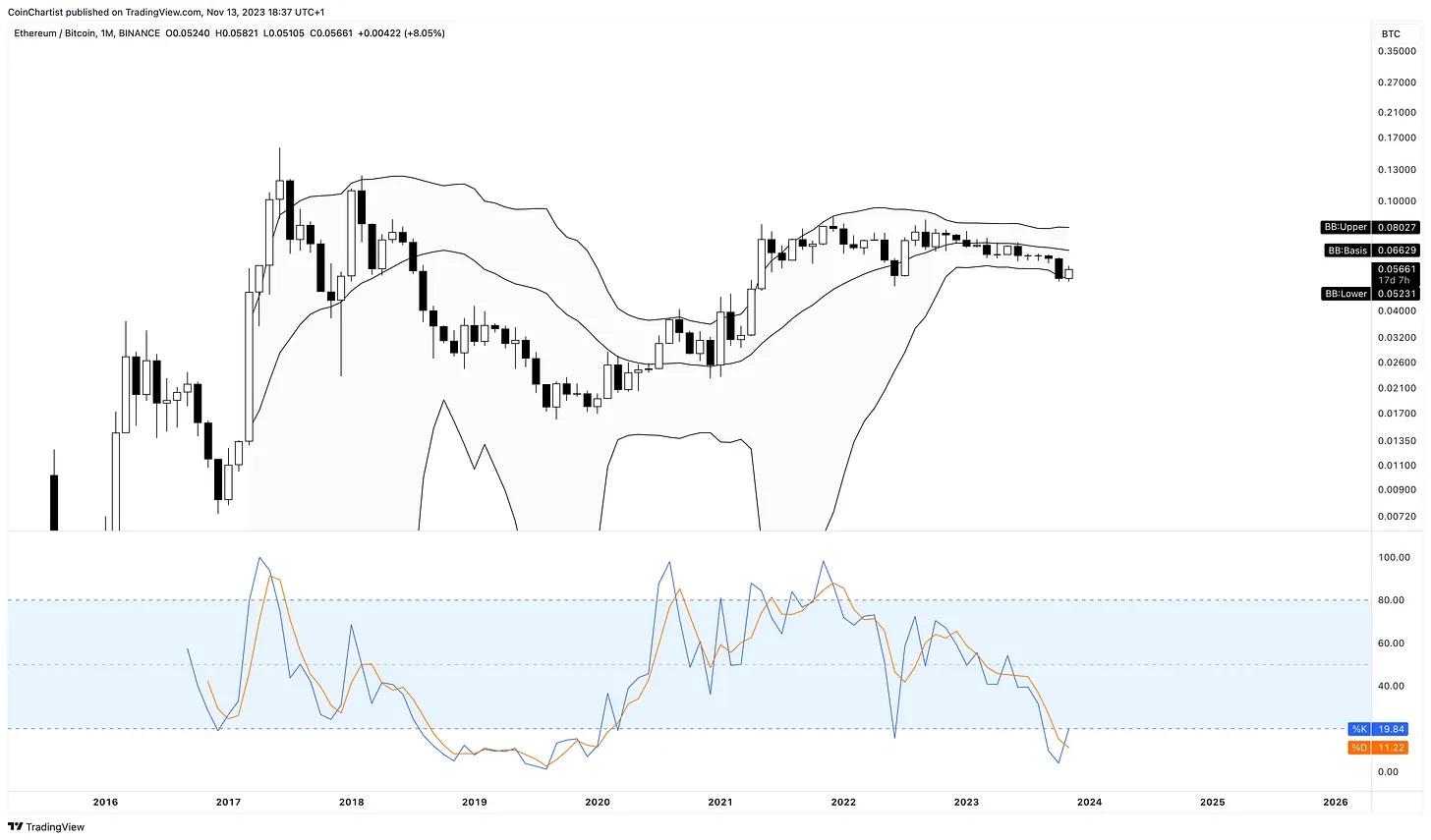
Looking ahead, Severino underscores the importance of Ethereum’s performance against Bitcoin, “But if ETHBTC can push back above 20 this will generate a buy signal on the 1M Stochastic and kickstart Ether’s over-performance above Bitcoin.” This analysis provides a detailed perspective on Ethereum’s potential future trajectory in the crypto market.
Ethereum 2.0 Price Prediction
The continuous evolution of Ethereum through its 2.0 upgrades sets the stage for an optimistic price prediction. As the network becomes more scalable, secure, and sustainable, the intrinsic value of Ethereum is likely to increase.
The successful completion of the Shanghai/Capella upgrade, which introduced staking, is already a significant milestone that demonstrates the network’s commitment to its roadmap. Such advancements are expected to reinforce investor confidence and could catalyze a bullish outlook for Ethereums future price.
Ethereum 2.0 Roadmap
Ethereum 2.0 represents a series of upgrades aimed at improving the network’s scalability, security, and sustainability. Contrary to the previous term ‘ETH2’, the roadmap is now defined by more specific upgrade milestones:
Past and Completed Upgrades
The Merge: This critical upgrade on September 15, 2022 marked Ethereum’s transition from proof-of-work (PoW) to proof-of-stake (PoS) and was a foundational step in the Ethereum 2.0 roadmap, eliminating the need for energy-intensive mining.
Another key feature, staking withdrawals has already been enabled with the Shanghai/Capella upgrade, which went live on April 12, 2023
Future Ethereum Upgrades
- The Surge: The next phase involves scalability improvements through rollups and data sharding. Danksharding, a key component, aims to make layer 2 rollups cheaper by incorporating “blobs” of data into Ethereum blocks.
- The Scourge: This phase focuses on ensuring censorship resistance, decentralization, and addressing protocol risks, such as those arising from miner extractable value (MEV).
- The Verge: It is designed to make verifying blocks easier.
- The Purge: This stage aims to reduce computational costs and simplify the protocol, making running nodes more efficient.
- The Splurge: This includes miscellaneous upgrades that do not fit into the other categories but are essential for the network’s growth and enhancement.
The Ethereum community has replaced the term “Ethereum 2.0” with more specific names for each upgrade, providing clearer insight into the network’s transition and improvements. These upgrades aim to turn Ethereum into a fully scaled, resilient platform, capable of supporting a global decentralized application system. As implementation of these phases progresses, Ethereum’s growing appeal as an investment could positively influence its price predictions.
Proto-Danksharding: EIP-4844
EIP-4844 introduces “shard blob transactions” to enhance Ethereum’s data availability in a way that aligns with future full sharding plans. This proposal creates a new transaction format containing “blobs” – large data segments essential for rollups, a Layer 2 solution, but inaccessible for EVM execution. It serves as a temporary scaling solution, bridging the gap until full sharding implementation.
Notably, rollups have become increasingly important for scaling Ethereum, as they offer a way to execute transactions outside the main Ethereum chain (Layer 1) and then post the data back to Layer 1. EIP-4844’s format is expected to greatly reduce transaction fees for rollups by offering a cheaper data storage mechanism compared to current methods.
Full Danksharding
Full Danksharding, which advances from Proto-Danksharding, will likely further reduce costs for Layer 2 rollups. It introduces “blobs” in a format slated for use in the final sharding design. This includes a new transaction type and an independent fee market for these blobs.
Full Danksharding will build on Proto-Danksharding and aims to further cut Layer 2 rollups’ costs. It will comprehensively implement data availability sampling and essential components for a fully sharded Ethereum network, including proposer-builder separation and proof of custody. This approach aims to assign only a portion of the data to validators, reducing the network’s load and enhancing scalability.
Ethereum 2.0 Price Predictions: Will Ethereum Recover?
As Ethereum continues to progress with its 2.0 upgrades, the financial community has been actively speculating on its future value. Here are some Ethereum price predictions from renowned institutions and analysts, answering the question “will Ethereum recover”:
VanEck: The investment management firm predicts that Ethereum’s price could reach as high as $11.8k by 2030. This projection is based on their assessment that Ethereum’s network revenues could rise from $2.6 billion to $51 billion in 2030, assuming Ethereum captures a 70% market share among smart contract platforms.
Standard Chartered: Analysts at Standard Chartered are bullish on Ethereum’s long-term potential. They forecast that the price of ETH could hit $4,000 by the end of 2024 and double to $8,000 by the end of 2026. Their Ethereum bull run prediction is based on Ethereum’s established dominance in smart contract platforms and the potential for emerging uses in areas like gaming and tokenization. Moreover, they suggest that the upcoming Bitcoin halving in April 2024 could positively impact the broader crypto market, especially Ethereum.
Also, the potential approval of a spot Ethereum ETF in the US could significantly impact Ethereum’s price. BlackRock, the world’s largest asset manager, filed for a spot Ethereum ETF in mid-November 2023. The approval of this ETF would mark a major milestone for Ethereum, potentially attracting more institutional and retail investments and substantially boosting Ethereum’s market price.
FAQ: Ethereums Future
Will Ethereum recover?
Ethereum’s recovery depends on various factors including market trends, technological advancements, and broader economic conditions. With ongoing upgrades like Ethereum 2.0, many analysts remain optimistic about its long-term potential.
Will Ethereum Go Back Up?
Many market experts predict Ethereum will go back up. They are citing improvements from Ethereum 2.0 and increasing adoption in DeFi, NFTs and traditional finance.
Where Is Ethereum Going?
Ethereum is transitioning to a more scalable, secure, and sustainable network with Ethereum 2.0. This is potentially leading to increased adoption and value.
What Is The Ethereum Burn?
The Ethereum burn, introduced in EIP-1559, permanently destroys a part of transaction fees, potentially creating deflationary pressure on Ethereum’s supply.
Is Ethereum Going Back Up?
Current market predictions and the development roadmap suggest potential for Ethereum’s price to increase. But the exact trajectory will depend on multiple factors.
How Many Ethereum Burned So Far?
When Will The Ethereum Bull Run Start?
The start of a bull run for Ethereum is speculative. It depends on market cycles, investor sentiment, and significant catalysts like upgrades and regulatory developments.
Will Ethereum Go Down?
Market volatility is inherent to cryptocurrencies. While Ethereum may experience downturns, its fundamental development aims to mitigate such risks and foster growth.
What Will Be The Future Price Of Ethereum?
Various predictions exist, ranging from moderate increases to high valuations by 2030. Standard Chartered predicts $8,000 per ETH by the end of 2026.
Is Ethereum Going To Go Back Up?
The general consensus among many analysts is positive. The value of Ethereum is expected to rise as it develops and becomes more widespread in the blockchain sector.
Featured image from Shutterstock, charts from TradingView.com


