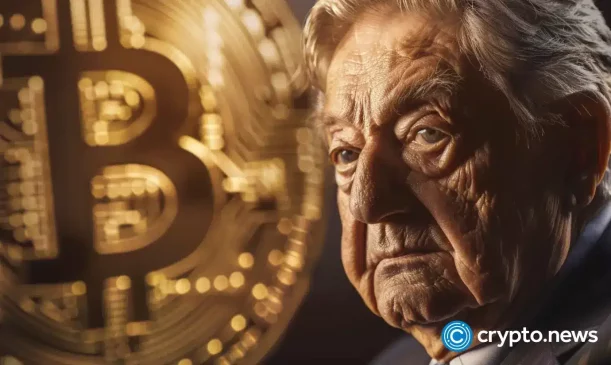
What prompted billionaire investors like George Soros, Mark Cuban, and others to change their stance on Bitcoin and dive into the crypto market?
George Soros, the Hungarian-American billionaire and legendary investor, is known for his sharp financial insights and bold moves in the investment world.
Back in January 2018, Soros made headlines at the World Economic Forum in Davos by calling Bitcoin a “bubble,” comparing the crypto frenzy to the tulip mania of the 1600s in the Netherlands.
However, in a surprising turn of events, Soros Fund Management revealed in October 2021 that it had ventured into the crypto world by owning some Bitcoin.
The fund’s interest in crypto didn’t stop there. During Q1 2024, Soros Fund Management increased its stake in MicroStrategy, a company heavily invested in Bitcoin, with holdings worth over $135 million.
How has Soros’s stance on crypto evolved over the years, and which other billionaires have caught the crypto FOMO (fear of missing out)? Let’s dive deeper into the details and find out.
From skeptic to investor: Soros’s changing stance
When George Soros spoke at Davos in 2018, he was quite clear about his skepticism towards Bitcoin (BTC), describing it as a classic bubble. His primary concern was its volatility, which he believed made it unsuitable as a currency.
“Bitcoin is not a currency,” Soros said, “because a currency is supposed to be a stable store of value, and a currency that can fluctuate 25% in a day can’t be used, for instance, to pay wages. Because the wages could drop by 25% in a day.”
Despite his reservations about Bitcoin, Soros was optimistic about the underlying blockchain technology. He saw its potential for good, particularly in helping migrants keep their money safe.
Fast forward to October 2021, and Soros Fund Management revealed it owned some Bitcoin. Dawn Fitzpatrick, CEO and chief investment officer of Soros Fund Management, stated at a Bloomberg event that the fund owned “some coins … but not a lot.”
By December 2022, Soros Fund Management had further deepened its involvement in the crypto sector. The fund purchased $39.6 million worth of convertible debentures in Marathon Digital Holdings, a prominent crypto mining company.
Convertible debentures are long-term debt instruments that can be converted into stock, showing Soros’s strategic approach to gaining exposure to the crypto market.
In addition, the fund acquired large positions in MicroStrategy. Soros’s 13F filings with the SEC revealed both call and put options on MicroStrategy shares, as well as nearly $200 million in MicroStrategy preferred shares.
And now, by May 2024, Soros Fund Management’s interest in MicroStrategy has grown even more, with holdings valued at over $135 million.
This investment is notable because MicroStrategy has been a major player in the Bitcoin market, holding over 214,000 BTC, thanks to its co-founder Michael Saylor’s aggressive Bitcoin acquisition strategy.
Mark Cuban: from bananas to blockchain believer
Mark Cuban, the billionaire owner of the Dallas Mavericks, has had quite a journey with cryptocurrencies.
Back in 2019, during a YouTube Q&A session, Cuban famously quipped that he would “rather have bananas than Bitcoin,” humorously citing his early skepticism.
He compared Bitcoin to baseball cards and comic books, emphasizing that these items, in his view, had no intrinsic value.
Despite his initial doubts, Cuban’s stance on crypto began to change. By 2021, Cuban had become a vocal supporter of decentralized finance (DeFi) and non-fungible tokens (NFTs).
He saw the potential of smart contracts and decentralized applications (dApps) to innovate industries beyond finance. As a result, his investment portfolio grew to include projects like Polygon (MATIC), a layer 2 scaling solution for Ethereum (ETH).
Cuban’s Dallas Mavericks even started accepting Bitcoin and other crypto assets for tickets and merchandise, further cementing his commitment to the crypto space.
Cuban’s dedication to the crypto industry is also evident from his investment strategy. He revealed that 80% of his non-“Shark Tank” investments are focused on crypto and blockchain technology.
He sees the decentralization aspect of digital assets as the biggest draw, with a particular interest in decentralized autonomous organizations (DAOs).
DAOs operate without a central authority, relying on token holders to make decisions, which Cuban finds appealing for its democratic approach.
Today, Mark Cuban is one of the most prominent billionaire advocates for blockchain technology. His journey from preferring bananas over Bitcoin to investing heavily in blockchain projects is definitely a tale worth sharing.
Warren Buffett: from skepticism to strategic investments
Warren Buffett, the legendary investor and CEO of Berkshire Hathaway, has always been known for his critical view of cryptocurrencies. In 2018, he famously called Bitcoin “rat poison squared,” expressing deep doubts about its value and long-term sustainability.
Buffett prefers investments in companies with tangible assets and steady cash flows, which makes the wild ups and downs of cryptocurrencies unappealing to him.
But despite his harsh words, Buffett’s actions tell a more nuanced story. In late 2021, Berkshire Hathaway made a surprising move by investing $1 billion in Nubank, a Brazilian digital bank that’s friendly to cryptocurrencies.
According to a 13F filing with the SEC, Berkshire bought 107.1 million shares of Nu Holdings at an average price of $9.38 per share.
This big investment wasn’t Buffett’s first dance with Nubank. Earlier in June 2021, Berkshire Hathaway had already poured $500 million into Nubank during a Series G funding round extension. This round valued Nubank at $30 billion.
In December 2021, when Nubank went public, Berkshire Hathaway bought another 30 million shares for $250 million. At that point, Nubank’s value skyrocketed to $41.5 billion.
What does it mean? Buffett’s investments in Nubank hint at a careful yet strategic interest in the fintech and crypto space. While he remains cautious about directly investing in crypto, his actions suggest a slow but steady adaptation to the changing environment.
Capitalists always dance to the tune of money
Money talks, and in the world of finance, it speaks louder than anything else. The lure of profit can turn even the staunchest skeptics into enthusiastic supporters and, occasionally, cause fervent believers to become wary critics.
Goldman Sachs is a prime example. In 2018, they halted their plans to open a crypto trading desk due to regulatory uncertainty and lack of institutional interest.
But by 2021, as Bitcoin surged and institutional demand grew, Goldman Sachs relaunched its crypto trading desk, offering Bitcoin futures and non-deliverable forwards to its clients.
At the Consensus 2024 conference hosted by CryptoX, Goldman Sachs even celebrated the success of new spot Bitcoin ETFs.
Mathew McDermott, the investment bank’s global head of digital assets, called the SEC’s approval of spot BTC ETFs a “big psychological turning point” and celebrated their “astonishing success.”
Ray Dalio, founder of Bridgewater Associates, was another notable skeptic. He initially criticized Bitcoin in September 2017 calling it a “bubble”, stating it was neither a good store of value nor a medium of exchange.
However, by 2021, Dalio revealed that he owned some Bitcoin and called it “one hell of an invention”, recognizing its potential as a hedge against inflation and currency devaluation.
But why are these capitalists so eager to embrace this new world? The answer lies in diversification and hedging.
With inflation rates hitting multi-decade highs and traditional assets underperforming, digital assets offer an attractive hedge against economic uncertainties.
The future of finance is being written in code and blockchain, and those willing to dance to this new tune will lead the way.


