
DeepSeek AI’s release hit crypto markets hard, pulling down tokens across the board. Is this a temporary dip or the beginning of a major market reset?
Crypto sinks deeper with DeepSeek AI
As of Jan. 27, the total crypto market cap has slipped by over 5% in the last 24 hours, sinking to $3.59 trillion as per CoinGecko. This marks one of the sharpest sell-offs since Trump’s inauguration on Jan. 20.
Bitcoin (BTC), the flagship crypto, hasn’t been spared either, dipping around 5% in the last 24 hours to trade at $99,800 levels as of this writing.
Meanwhile, Ethereum (ETH) has tumbled even further, losing 7.5% of its value to hover around $3,100. Altcoins have fared even worse, with losses ranging from 10% to 20%.
The timing couldn’t be more curious. On Jan. 23, Trump signed several executive orders that many hailed as a landmark move for crypto adoption in the U.S.
These orders came just two days after Acting SEC Chair Mark Uyeda launched a dedicated crypto task force to tackle regulatory ambiguity. Yet, instead of soaring on this optimism, the crypto market appears to have buckled under an invisible weight.
What’s causing this dissonance? Could the sell-off be tied to deeper investor anxieties, or is it merely a case of “buy the rumour, sell the news”?
Let’s delve into the potential triggers behind this market-wide slump, unpack the details of Trump’s orders, and consider what the future might hold for digital assets in this new political era.
Decoding the recent decline
While the executive orders seemed like a bullish catalyst, other factors have emerged to overshadow the optimism, triggering a broad sell-off across the market.
The immediate trigger for this decline appears to be the release of DeepSeek R1, an innovative AI model unveiled by China’s DeepSeek lab.
This open-source large-language model has been described as a major milestone for artificial intelligence, with Marc Andreessen calling it “AI’s Sputnik moment.”
What makes DeepSeek R1 stand out is its efficiency—it matches or surpasses the performance of leading models like those from OpenAI, but it was built on a modest $6 million budget and uses significantly fewer GPUs.
While this breakthrough is a huge leap for AI, it has rattled the market for AI-related crypto assets as investors reassess the value of tokens tied to GPU-intensive operations.
Render (RNDR), Near Protocol (NEAR), The Graph (GRT), and Artificial Superintelligence Alliance (FET) are among the hardest hit, with losses ranging from 7% to 9%.
Node.AI (GPU), which is heavily reliant on GPU-based operations, has seen a staggering 20% drop. Altogether, the total market cap of AI-focused cryptocurrencies has shrunk by 8%, now sitting at $38 billion.
This sell-off created a ripple effect, spilling over into the broader crypto market and pulling down even mainstream assets like Bitcoin and Ethereum.
The cascading losses can be partly explained by liquidations, a phenomenon that often amplifies price movements. Over the past 24 hours, nearly $942 million in futures positions have been liquidated, with an overwhelming $830 million of these being long positions.
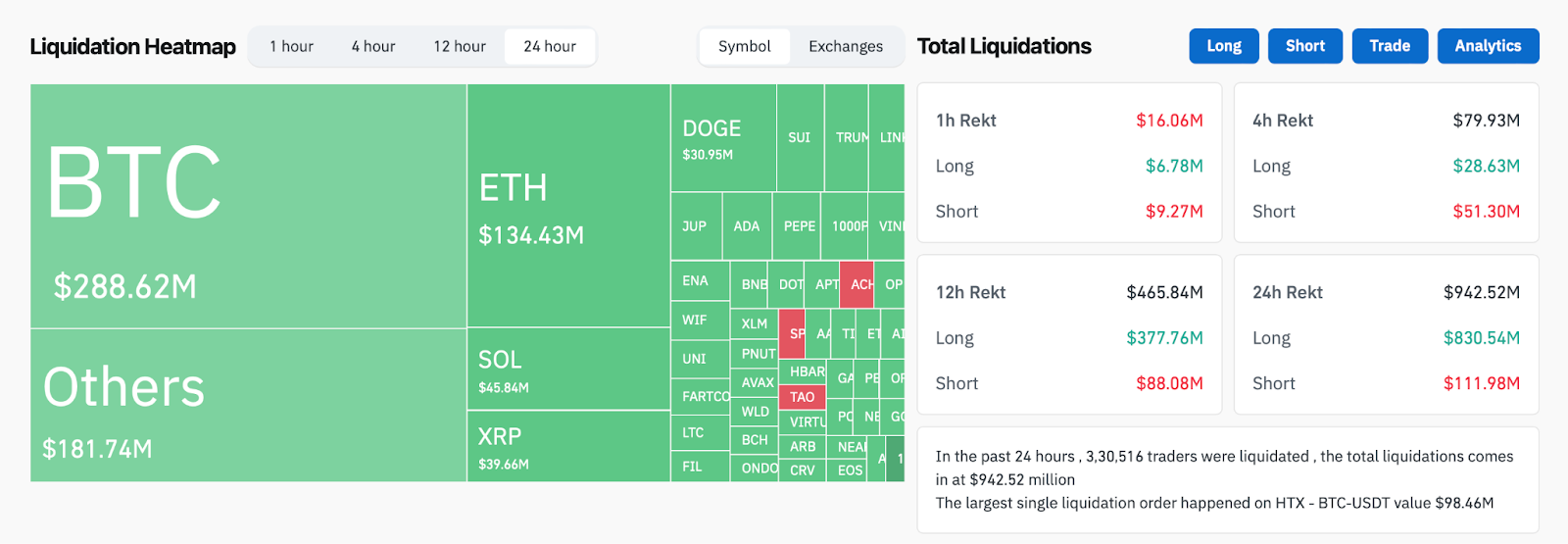
This stark imbalance between long and short liquidations clearly shows how unprepared traders were for the rapid sell-off triggered by the fallout from DeepSeek’s release.
Liquidations of this scale often create a vicious cycle — falling prices force more liquidations, which in turn accelerates the downward spiral. As a result, the market goes into a freefall.
At the same time, the macroeconomic environment is adding more pressure. The U.S. dollar index, which measures the dollar’s strength, has climbed to 107.74. Historically, a stronger dollar tends to weigh on Bitcoin and risk assets, as it makes them less attractive.
Amid this, investors are now looking ahead to the Federal Reserve’s Jan. 29 meeting, where there’s a 99.5% probability of interest rates remaining steady at 4.25% – 4.50%, according to the CME FedWatch Tool.
While the Fed is unlikely to raise rates, the market remains on edge, as even subtle hints from Chair Jerome Powell about future tightening could add to the uncertainty and further pressure on the already overheated market.
Deciphering the executive orders
President Trump’s executive order on Jan. 23 could mark a turning point for the crypto industry. Titled “Ensuring U.S. Leadership in Digital Financial Technology,” the order is a sweeping attempt to clarify crypto regulations, encourage innovation, and establish the U.S. as a global leader in digital assets.
One of the central features of this order is the creation of the Presidential Working Group on Digital Asset Markets.
For years, companies and investors have struggled with inconsistent regulations across states and Federal agencies, making it difficult to innovate or plan for the future.
This new group, led by David Sacks, Trump’s newly appointed AI & Crypto Czar, and including key figures like the Secretary of the Treasury, the Chairman of the SEC, and the heads of other relevant agencies, will focus on developing a single set of Federal rules for how cryptocurrencies operate in the U.S.
The Working Group has also been tasked with evaluating the creation of a “strategic national digital assets stockpile.” While the details are still vague, this initiative could mean that the U.S. will begin holding reserves of digital assets, potentially including cryptocurrencies lawfully seized by the government through enforcement actions.
Historically, the U.S. Marshals Service has auctioned off seized Bitcoin and other cryptocurrencies, but Trump’s order could signal a policy shift.
While the document itself does not explicitly mention Bitcoin, Trump previously stated during his campaign that he would work to ensure the federal government keeps 100% of the Bitcoin it currently holds or acquires in the future.
Another major move in the order is the administration’s stance on central bank digital currencies. These are government-controlled digital currencies, like the digital yuan in China, which centralize financial power under the government. Trump’s order explicitly prohibits Federal agencies from “undertaking any action to establish, issue, or promote CBDCs.”
This provision revokes the previous Administration’s Digital Assets Executive Order and the Treasury Department’s Framework for International Engagement on Digital Assets, both of which, Trump’s administration argues, suppressed innovation and undermined U.S. economic liberty.
The administration believes that economic freedom and innovation thrive better in an environment where private companies — not governments — lead the charge.
Moreover, many crypto businesses and investors have long complained about unclear or overly aggressive enforcement actions that stifle growth.
Hence, agencies have also been directed to review existing regulations, make recommendations to the Working Group, and propose changes to eliminate unnecessary burdens on the industry. This halts regulatory overreach, which has previously hindered the crypto sector.
What’s next for the crypto markets?
While the sell-off triggered by the DeepSeek R1 announcement and broader macroeconomic pressures has left investors uneasy, some prominent crypto analysts are still maintaining a bullish long-term outlook.
According to Michaël van de Poppe, a widely followed crypto analyst, the worst of the dip may already be behind us. “Markets are bouncing back quickly,” he noted in a recent tweet, pointing to signs of recovery as capital flows back into certain projects.
He added, “$ETH/BTC is likely to rotate up,” suggesting that Ethereum’s performance relative to Bitcoin could improve in the near future.
However, the outlook isn’t without its challenges. Aaron Crypto, another prominent crypto analyst, has highlighted that macroeconomic factors remain a key source of pressure on the crypto market.
“Altcoin MCap has retested its Q4 breakout,” he pointed out, referring to the sharp decline in the total market cap of altcoins as investors liquidated positions during the broader sell-off.
He attributed this partly to the ongoing “US stock market meltdown” but offered reassurance that this turbulence is likely temporary. He added, “The bull run is not over, and we’ll trade much higher in the coming months.”
While both analysts strike an optimistic tone about the medium to long-term prospects of the market, it’s important to remain cautious. The broader macroeconomic environment is far from stable.
The Fed’s next meeting could play a key role in shaping sentiment. Historically, crypto markets have struggled during periods of dollar strength, and any hawkish commentary from Fed Chair Jerome Powell could renew selling pressure.
Additionally, while Trump’s Executive Order has provided hope for more crypto-friendly policies in the U.S., there is still uncertainty about how this framework will be implemented and whether it will sufficiently address the challenges businesses face today.
All in all, while the market has shown signs of stabilizing after the recent sell-off, it’s not entirely out of the woods yet. It’s essential for traders and investors to tread carefully in the short term. Patience and vigilance will likely be key as the crypto market traverses this turbulent period.
Disclosure: This article does not represent investment advice. The content and materials featured on this page are for educational purposes only.


