Baby boomers are the fastest-growing demographic in crypto, with their numbers doubling in the space of a year, according to a survey by Australian exchange CoinSpot.
The total percentage of crypto investors over 60 remains relatively low — around 4.4% — but with their large retirement nest eggs and a lifetime’s worth of savings, boomers have an outsized impact on markets.
Former ANZ banker and payments consultant Rod Tasker, himself a baby boomer, says active crypto investors in his age bracket tend to be highly financially literate.
“Even if the number is fairly low, the amount of money invested is quite likely to be higher than other demographics,” he explains.
“A lot of them are quite sophisticated, they’ve already got their investment portfolios. They might have the investment property, the share portfolio, depending on risk appetite they might have got into options,” he says.
But at the other end of the scale, he says that baby boomers who grew up in a more trusting and less connected world often end up as targets of crypto scammers for their wealth.


“The baby boomer demographic does have people who are very vulnerable to that scamming for all sorts of reasons, ranging from dementia through to being brought up in a more sheltered world.”
According to the Pew Research Centre, baby boomers were born between 1946 and 1964. Though pretty much anyone over 50 in crypto stands a good chance of being labelled a boomer. In the US, boomers hold around $79 trillion in assets, according to the Federal Reserve.
Boomer gets scammed by Australian ‘prime minister’
Mike is an 80-year old former mortgage broker who became interested in a crypto investment opportunity after watching Australian Prime Minister Anthony Albanese interviewed about the scheme on current affairs panel show The Project.

“He had this Bitcoin investment program, which was definitely safe, and it was fantastic,” says Mike. “They were doing a buy low and sell high regularly and had this little algorithm that made it work.”
Unfortunately, the footage was a deepfake cooked up by AI that connected Mike to a crypto scam website, where a lovely chap from customer service encouraged him to send through a small initial investment of a few hundred euros.
When the site quickly began pestering him to send 10,000 euros, he started to realize something fishy was going on.
“It just seemed so genuine,” he says. “It appeared like he was talking.”
The experience made Mike extremely skeptical of Bitcoin. His unease only increased after a friend who’d bought four Bitcoin for a few hundred dollars almost a decade ago tried to cash them in online and was fleeced out of $400,000.
“She discovered that the cryptocurrency had been cashed, but the money was cashed for someone else,” he says. “She was very upset.”
Boomers are warming up to Bitcoin… slowly
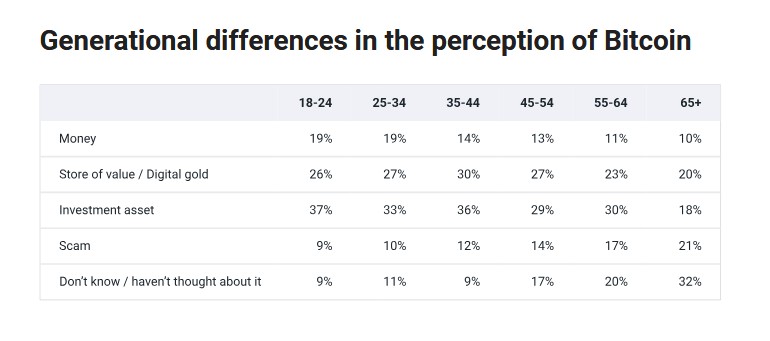
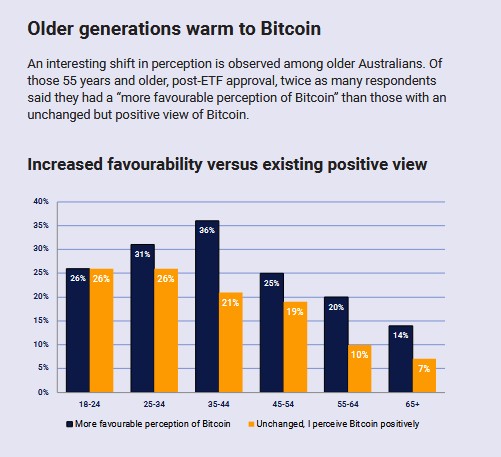
All too common stories like this have given crypto a bad reputation among baby boomers. Crypto adoption among boomers is far lower than among 50- to 59-year-olds (12.2% of whom are investors) and the 20.7% adoption rate of the general population, according to CoinSpot’s April survey.

But Tim Wilks, chief business development officer for CoinSpot, says there are signs boomers are warming up to crypto. The survey found 38.5% of Australians aged 60+ reported being open to investing in crypto in the future and do not reject it outright, which is virtually identical to the national average (37.8%).
“While the adoption curve for older Australians remains steeper than for younger cohorts, interest and adoption are both still growing,” he says. “The boomer generation is no longer dismissing crypto out of hand, and many are asking serious questions and weighing it as part of their retirement strategy.”
Investors over 60 who manage their own retirement funds are twice as likely to hold crypto (6.2%) than those who don’t (3.2%).
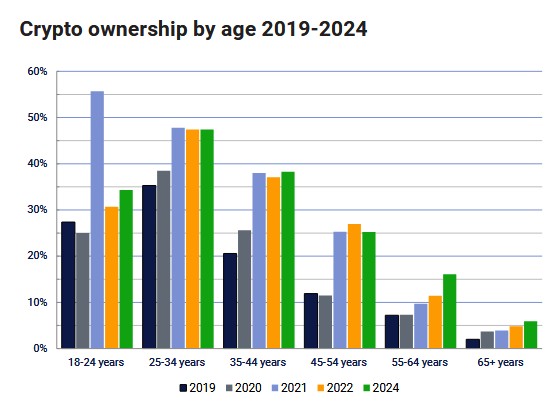
Another Australian exchange, Independent Reserve, found higher rates of crypto ownership among boomers than CoinSpot, with ownership among the 65+ age group tripling to 6% between 2019 and 2024. Among investors aged 55-64, ownership doubled to 16%.
However, IR also found that a majority of those over 65 (52.4%) either have no opinion (31.8%) or consider crypto to be a scam (20.6%).
In the US, data from Blockchain Statistics and Demandsage suggest that baby boomers make up 10% of crypto owners. In the UK, EY’s Wealth Report found that around 15% of boomers are looking to diversify their portfolios into alternative assets like Bitcoin.
Simon’s retirement plan is 100% crypto and Bitcoin
Crypto trader Simon B. from the Sunshine Coast is part of the high net worth Platinum group for crypto education and advisory service Collective Shift. He has all of his retirement funds in crypto and most of his other wealth, too.
The 57-year-old former IT professional used to be an active trader, but after losing 1 BTC in a day, he switched to longer-term investing. He says members of the Platinum group tend to be older and wealthier and have a different approach to investing than Collective Shift’s retail service.
“They’re a bit more mature than the younger folks in lots of different ways, not just in their investing crypto style — a lot of them have made money in the world in business and other things and view it fairly differently,” he says.
“There’s even a guy that joined the other day who’s 78.”
Read also
[Simon and other interviewees wanted to keep their last names private as they are worried about security threats from being publicly identified as wealthy crypto investors. Mike didn’t want it known publicly that he’d fallen for a scam.]
Simon explains that older investors tend to favor longer-term allocations to large-cap projects like Bitcoin, Ethereum, Solana, “maybe Sui,” and have little interest in memecoins.
Another member of the group, 52-year-old Alex P from Sydney, tells Magazine that the ETFs and the pro-crypto stance of the US government have helped legitimise crypto for older investors.
“It’s more legit than it used to be because you’ve now got the BlackRocks, you’ve got the US government, you’ve got the crypto czar there. I think once an asset gets to be a trillion dollars, then it needs to be taken seriously by investment funds.”
Simon agrees that baby boomers are warming up, but adds that it’s a very slow process.
“I definitely think it’s changing fairly rapidly. But I think that that snowball is still fairly small,” he says.
“I still think we’re in the very early adoption stage. And I think that there might now be, say, 3% to 5% of people that think it’s something decent in that age group.”

Bitcoin skeptical boomers want to invest in “something real”
One big mental block holding boomers back from investing in digital assets is conceptual. They can understand owning something in the real world, but find the idea of digital ownership more difficult.
“I think people my age and our background, and what we’ve done over our lifetime, suggest that we like something that is real,” explains Mike.
“If I buy a share in a company, I’ve got the share certificate. So I know I’ve got something real.”
In an opinion piece for The Independent, Bitcoin skeptic James Moore observed there has been “a generational change in thinking” on this topic.
“Bitcoin’s decentralized store of value is essentially backed by an idea, or a belief,” he wrote, adding that ideas are more powerful in the “digital world inhabited by millennials and the even-more-plugged-in Generation Z.”
Read also
“It’s interesting to note that what may seem intangible to Gen X parents and boomer grandparents is as real to their children as any physical product.”
Another issue for older people like Mike is that they’ve learned the hard way that anything that seems too good to be true, probably is.
He explains that stories of people getting rich overnight rings alarm bells.
“A thought in our younger days: if something sounds so absolutely fantastic, it probably isn’t,” he says.
Rich boomers love Bitcoin
A survey of 700 baby boomer clients worldwide by deVere Group in September reinforces the idea that it’s the most financially literate boomers who are interested in Bitcoin. The poll found that 45% of that subgroup of boomers now favor holding Bitcoin over safe haven assets like gold.
CEO Nigel Green described the finding as “a seismic shift in the investment world” driven by “the growing participation of major institutional investors, the introduction of regulated financial products like Bitcoin ETFs, and a more defined regulatory framework in key markets.”
Former National Australia Bank and Westpac banker Ken Standfield, 60, decided to start his crypto education YouTube channel and website, CryptoTradingKS, in 2021 after a brush with death due to a brain tumor.
The community is now about 16,000 strong, mostly older, high-net-worth professionals with some approaching, or already in, retirement. The oldest member is 89.
“I’ve got people with incredibly large portfolios,” he says. “They’re really very professional, they’ve got a lot of savvy, they’re very smart.”
Unlike Collective Shift’s Platinum group, members of Standfield’s community are more often active traders who buy and sell based on technical analysis, signals like volatility indicators and torrents of data.
“These elderly investors, the more mature inside our community, they still trade,” he says. “They can trade $10,000, $50,000, $100,000.”
But Standfield says baby boomers have a much greater focus on protecting what they have, rather than risking everything.
“I classify myself as an older trader because I can’t lose my capital,” he says. “Having worked all my life to get where I am, if I screw it up, it’s gone and what am I going to do? That’s hard to make back.”
But while older investors often focus on minimizing risk and preserving their nest eggs, something that’s often overlooked is that playing crypto markets can be a lot of fun. It gives retired people with plenty of time on their hands a fascinating hobby.
“I’m never, ever going to retire. It doesn’t matter how old I am. I could be 99. I’ll still be doing something. And I think for older investors: Don’t retire!” declares Standfield.
“And when you know what you’re doing it can make you a lot of money as well and that’s really, really important.”
Subscribe
The most engaging reads in blockchain. Delivered once a
week.


Andrew Fenton
Based in Melbourne, Andrew Fenton is a journalist and editor covering cryptocurrency and blockchain. He has worked as a national entertainment writer for News Corp Australia, on SA Weekend as a film journalist, and at The Melbourne Weekly.


