
The Commodity Futures Trading Commission (CFTC), a US financial regulator, is integrating a financial surveillance tool developed by stock exchange company Nasdaq in a bid to overhaul its 1990s infrastructure.
Nasdaq’s software is focused on detecting market abuse, including insider trading activity and market manipulation in equities and crypto markets, Tony Sio, head of regulatory strategy and innovation at Nasdaq, told Cointelegraph. He said:
“Tailored algorithms detect suspicious patterns unique to digital asset markets. It offers real-time analysis of order book data across crypto trading venues and cross-market analytics that can correlate activities between traditional and digital asset markets.”
The data fed into the monitoring system will be “sourced by the CFTC through their regulatory powers,” Sio said.
Financial surveillance continues to be a hot-button issue in crypto, with privacy advocates arguing surveillance creates conditions for a digital “prison,” and others arguing that anti-money laundering techniques are necessary for institutional adoption of crypto.
Related: US Treasury’s DeFi ID plan is ‘like putting cameras in every living room’
DeFi sector increasingly concerned with surveillance
The US Treasury Department is exploring the possibility of requiring digital identification checks embedded within decentralized finance (DeFi) smart contracts to combat illicit financial flows.
Combatting illicit finance was one of the directives given in the White House’s crypto report from July, which also included tax and market structure proposals for digital assets in the US.
The White House report recommended that the Treasury Department and the National Institute of Standards and Technology (NIST) develop additional know-your-customer (KYC) parameters for digital assets.
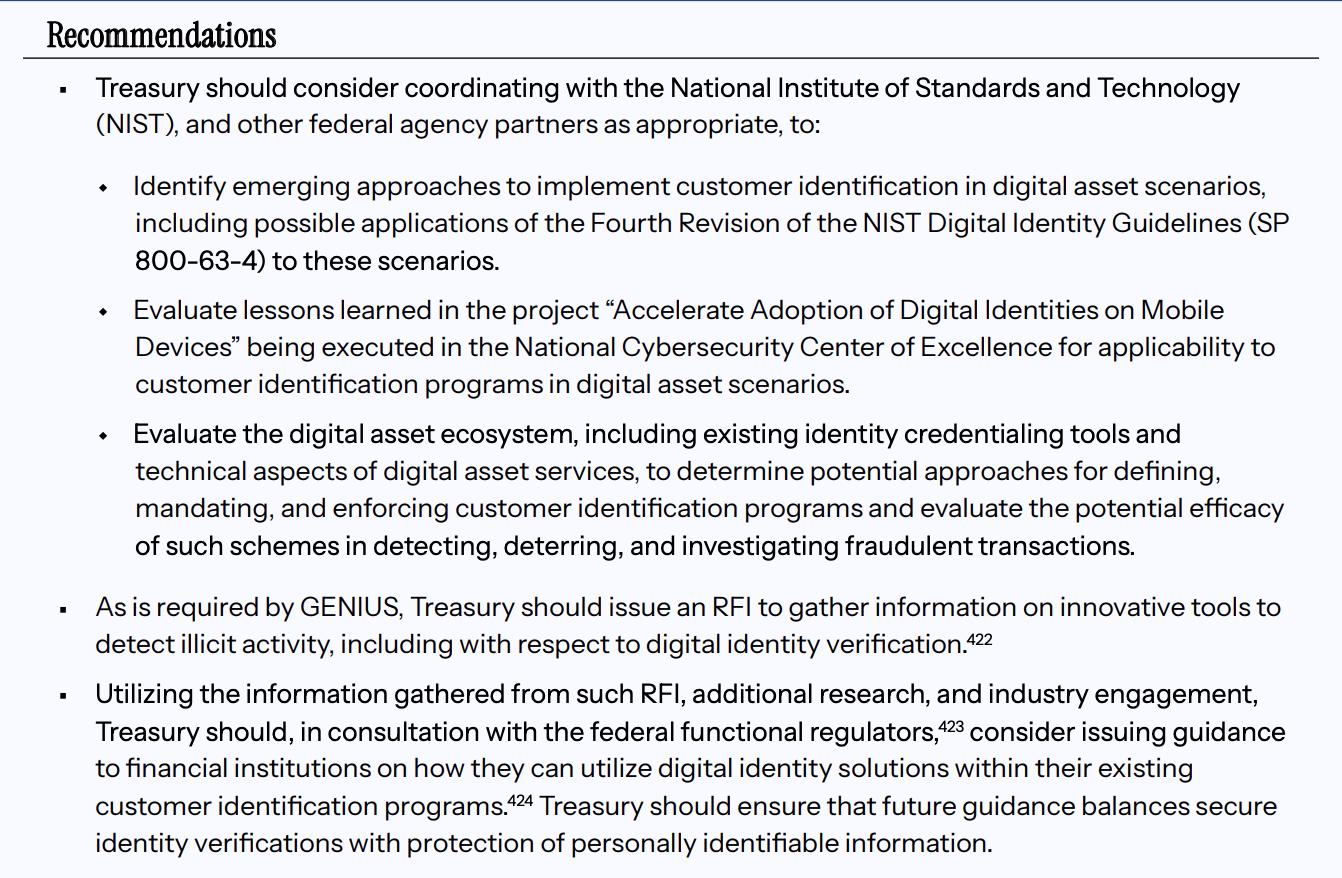
The report also recommended revising the existing NIST digital identity guidelines and overhauling identity credential tools.
Critics of these proposals say that adding such tools to DeFi protocols betrays the core ethos of permissionless, decentralized architecture.
“If you turn a neutral, permissionless infrastructure into one where access is gated by government-approved identity credentials, it fundamentally changes what DeFi is meant to be,” Mamadou Kwidjim Toure, CEO of investment platform Ubuntu Tribe, told Cointelegraph.
Magazine: Can privacy survive in US crypto policy after Roman Storm’s conviction?


