Moonwell, a decentralized finance (DeFi) lending protocol deployed on Base and Optimism, was exploited for about $1.78 million after a pricing oracle for Coinbase Wrapped Staked ETH (cbETH) returned a value of about $1.12 instead of $2,200, creating a mispricing that attackers were able to use for profit.
Moonwell said in an incident post-mortem that a governance proposal executed on Sunday misconfigured the cbETH oracle by using the cbETH/ETH exchange rate alone, causing the system to report cbETH at about $1.12. The protocol said liquidation bots and opportunistic borrowers exploited the mispricing, leaving roughly $1.78 million in bad debt.
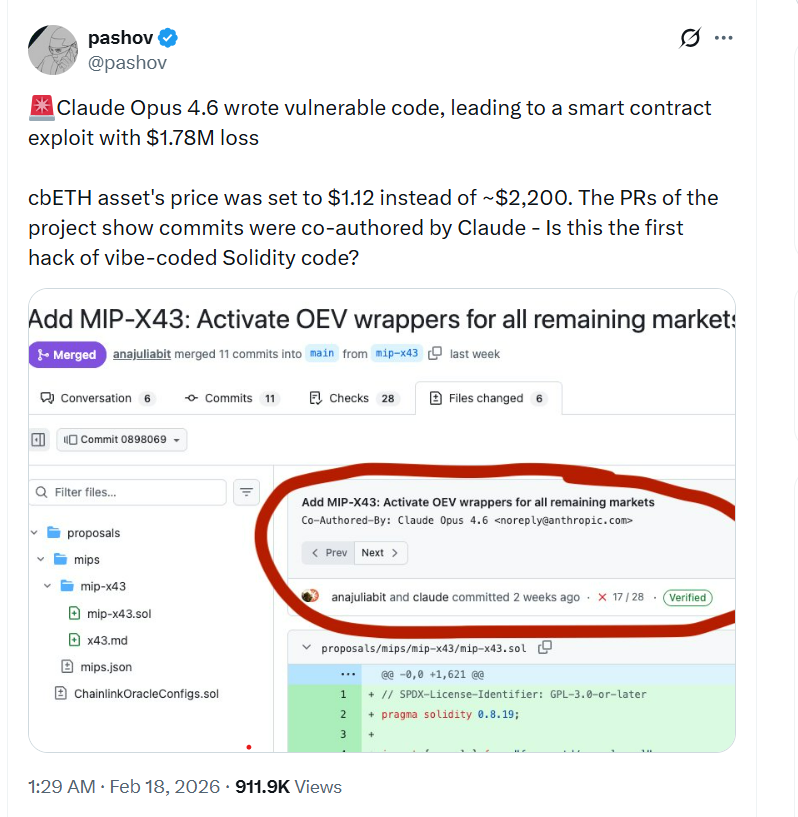
The pull requests for the affected contracts show multiple commits co-authored by Anthropic’s Claude Opus 4.6, prompting security auditor Pashov to publicly flag the incident as an example of artificial intelligence-written or AI-assisted Solidity backfiring.
Speaking to Cointelegraph about the incident, he said that he had linked the case to Claude because there were multiple commits in the pull requests that were co-authored by Claude, meaning that “the developer was using Claude to write the code, and this has led to the vulnerability.”
Pashov cautioned, however, against treating the flaw as uniquely AI-driven. He described the oracle issue as the kind of mistake “even a senior Solidity developer could have made,” arguing that the real problem was a lack of sufficiently rigorous checks and end-to-end validation.
Initially, he said that he believed there had been no testing or audit at all, but later acknowledged that the team said it had unit and integration tests in a separate pull request and had commissioned an audit from Halborn.
In his view, the mispricing “could have been caught with an integration test, a proper one, integrating with the blockchain,” but he declined to criticise other security firms directly.
Related: How South Korea is using AI to detect crypto market manipulation
Small loss, big governance questions
The dollar amount of the exploit is small compared to some of DeFi’s largest incidents, such as the Ronin bridge exploit in March 2022, where attackers stole more than $600 million, or other nine-figure bridge and lending protocol hacks.
What makes Moonwell notable is the mix of AI co-authorship, a basic-seeming price configuration failure on a major asset, and existing audits and tests that failed to catch it.
Pashov said his own company would not fundamentally change its process, but if code appeared “vibe coded,” his team would “have a bit more wide open eyes” and expect a higher density of low-hanging issues, even though this particular oracle bug “was not that easy” to spot.
“Vibe coding” vs disciplined AI use
Fraser Edwards, co-founder and CEO of cheqd, a decentralized identity infrastructure provider, told Cointelegraph that the debate around vibe coding masks “two very different interpretations” of how AI is used.
Related: How AI crypto trading will make and break human roles
On one side, he said, are non-technical founders prompting AI to generate code they cannot independently review; on the other, experienced developers using AI to accelerate refactors, pattern exploration and testing inside a mature engineering process.
AI-assisted development “can be valuable, particularly at the MVP [minimal viable product] stage,” he noted, but “should not be treated as a shortcut to production-ready infrastructure,” especially in capital-intensive systems like DeFi.
Edwards argued that all AI-generated smart contract code should be treated as untrusted input, subject to strict version control, clear code ownership, multi-person peer review and advanced testing, especially around high-risk areas such as access controls, oracle and pricing logic, and upgrade mechanisms.
“Ultimately, responsible AI integration comes down to governance and discipline,” he said, with clear review gates, separation between code generation and validation, and an assumption that any contract deployed in an adversarial environment may contain latent risk.
Magazine: South Korea gets rich from crypto… North Korea gets weapons


