
Ethereum has been consolidating below $2,200 for weeks. The selling pressure is real. The uncertainty is higher. And the participants who hold enough ETH to move markets just crossed back into profit, which, in the history of this asset, has never happened quietly.
Related Reading
A CryptoQuant analyst tracking the behavior of Ethereum’s largest holders has identified a transition that demands attention precisely because of how rarely it occurs. The cohort holding more than 100,000 ETH — wallets large enough that their decisions do not just reflect the market, they influence it — briefly entered an unrealized loss state as Ethereum’s price declined. They have now returned to profitability.
That sequence matters for a specific structural reason. When whale-sized holders are underwater, they face a choice between absorbing the loss and selling to prevent it from deepening. The market lives under that overhead.
Every session at the wrong price level is a session where the largest holders have an incentive to exit. When that cohort returns to profit, the incentive structure inverts — they are no longer potential sellers defending a loss, they are holders with gains and no urgency to move.
Every Time. Without Exception. Until Now, Nobody Was Watching
The analyst’s historical reading is the element that transforms the current whale profitability transition from a data point into a signal. In the entire recorded history of Ethereum, every single instance where this cohort — holders of more than 100,000 ETH — crossed from an unrealized loss state back to a profitable state marked the beginning of a rally. Not in most instances. Not the majority. Everyone.
That is not a tendency. It is a pattern with a perfect track record across every market cycle Ethereum has experienced. The corrections, the bear markets, the prolonged consolidations — each one produced at least one moment where the largest holders briefly went underwater before recovering. And each one of those moments, without exception, preceded upward movement.
The analyst’s conclusion is stated without embellishment: that historic signal has appeared again.
What that means for the current consolidation below $2,200 is not a guarantee — no signal in financial markets carries certainty, and the macro environment remains genuinely uncertain. What it means is that the on-chain condition that has historically marked the beginning of Ethereum rallies is now present, for the first time since the current correction began.
The pattern has never been wrong. The question is whether this cycle is the first time it fails — or the latest time it does not.
Related Reading
Ethereum Holds Critical Weekly Support as Structure Tightens
Ethereum is consolidating near the $2,150–$2,200 region on the weekly timeframe, a level that is increasingly acting as a structural pivot. After the rejection from the $4,000–$4,500 range in late 2025, ETH entered a corrective phase that found support just above the 200-week moving average (red), preserving the long-term trend despite the volatility.
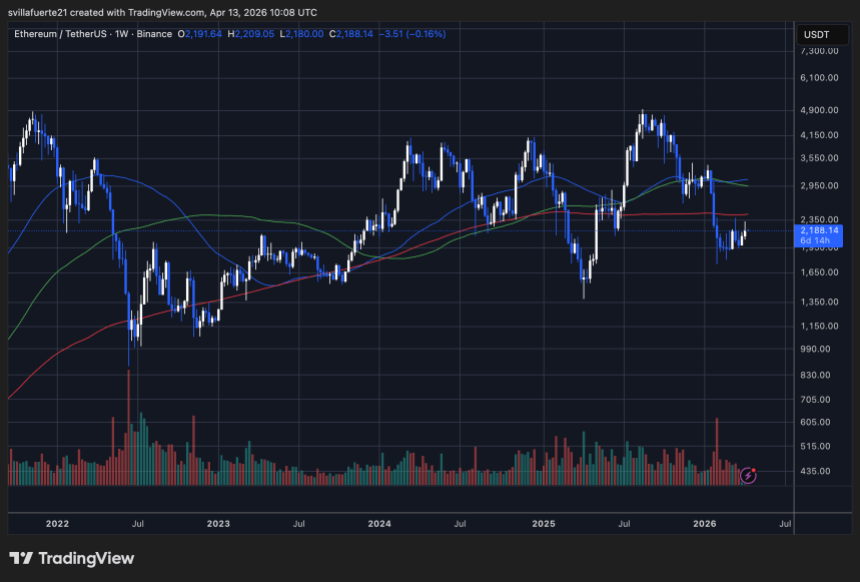
The current structure reflects compression rather than continuation. Price is trading between the 100-week (green) and 200-week moving averages, while the 50-week (blue) has flattened and is beginning to turn slightly upward. This convergence of key averages signals a market in equilibrium, where neither buyers nor sellers have clear control.
Related Reading
Importantly, the recent downside wicks into the $1,700–$1,800 zone were met with strong buying, indicating demand remains active at lower levels. However, upside attempts have stalled below the $2,400–$2,600 region, reinforcing that resistance remains intact.
Volume patterns align with this interpretation. Spikes during sell-offs suggest liquidation-driven moves, while the current normalization indicates reduced stress but limited conviction.
Structurally, Ethereum is coiling within a broad range. A break above $2,500 would confirm strength, while a loss of $2,000 would expose deeper support. For now, the market remains balanced, awaiting resolution.
Featured image from ChatGPT, chart from TradingView.com


