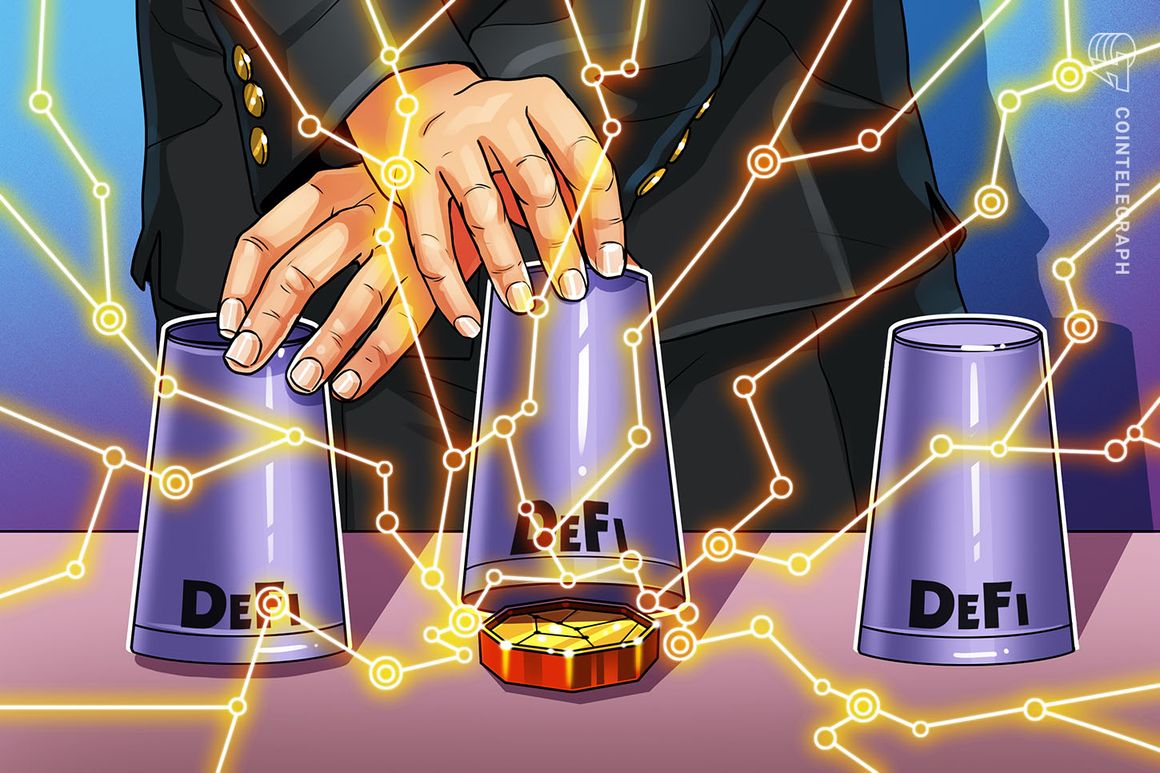
How do DeFi projects generate profit?

This week’s episode of Cointelegraph’s Market Talks welcomes Alvin Xu, the co-founder and CEO of Maverick Protocol, a platform that is taking a new approach to building decentralized finance (DeFi) infrastructure. Xu has been in the crypto space since 2018, and before co-founding Maverick, he led products and ecosystems across MetaMask, Abra Wallet, BitTorrent and the Tron Foundation. The show kicks off with a discussion about the Ethereum Community Conference in Paris, where Xu was a guest. He gives the inside scoop on all the latest updates and developments from the conference. Capital…

DeFi Protocol Conic Finance Hacked for 1,700 Ether

Each Omnipool allocates liquidity of a single asset into different Curve pools. All Curve liquidity provider (LP) tokens get staked on Convex to boost Curve (CRV) rewards earnings. Convex (CNX), another Curve ecosystem token, is also rewarded, as is Conic (CNC), Conic’s native token. Source

Africa-Focused DeFi Platform Mara Releases Testnet for Upcoming Layer 2

“Blockchain technology has become a necessary utility and infrastructure that is critical and essential to the development of every country, similar to electricity or the internet,” said Chi Nnadi, CEO of Mara, in an email to CoinDesk. “Opportunities abound in Africa that can be harnessed using blockchain as a technology to deliver widespread utility for African people.” Original Source AfricaFocusedDeFiLayerMARAPlatformReleasesTestnetUpcoming CryptoX Portal

Coin Center and Blockchain Association slam ‘unworkable’ US Senate DeFi bill

Crypto industry advocacy bodies have slammed a newly proposed United States Senate bill for what they say is a confused approach to regulating the decentralized finance (DeFi) sector. On July 20, crypto think tank Coin Center and crypto advocacy group the Blockchain Association released separate statements describing the legislation as a “messy,” “unworkable,” and “unconstitutional” way of regulating DeFi. Introduced on July 18, the bipartisan Crypto-Asset National Security Enhancement Act (CANSEE) bill aims to reign in money laundering violations in DeFi. If passed, the legislation would extend new penalties to…

Liquid staking claims top spot in DeFi: Binance report

Liquid staking is a decentralized finance (DeFi) subsector that lets users earn yield by staking their tokens without losing their liquidity. It has become the biggest DeFi sector in terms of total value locked (TVL), according to crypto exchange Binance’s Half-Year Report 2023.  Within the report, the crypto exchange highlighted that liquid staking had dethroned decentralized exchanges (DEXs) as the top-ranking DeFi category by TVL as of April 2023.  The staking mechanism was a crucial part of staking Ether (ETH) before the Ethereum Shanghai upgrade when users were unable to…

DeFi liquidity protocol adds ConsenSys-developed zkEVM rollup Linea

Amid the growing popularity of layer-2 scaling solutions based on zero-knowledge (ZK) proofs, decentralized finance liquidity protocol Symbiosis has added support for Linea, a zkEVM-based scaling solution for cross-chain swaps developed by ConsenSys. Symbiosis said in a statement that Linea is a developer-ready zkEVM rollup, which means it is Ethereum-compatible and thus lets developers reuse a lot of existing infrastructure for creating multi-asset solutions. Linea comprises 100+ protocols, developer tools and decentralized applications, making it a potentially helpful scaling tool for developers in the Ethereum ecosystem. Symbiosis broke into the…

New bill proposes strict rules for DeFi protocols

The U.S. Senate is again preparing to tackle crypto industry regulation through a new bill. The proposed Crypto-Asset National Security Enhancement Act of 2023, backed by bipartisan support, aims to enforce strict anti-money laundering (AML) measures on decentralized finance (DeFi) protocols, mandating them to adopt banking-like controls for their users. Regulating DeFi DeFi protocols, the decentralized applications enabling users to engage in crypto borrowing, lending, and trading through smart contracts, present a unique regulatory challenge due to their operation on permissionless blockchains.  However, the proposed bill released on July 18 addresses these…

Bipartisan bill to regulate DeFi, crypto security risks, introduced into US Senate

United States Senator Jack Reed sponsored a bipartisan bill introduced into the Senate on July 18 that would tighten Know Your Customer and Anti-Money Laundering (KYC/AML) and sanctions requirements for decentralized finance (DeFi). According to a news release on Reed’s website, the bill is titled the Crypto-Asset National Security Enhancement and Enforcement (CANSEE) Act. The bill would subject DeFi operations to the same requirements as “other financial companies, including centralized crypto trading platforms, casinos, and even pawn shops.” The bill would make “anyone who controls that project” liable for the…