The Australian crypto industry has called on the newly reelected Labor government to urgently make digital asset legislation a top priority to ensure Australia doesn’t fall further behind global markets.
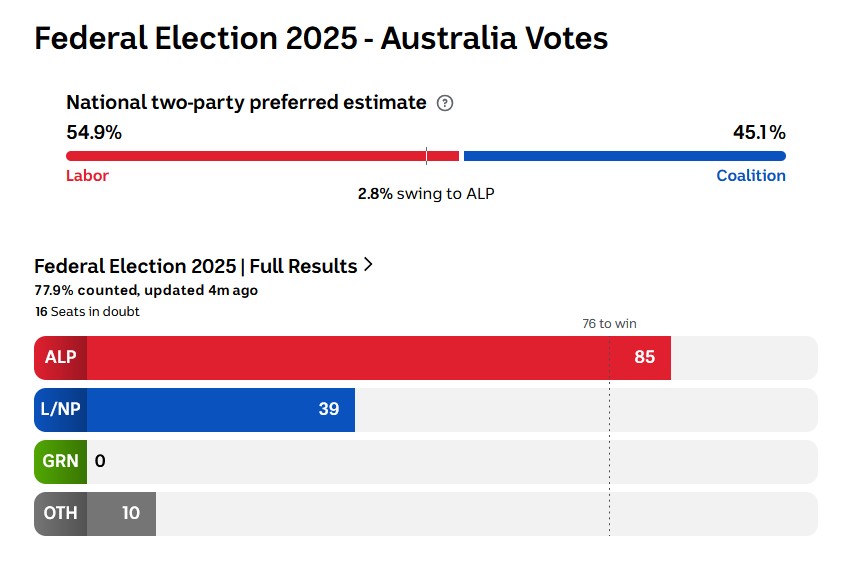
The incumbent Australian Labor Party was returned in a landslide on May 3, picking up 54.9% of the two-party-preferred vote, against the Liberal and National Parties on 45.1%. Both parties went to the election promising crypto law reform, but only the opposition pledged to deliver draft legislation within 100 days.
Joy Lam, Binance’s head of global regulatory and APAC legal, said the exchange has been consulting with Treasury officials since late 2023 about its proposed legislation, and it was now time for action.
“Timing is really quite critical now because obviously it’s something that has been discussed and kicked around for quite a few years,” she told Cointelegraph.
Coinbase managing director for APAC John O’Loghlen said the reelected Albanese Government has the “opportunity and the responsibility to move quickly on this issue” and called for a Crypto-Asset Taskforce to be established within its first 100 days “with the aim of bringing forward legislation that protects consumers, promotes innovation, and stops the exodus of talent and capital to other markets.”
BTC Markets CEO Caroline Bowler said that “beyond the political implications, this result sets the stage for meaningful progress in Australia’s approach to digital asset regulation.”
Lam noted that the UK released its draft regulations last week, stablecoin bills are moving forward in the US, and the EU has already implemented its MiCA legislation.
“So there’s a very clear shift. Everyone’s moving towards providing the regulatory framework that is needed for the industry to develop in a sustainable way. So time is really of the essence now.”
Draft crypto legislation within months
Treasurer Jim Chalmers’ office told Cointelegraph that exposure draft legislation would be released sometime this year for consultation, and any legislated reforms would be “phased in over time to minimize disruptions to existing businesses.”
Although the Treasury has draft legislation on “regulating digital asset platforms” and “payments system modernization” scheduled for release by the end of June, Lam isn’t confident. “I don’t know whether this quarter specifically is still sort of the timeline,” she said.
Related: Australian election will bring pro-crypto laws either way
While the ALP has been attacked by some over not taking any action in its first term in government, that may actually have resulted in a better outcome than legislation that took its cues from the approach of Joe Biden’s administration, which took a hard line on banks dealing with cryptocurrency and viewed most coins as securities.
Industry figures report a noticeable evolution in the government’s approach to crypto between when proposals were first put out for consultation at the end of 2023 and when the Treasury released its much more positive “Statement on Developing an innovative Australian digital asset industry” in March this year.
The statement sets out key priorities, such as using the existing Australian Financial Services License (AFSL) regime to underpin the regulation of Digital Asset Platforms and payment stablecoins. It’s focused on the safe custody of client assets by centralized providers and sidesteps issues around decentralized finance platforms.
Lam welcomed the use of the AFSL regime. “Obviously, we don’t need to reinvent the wheel,” she said. “It’s something that people know and understand. It’s a pretty sensible move, and it’s also going to be much easier for regulators.”
Tokenization and sandbox
The government will also review the Enhanced Regulatory Sandbox, which aims to provide space for innovative digital asset startups to grow free of red tape. The statement also highlights opportunities with tokenization.
Lam said the change in emphasis showed the government has been listening to the industry.
“It reflects the industry feedback that they would have received in 2023 as a result of the consultation, as well as the changing landscape because obviously it’s been evolving pretty quickly internationally,” Lam said.
“They do have the benefit now of looking at what has worked and hasn’t worked in other jurisdictions, and really building on those lessons.”
Dea Markovy, policy director at Fireblocks, told Cointelegraph that “a lot of the groundwork and research is done” and it was looking broadly positive.
“Of course, a lot of details are still to come around Australia’s Digital Asset Platforms (DAPs) regime. What is significant here is the willingness of the Government to cut through the complexity and uncertainty on crypto intermediaries licensing.”
The securities regulator ASIC released its own crypto regulations proposals (INFO 225) in December, and feedback from those consultations will help inform the government’s new legislation.
“In essence, it details how different token issuances and crypto intermediation will fit into Australia’s existing securities legislation, providing for a transition period,” explained Markovy.
The draft guidance suggests NFTs, in-game assets and memecoins are not financial products — the local equivalent of a “security” — while a yield-bearing stablecoin or a gold-backed token probably are.
The Treasury statement also highlighted issues with debanking. Lam said that simply regulating the industry would go a long way toward solving the issue.
“What we really want from governments and regulators is that clean licensing framework, because that goes a long way to mitigating the risk and giving the banks the comfort that they need,” she said. “And then, there’s probably going to need to be some additional guidance given to banks.”
Magazine: ZK-proofs are bringing smart contracts to Bitcoin — BitcoinOS and Starknet


