Khushi V Rangdhol
Jun 30, 2025 07:23
India faces a $300 billion export-credit gap, but blockchain’s “tokenised trade finance” could streamline processes, digitizing LCs and invoices to enhance access for small firms.
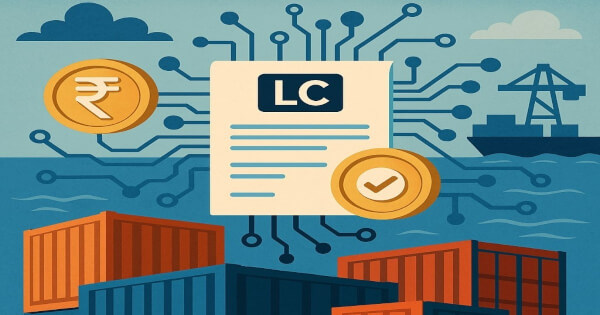
India’s exporters ship about US $770 billion in goods and services a year, yet small and mid-size firms still struggle to turn purchase orders into bank credit. The Asian Development Bank’s latest Trade Finance Gaps, Growth and Jobs survey pegs the global shortfall at US $2.5 trillion in 2022, up almost 50 % from the pandemic low. Industry groups and IFC studies put India’s share of that gap at roughly US $300 billion, concentrated in working-capital loans that never reach MSMEs. Blockchain builders say the cure may be “tokenised trade finance”—digitising invoices, letters of credit and collateral into on-chain assets that investors anywhere can fund in real time.
Why Letters of Credit Still Run on Paper
A typical textile exporter in Tiruppur ships fabric to a buyer in Milan under a letter of credit (LC). The LC passes through four banks, six paper documents and a manual checking loop that often lasts 7–10 days. Any mismatch—an extra comma on a bill of lading—can freeze payment. Banks therefore ration credit to known corporates and over-collateralise the rest, leaving smaller suppliers in limbo.
How Tokenisation Changes The Workflow
- Document digitisation. Bills of lading, inspection reports and warehouse receipts are hashed and timestamped on a permissioned ledger.
- Smart-contract LC. Terms encoded in the contract self-execute: when the shipping line uploads IoT-verified arrival data, payment triggers automatically.
- Invoice tokens. The receivable becomes a fungible token that can be discounted or repo-financed by global liquidity pools 24/7.
A blockchain record cannot eliminate fraud, but it slashes the cost and time of document matching—banks can extend credit against real-time data rather than days-old PDFs.
Three Live Rails to Watch
- Contour 2.0 – The once-faltering LC consortium found new life after Singapore-based Xalts acquired the platform in 2024. Indian banks including ICICI and Citi India have since run pilot on-chain LCs that cut processing time from 5–7 days to under 24 hours.
- SGTraDex – Singapore’s trade-data exchange went live in mid-2024 and now pipes digitised documents to DBS trade-finance desks; Indian exporters using Singapore forwarders can opt in via a single API.
- Project mBridge – A joint CBDC platform of the BIS Innovation Hub, Hong Kong, China, Thailand and the UAE. Its MVP, reached in 2024, settled pilot cross-border trades in seconds and flagged programmable trade finance as a top-priority use case. RBI is an observer; participation would let rupee-settled LCs clear alongside dirham or yuan on the same ledger.
India’s Own Experiments
- GIFT City sandbox. The International Financial Services Centres Authority (IFSCA) is reviewing tokenised-assets rules that would let fintechs issue rupee or dollar LC tokens inside the SEZ. A public consultation closed in February 2025; final guidelines are promised this year.
- EXIM Bank digital LC pilot. Budget documents for FY 2025 mention a proof-of-concept to “tokenise export credit guarantees,” although no public results are out yet. If adopted, the scheme would let banks rediscount EXIM-guaranteed tokens with global investors, freeing balance-sheet space for fresh MSME loans.
What Could Go Right
- Cost curves. Contour trials cut bank processing fees by 50–70 %. At scale, those savings can be priced into lower LC advisory charges for small exporters.
- Risk sharing. Tokenised invoices can settle in pools funded by insurers, hedge funds or development banks. A new US $1 billion HSBC–IFC facility announced in late 2024 explicitly targets digital trade-finance assets in emerging markets.
- Data visibility. A shared ledger gives regulators instant AML/KYC sightlines—no more hunting through couriered documents when red flags emerge.
What Could Stall Progress
- Legal enforceability. India’s Negotiable Instruments Act still assumes a paper bill of exchange. Parliament must amend “possession” definitions before a purely digital LC is fully court-proof.
- GST and stamp duty. Token transfers can trigger multiple state-levy interpretations; clarity is needed to stop mid-chain friction.
- On-chain liquidity. Today’s tokenised-LC pilots clear in the tens of millions, not billions. Without larger secondary pools, banks will keep one foot in the old system.
A Playbook from Hong Kong and Singapore
Both hubs treat tokenised trade assets as uncertificated securities, clearing them through licensed “market operators.” That certainty let the Hong Kong Monetary Authority settle its 2023 tokenised green bond in T + 1, five times faster than a vanilla global note. If Mumbai and Delhi emulate that legal plumbing, token pools in Hong Kong or Dubai could seamlessly fund Gujarat-issued LC tokens—matching India’s exporters with foreign dollar liquidity at speed.
Outlook
Tokenisation will not magic away India’s US $300 billion export-credit gap overnight, but early pilots show it can shave days off settlement, unlock new investor bases and shrink compliance costs—the trio of frictions that lock MSMEs out of trade finance. The next 12 months will be decisive: if GIFT City rolls out its rulebook and RBI joins mBridge trials, the first fully regulated, on-chain LC corridors could be live by 2026. That would turn blockchain from conference jargon into a working capital machine—exactly where Indian exporters need help most.
Image source: Shutterstock


