
Bitcoin (BTC) has dropped 10% over the last 30 days, as several groups of wallet holders switched from distribution to accumulation.
Data suggests that this accumulation, coupled with record realized losses, points to a potential shift in momentum.
Key takeaways:
-
Bitcoin whales and mid-sized holders are aggressively accumulating BTC at current levels.
-
Whales and sharks are now absorbing nearly 240% of the newly mined BTC supply.
-
Bitcoin’s realized losses neared $5.8 billion on Nov. 22, the largest since FTX, a classic capitulation sign.
Strong Bitcoin accumulation at current levels
Bitcoin whales increased their risk-on appetite following the recent drop to $80,000, using the dip as an opportunity.
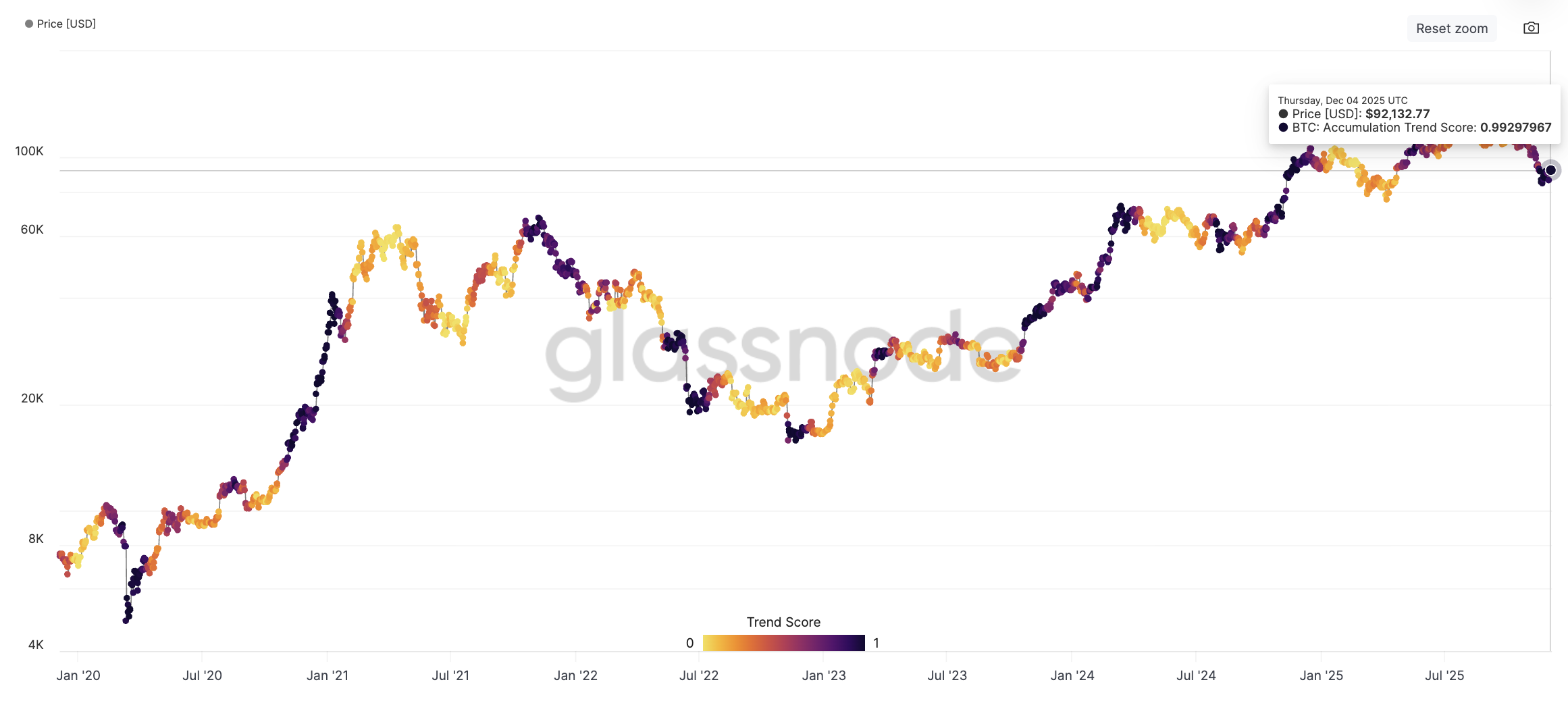
Glassnode data indicates that the Bitcoin accumulation trend score (ATS) is nearing 1 (see chart below), indicating intense accumulation by large investors.
Related: Bitcoin’s ‘momentum is igniting,’ but these are BTC price levels to watch
An ATS of closer to 1 (dark blue) indicates that the whales are accumulating more Bitcoin than they are distributing, and a value closer to 0 (light yellow) indicates they are distributing or not accumulating.
The spike in trend score indicates a transition from distribution to accumulation across almost all cohorts. This shift mirrors a similar accumulation pattern observed in July, which aligned with Bitcoin’s rally to the previous all-time high of $124,500 reached on Aug. 14, from sub-$100,000 levels in June.
Additional data from Glassnode reveals a resurgence in buying by small to mid-sized entities holding between 10 and 1,000 BTC, which have accumulated aggressively over the past few weeks.
Bitcoin whales absorb nearly 240% of new supply
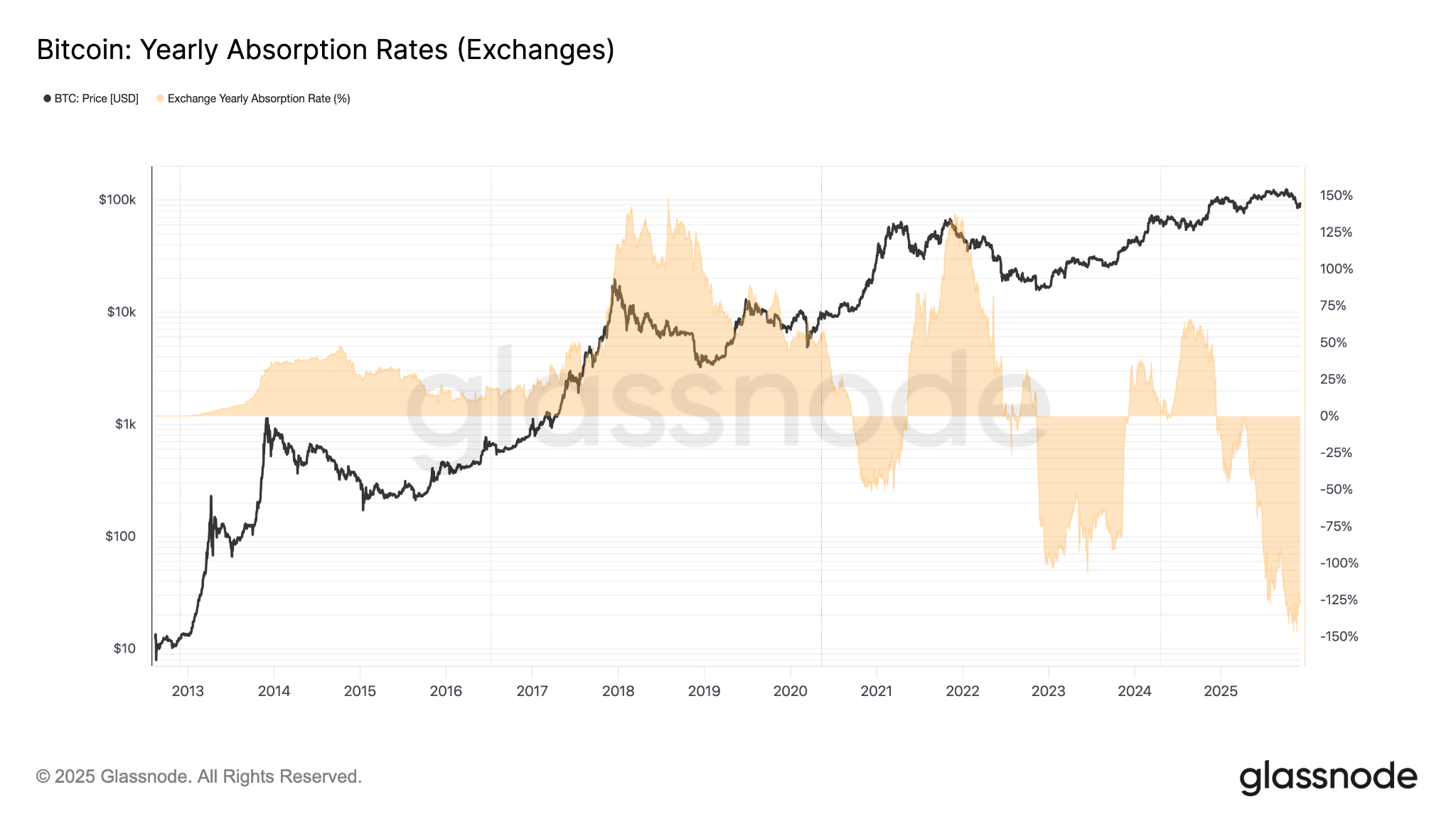
Reinforcing this accumulation trend is the yearly absorption rate metric, which shows that whales and sharks are now absorbing about 240% of BTC’s yearly issuance, while exchanges are losing coins at a historic pace.
Notably, Bitcoin’s yearly absorption rate by exchanges has plunged below -130% as outflows continue. This signals a growing preference for self-custody or long-term investment.
Meanwhile, larger holders (100+ BTC) are scooping up almost one and a half times the new issuance, marking the fastest rate of accumulation among sharks and whales in Bitcoin’s history.
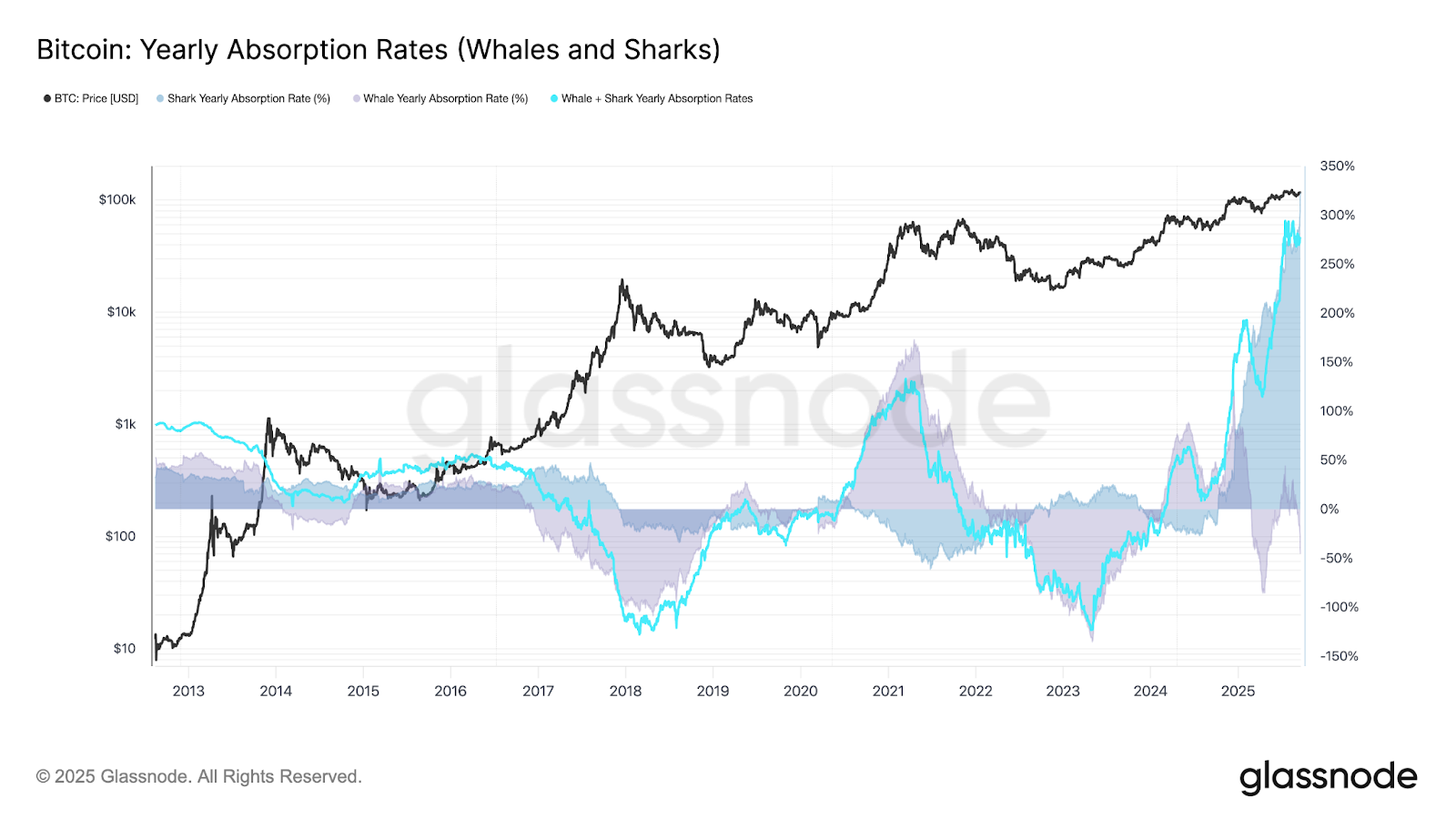
This marks a structural shift as traditional finance increasingly adopts BTC, particularly with the emergence of Bitcoin treasury companies and new ETF demand.
Bitcoin realized losses surpassed $5.7 billion
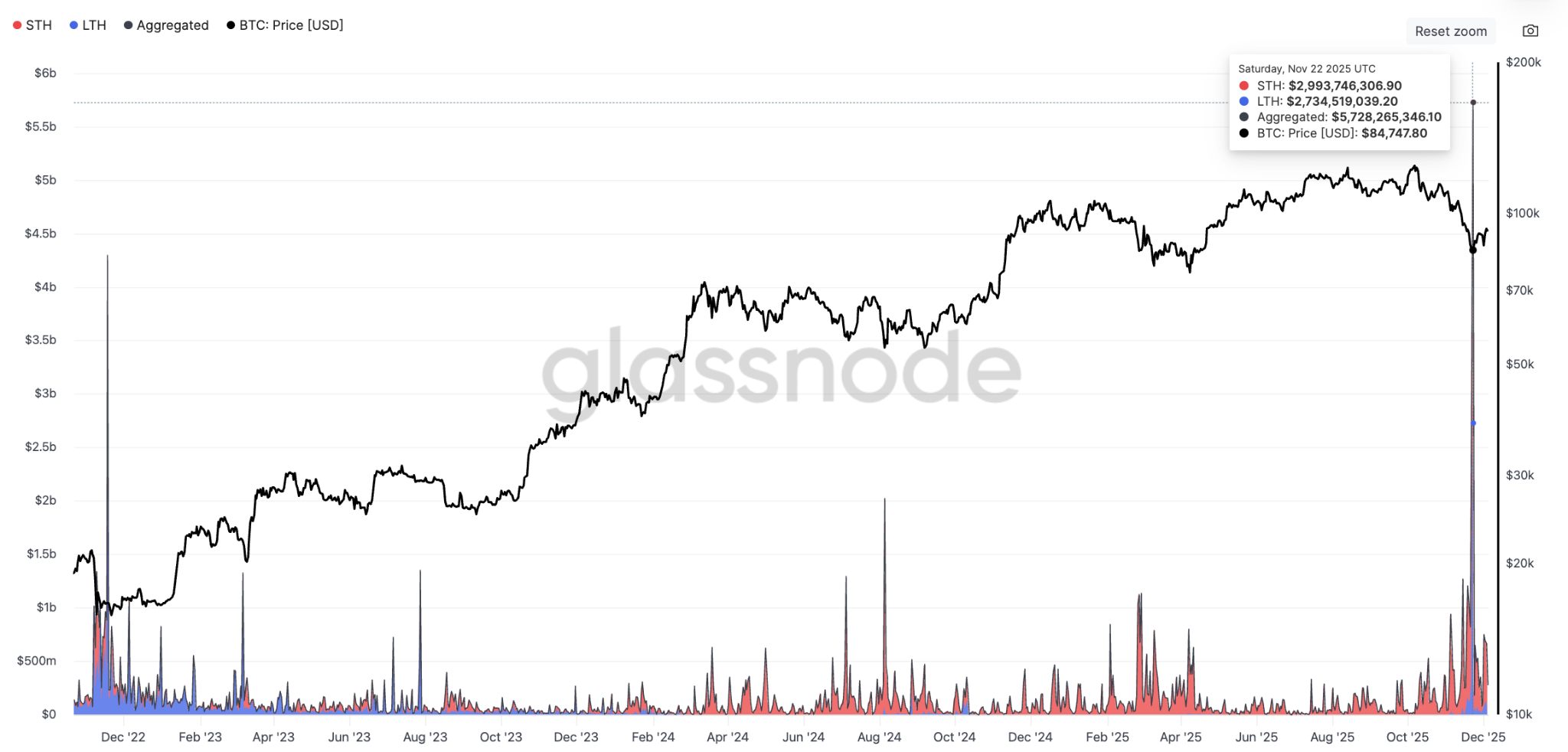
Additional data from Glassnode showed that Bitcoin’s recent drawdown “triggered the largest spike in realized losses since the FTX collapse in late 2022.”
The chart below reveals that BTC realized losses by short-term holders (STHs) reached $3 billion on Nov. 22, while losses by long-term holders (LTHs) reached $1.78 billion. The aggregate realised losses by all the holders reached $5.78 billion after Bitcoin dropped to $80,000 on Nov. 21.
Glassnode added:
“STHs account for the bulk of the losses, while LTH losses stay comparatively contained, indicating that the stress is largely on recent buyers.”
As Cointelegraph reported, short-term Bitcoin traders are facing the most pressure from the current downturn in terms of unrealized losses, with ETFs accounting for a maximum of 3% of the recent selling pressure.
This article does not contain investment advice or recommendations. Every investment and trading move involves risk, and readers should conduct their own research when making a decision.
This article does not contain investment advice or recommendations. Every investment and trading move involves risk, and readers should conduct their own research when making a decision. While we strive to provide accurate and timely information, Cointelegraph does not guarantee the accuracy, completeness, or reliability of any information in this article. This article may contain forward-looking statements that are subject to risks and uncertainties. Cointelegraph will not be liable for any loss or damage arising from your reliance on this information.


