
Ethereum remains under heavy pressure, struggling to hold above the $2,300 level as selling dominates across the broader crypto market. After weeks of weakening structure, price action has failed to attract sustained demand, prompting many analysts to warn that further downside may still lie ahead. With risk appetite fading and leverage being unwound, attention is increasingly shifting from short-term rebounds to signals that could define the next phase of the cycle.
Related Reading
A recent report from CryptoQuant highlights a notable development on the network side. The Ethereum Transfer Count (Total), smoothed by a 14-day Simple Moving Average, surged sharply to approximately 1.17 million on January 29, 2026. This abrupt and near-vertical rise in activity stands out against recent trends and has historically coincided with periods of heightened market stress rather than organic growth.
While elevated network activity is often associated with adoption, sharp spikes of this magnitude tend to emerge during moments of extreme positioning—either distribution into strength or forced movement during volatility. In past cycles, similar transfer count surges appeared near major inflection points, often preceding meaningful price corrections.
As Ethereum trades near multi-month lows, this spike raises a critical question for investors: Does the surge in on-chain activity reflect defensive repositioning ahead of another leg down, or is it the final phase of a broader reset? The answer may determine whether ETH stabilizes—or extends its decline.
The report explains that a retrospective look at Ethereum’s transfer count reveals a recurring and cautionary pattern. Spikes of the magnitude seen recently have only appeared at a handful of critical turning points in the network’s history. On January 18, 2018, a sharp surge in transfers marked the cycle peak, immediately followed by the start of a prolonged bear market. A similar event occurred on May 19, 2021, when a sudden jump in network activity coincided with a major market crash and a deep price correction.
From an on-chain perspective, this context matters. While analysts often associate rising network activity with growing adoption, a parabolic surge in transfer counts near price peaks typically signals an overheated market. These spikes tend to occur during moments of extreme stress or euphoria, when large volumes of assets are moving simultaneously.
In practice, this can reflect distribution, as long-term holders or institutional participants move funds toward exchanges to realize profits or peak volatility, where trading activity reaches a climax before momentum reverses.
The current setup closely resembles those earlier episodes. Although the broader macro environment has changed since 2018 and 2021, the behavior of network participants appears strikingly similar. If historical patterns hold, Ethereum may be entering a high-risk zone where the probability of further downside increases. Consequently, traders and investors must exercise caution and monitor confirmation signals closely before assuming stability has returned.
Related Reading
Ethereum’s weekly chart shows a market that has decisively shifted from expansion to distribution. The price is now struggling to stabilize after losing the $2,300–$2,400 support zone. The latest breakdown pushed ETH back toward the $2,200 area, a level that previously acted as a pivot during earlier consolidation phases in 2024 and mid-2025. The inability to hold above this zone reinforces the idea that sellers remain in control on higher timeframes.
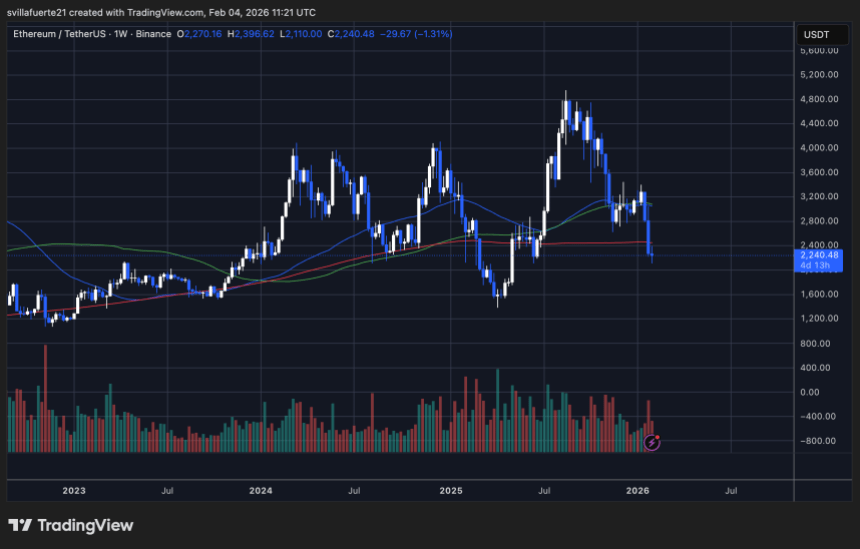
From a trend perspective, ETH is trading below its short- and medium-term moving averages. Both of which have rolled over and are beginning to slope downward. This configuration typically reflects a loss of upside momentum and signals that traders sell into rallies rather than accumulate on dips. The long-term moving average near the mid-$2,400s has flattened. This suggests that the market is transitioning from trend to range, with downside risk still present.
Related Reading
Elevated volume accompanied the recent sell-off, signaling conviction behind the move rather than a low-liquidity drift. Historically, similar volume spikes during downswings have preceded either deeper drawdowns or prolonged consolidation phases.
ETH has also printed a sequence of lower highs since the peak above $4,800, confirming a broader bearish market structure. Unless price can reclaim and hold above the $2,400–$2,500 region, the path of least resistance remains sideways to lower. With the market likely probing for demand at lower support levels before any sustainable recovery can form.
Featured image from ChatGPT, chart from TradingView.com


