
Key Takeaways
- Timechainindex.com founder Sani first flagged Noah Doe’s NY lawsuit targeting 39,069 wallets worth $293B in BTC.
- Galaxy Research’s Alex Thorn finds the $10-per-address valuation off by 9 orders of magnitude, weakening the legal claim.
- A New York default judgment could surface by late June 2026, though courts are unlikely to rubber-stamp the full request.
Galaxy Research’s Alex Thorn Tears Apart $10 Bitcoin Valuation in $293B NY Lawsuit
Galaxy Research analyst Alex Thorn confirmed Sani’s initial post and added that his firm has tracked the matter since the fall, stating the team is now “comprehensively unpacking” a lawsuit in which “3 anonymous parties want a NY court to grant them ~3.8M BTC ($293B), incl. coins long believed to be Satoshi.”
The case, New York County Supreme Court Index No. 153119/2026, was filed March 11, 2026 and expanded on May 1 to name 39,069 “John Doe” defendant addresses. The plaintiffs are identified only as “Noah Doe” and two Wyoming limited liability companies, ABC Company and XYZ Company, with no beneficial owners disclosed in the filings.
Noah Doe claims he used a proprietary algorithm to identify dormant bitcoin addresses, then physically delivered USB drives listing those addresses to the NYPD 17th Precinct as found property. He did not obtain private keys or take possession of any funds. He then invoked New York’s lost-and-found statute, Article 7-B of the Personal Property Law, to argue that title to the wallets has already vested in him.
The legal theory hinges on a single number supplied by an unnamed expert: each address is valued at under $10. That figure triggers Section 257(2) of the statute, a shortcut track for low-value lost property that vests title in the finder just one year after the find, without requiring a prolonged police holding period.
Galaxy Research’s onchain analysis dismantles that valuation directly. According to Thorn’s report, the 39,069 addresses hold 3,799,629 BTC worth approximately $293.5 billion at current prices. The average address holds 97.25 BTC, worth roughly $7.5 million, while the median holds 50 BTC, worth approximately $3.86 million. As the Galaxy report states, “the distance between ‘under $10’ and $293.5 billion is a gap of nine orders of magnitude.”
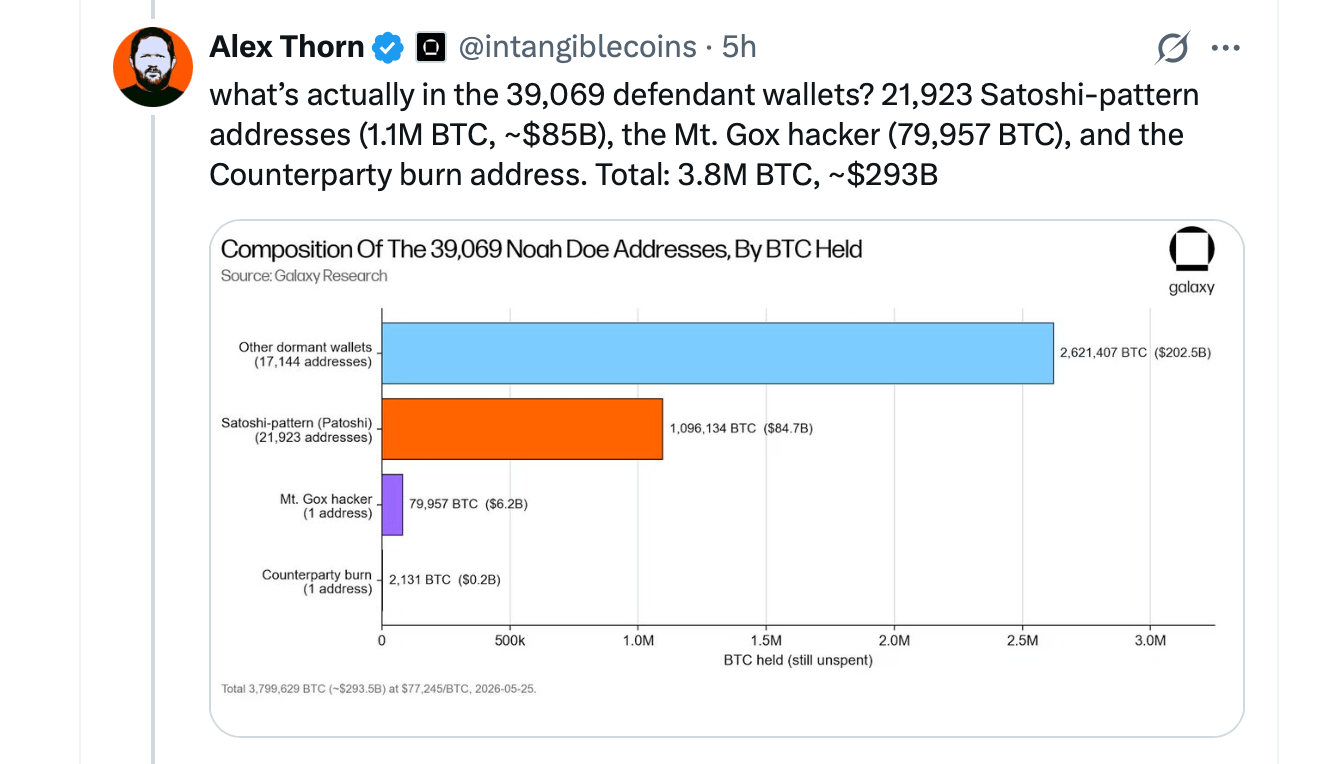
The defendant pool is itself legally complicated. John Doe #1 is the Mt. Gox hacker address holding roughly 79,957 BTC in coins stolen in 2011 and actively contested by investigators. John Doe #104 is the Counterparty burn address, provably unspendable, a wallet no person has ever controlled or ever could. And 21,923 addresses carry the well-documented “Patoshi” nonce pattern tied to Satoshi Nakamoto, holding an estimated 1.096 million BTC. None of those categories fits a standard legal theory of abandoned property.
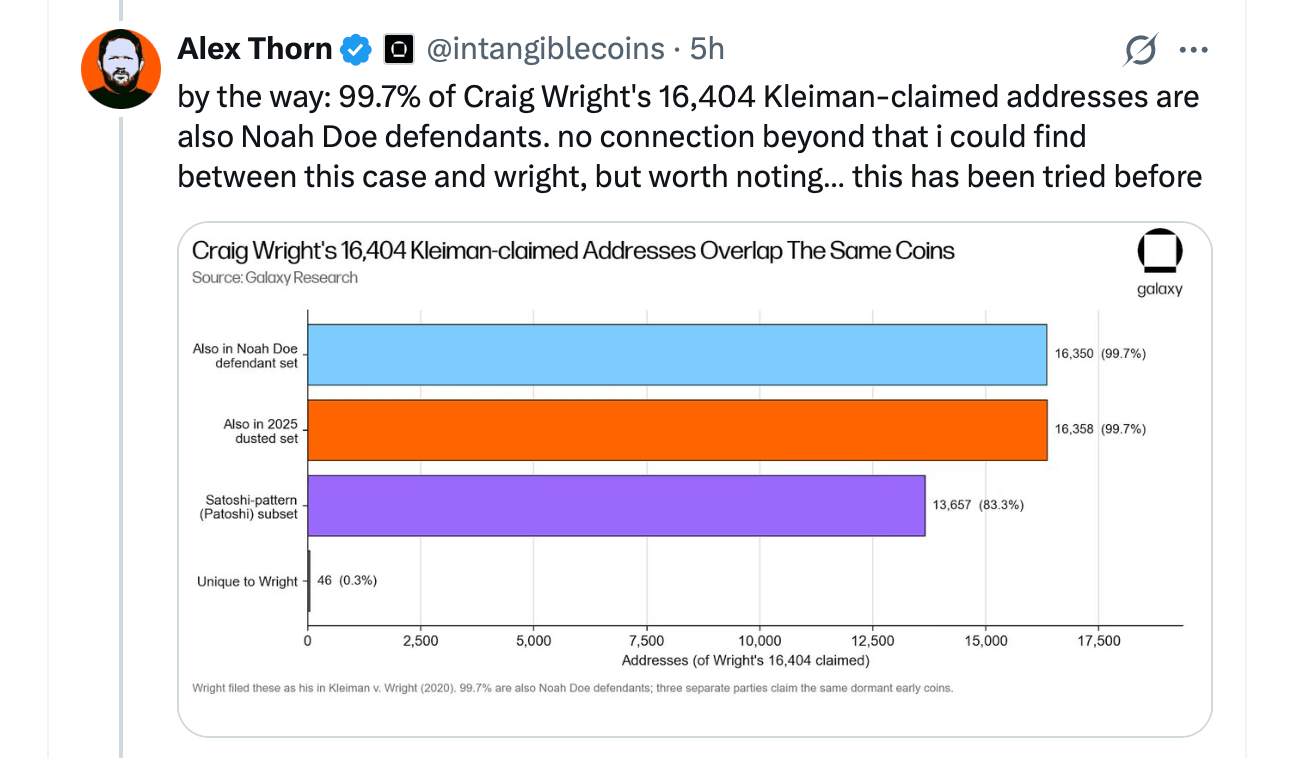
The Galaxy report also notes a near-total overlap with coins once claimed by Craig Wright in Kleiman v. Wright: 16,350 of Wright’s 16,404 addresses, or 99.7%, appear in the Noah Doe defendant list. Wright was found in contempt by a U.K. court in 2024 after courts rejected his claim to be Bitcoin’s creator. The report notes the overlap is notable, though no direct connection between Wright and the current case has been established.
To serve 39,069 anonymous defendants, plaintiffs obtained court authorization for onchain service via OP_RETURN messages carrying a link to the pleadings. Galaxy Research verified the operation through its own Bitcoin full node, confirming 98 batch transactions across Bitcoin blocks 950446 to 950576. Each address received 546 satoshis, roughly 4 cents, alongside the message: “COURT-ORDERED LEGAL NOTICE: https://www.ilawconotices.com/153119-2026.”
Whether that constitutes valid service is an open question. Bitcoin wallets are not built like Ethereum accounts, and most BTC wallet software does not display OP_RETURN payloads. Many wallets filter incoming dust by default. Galaxy’s study notes the method “takes the outward form of onchain service without delivering the thing service is supposed to do, which is reach the person being served.”
The Affirmation of Service was signed by a “Carlos J. Voltron,” described as a blockchain engineer with more than 10 years of experience. Galaxy Research searched public records and databases and found no real person by that name active in the field. The only prominent result for the name is a 2008 satirical piece in The Onion. If the affiant’s identity cannot be verified, any default or declaratory judgment built on the affidavit could later be challenged.
Plaintiffs’ counsel David D. Lin of Lewis and Lin LLC in Brooklyn filed the complaints and the pseudonym motion, keeping all three plaintiffs shielded from public identification. Galaxy Research notes that Noah Doe invokes the risk of “wrench attacks” and kidnapping as justification for his own anonymity, while the relief he seeks would require the actual Bitcoin holders to surface publicly to defend their coins.
Even a complete plaintiff victory would not hand Noah Doe or the Wyoming LLCs a single private key. What a New York judgment would produce is a legal document that could be presented to a centralized exchange or custodian if any of the named coins ever arrive at a regulated venue, potentially freezing assets and forcing holders to prove ownership and sacrifice anonymity. Galaxy Research’s Thorn describes the judgment as “a cloud on title” and concludes the true value of the case lies in that leverage, not in any direct access to the coins.
A technical default is expected by late June 2026, approximately 30 days after service. Thorn estimates the probability the court grants the full title-vesting declaration on default as low to moderate, noting the theory is novel, the stakes are high, and the questionable affidavit of service gives the court clear reason to demand a hearing before acting.


