
Cryptocurrency wallet makers and security companies are pushing out post-quantum products even though large-scale quantum computers capable of breaking Bitcoin do not exist yet.
The US National Institute of Standards and Technology (NIST) finalized its first post-quantum cryptography standards in 2024 and called for migrations before 2030.
As standards bodies plan for a gradual cryptographic transition, parts of the wallet market are already monetizing that future.
“I do feel that it is a bit of a fear tax. We know that quantum computers are far away — still five to 15 years away,” Alexei Zamyatin, co-founder of Build on Bitcoin (BOB), told Cointelegraph.
Bitcoin is trading roughly 50% below its October 2025 all-time high. Among the handful of theories attempting to explain crypto’s recent decline is a growing concern that quantum computing risks may be deterring institutional capital from Bitcoin.
The quantum risk is not zero, and it is not sudden
The quantum vulnerability often discussed is Bitcoin’s Elliptic Curve Digital Signature Algorithm, which authorizes transactions. In theory, a powerful quantum computer could derive a private key from an exposed public key and claim the coins sitting in an address.
Today’s quantum hardware isn’t capable of breaking the elliptic curve signatures. But that doesn’t mean threat actors are waiting around for a technical breakthrough.
“Many users expect a single ‘Q-Day’ in the future when cryptography suddenly fails. In reality, risk accumulates gradually as cryptographic assumptions weaken and exposure increases,” Kapil Dhiman, CEO and co-founder of Quranium, told Cointelegraph.
“Harvest now, decrypt-later strategies are already active, meaning data and signatures exposed today are being collected against future capability,” he said.
Related: What if quantum computers already broke Bitcoin?
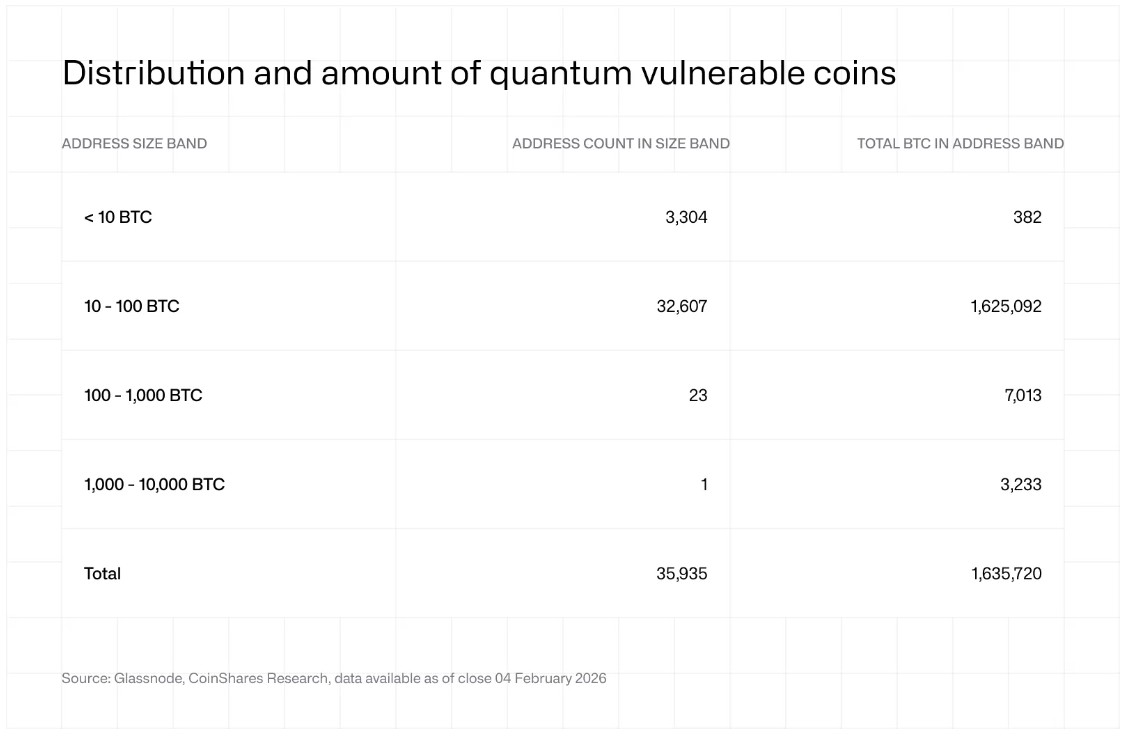
In Bitcoin’s case, the concern is for older exposed public keys. Once a public key appears onchain, it remains permanently visible. Modern address formats obscure public keys until coins are spent.
CoinShares Bitcoin researcher Christopher Bendiksen said that just 10,230 Bitcoin (BTC) sit in addresses with publicly exposed public keys that would be vulnerable to a sufficiently powerful quantum attack.
The quantum fear business
While the Bitcoin community debates how far away quantum computing is, crypto wallet makers are operating on their own clock.
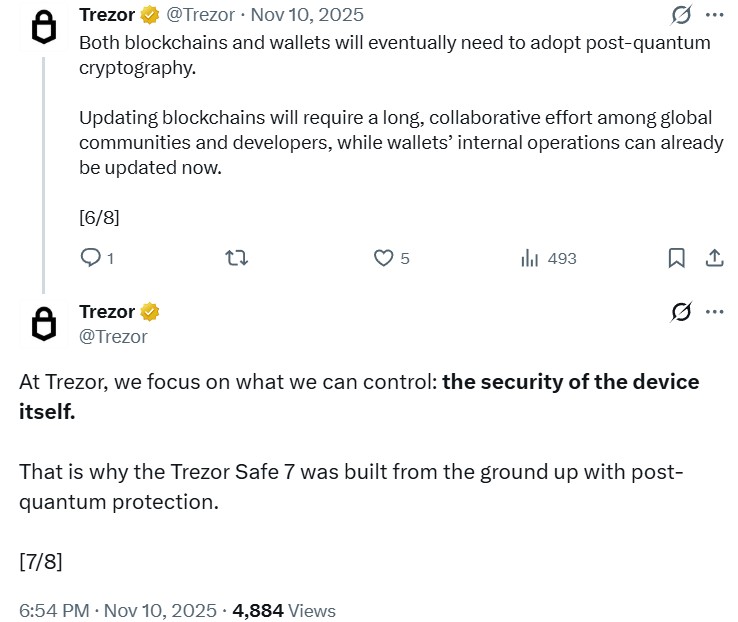
Trezor’s Safe 7 is marketed as a “quantum-ready” hardware wallet. Separately, qLabs recently introduced the Quantum-Sig wallet, which it claims embeds post-quantum signatures directly into its signing process.
BOB’s Zamyatin argued that wallet-level defenses would not solve Bitcoin’s quantum risk. Bitcoin transactions are authorized using a signature scheme embedded in the protocol itself. If that cryptography were ever broken, the fix would require a protocol-level change.
“I personally wouldn’t invest a lot of money into a quantum wallet right now because I don’t even know what protection it gives me for Bitcoin. It can’t really give me any protection, in my opinion, because Bitcoin doesn’t have a quantum-resistant signature scheme yet.”
Ada Jonušė, executive director at qLabs, agreed that full quantum resilience requires protocol-level defense. However, brushing off modern infrastructure as a fear tax overlooks the transitional nature of security upgrades.
“Quantum risk is not binary. Even before a protocol-level migration occurs, there is a real ‘harvest now, decrypt later’ threat,” she told Cointelegraph, claiming that qLabs’ approach reduces exposed key surface.
“Quantum readiness is about proactive infrastructure planning, not fear monetization,” Jonušė said.
Related: Bitcoin’s quantum countdown has already begun, Naoris CEO says
Trezor also admitted that blockchains themselves need to change their cryptography and protocol. But Tomáš Sušánka, the company’s chief technology officer, told Cointelegraph that wallets can implement protections right away instead of waiting for protracted blockchain upgrades.
“Once the blockchains upgrade, wallets must also support the same algorithms to remain compatible,” Sušánka said. He added that Trezor Safe 7 uses a post-quantum algorithm to protect against future quantum computers forging digital signatures and signing malicious firmware updates.
Market incentives and Bitcoin’s governance hurdle
Unlike iPhones, which are released almost every year, hardware wallets and other security products typically have multi-year product lifecycles. Introducing post-quantum features in a new product gives a reason for customers to buy a new device, even if the threat is distant.
“Yes, parts of the crypto industry do have incentives to amplify quantum risk, but that incentive is increasingly driven by regulatory and institutional alignment, not short-term sales alone,” said Dhiman, whose Quranium powers the Qsafe wallet.
“For most users, quantum-secure wallets today function as long-term insurance. The responsible approach is to acknowledge the transition ahead, avoid urgency driven by fear and choose systems designed to evolve without forcing abrupt replacements.”
Several blockchains are advancing with post-quantum strategies, but Bitcoin has been relatively hesitant. Some of the network’s most influential voices have brushed off the threat as a problem for the future.
Unlike Bitcoin, Ethereum has a widely recognized figurehead. Co-founder Vitalik Buterin has advocated for post-quantum preparations, and the network has been steering in that direction.
For Bitcoin, the issue is social consensus, coordination and the willingness to act, according to Zamyatin.
“It’s not like [Bitcoin has] one person that everyone will follow. It will require a broad social consensus, which is very hard to achieve,” he said.
Wallet makers agree that full quantum protection has to come from the protocol. But even if the risk is years away, they can act as insurance to help investors sleep better at night, though some argue they amount to a fear tax.
Magazine: Is China hoarding gold so yuan becomes global reserve instead of USD?
Cointelegraph Features and Cointelegraph Magazine publish long-form journalism, analysis and narrative reporting produced by Cointelegraph’s in-house editorial team and selected external contributors with subject-matter expertise. All articles are edited and reviewed by Cointelegraph editors in line with our editorial standards. Contributions from external writers are commissioned for their experience, research or perspective and do not reflect the views of Cointelegraph as a company unless explicitly stated. Content published in Features and Magazine does not constitute financial, legal or investment advice. Readers should conduct their own research and consult qualified professionals where appropriate. Cointelegraph maintains full editorial independence. The selection, commissioning and publication of Features and Magazine content are not influenced by advertisers, partners or commercial relationships.


