
On Friday, the Japanese government approved a $135-billion (21.3 trillion Japanese yen) stimulus package, mainly aimed at price relief and subsidizing gas and household electricity bills.
Prime Minister Sanae Takaichi and her cabinet believe the plan will dampen inflation by 0.7 percentage points on average from February to April. But markets, including crypto markets, are concerned.
The yen has significantly weakened against the US dollar, hitting 10-month lows; Japanese government 10-year bond yields reached 1.84% on Thursday, the highest level since the 2008 financial crisis. Major government spending like this stimulus package is likely to lead to the issuance of more bonds, further weakening the yen, which would prompt the Bank of Japan to intervene with rate hikes. That could trigger mass sell-offs in the US.
It could happen soon. Finance Minister Satsuki Katayama said on Friday, “We are alarmed by recent one-sided, sharp moves in the currency market.” In tandem, Bank of Japan governor Kazuo Ueda said that the bank will discuss the “feasibility and timing” of a rate hike in subsequent meetings.
Bitcoin (BTC) has continued to slump amid this news. Historically, a weakened yen has served as a profitable haven for Bitcoin traders. They could borrow yen at low-interest rates, convert it into US dollars and invest in high-yield assets. However, Japan’s record debt levels and a potential rate hike have prompted traders to reconsider the yen’s stability.

PubKey opens in Washington, DC
It hasn’t all been doom and gloom for Bitcoin this week. Market hopes rose on Thursday when Bitcoin-themed bar PubKey opened its doors in Washington, DC for the first time.
A surprise appearance by pro-crypto Treasury Secretary Scott Bessent made the rounds on X. Some viewed it as a bullish sign: “Having the Secretary of the Treasury at the Pubkey DC launch seems like a moment I could easily look back on and say ‘wow, it was all so obvious’,” treasury company Strive’s Ben Werkman said in an X post.
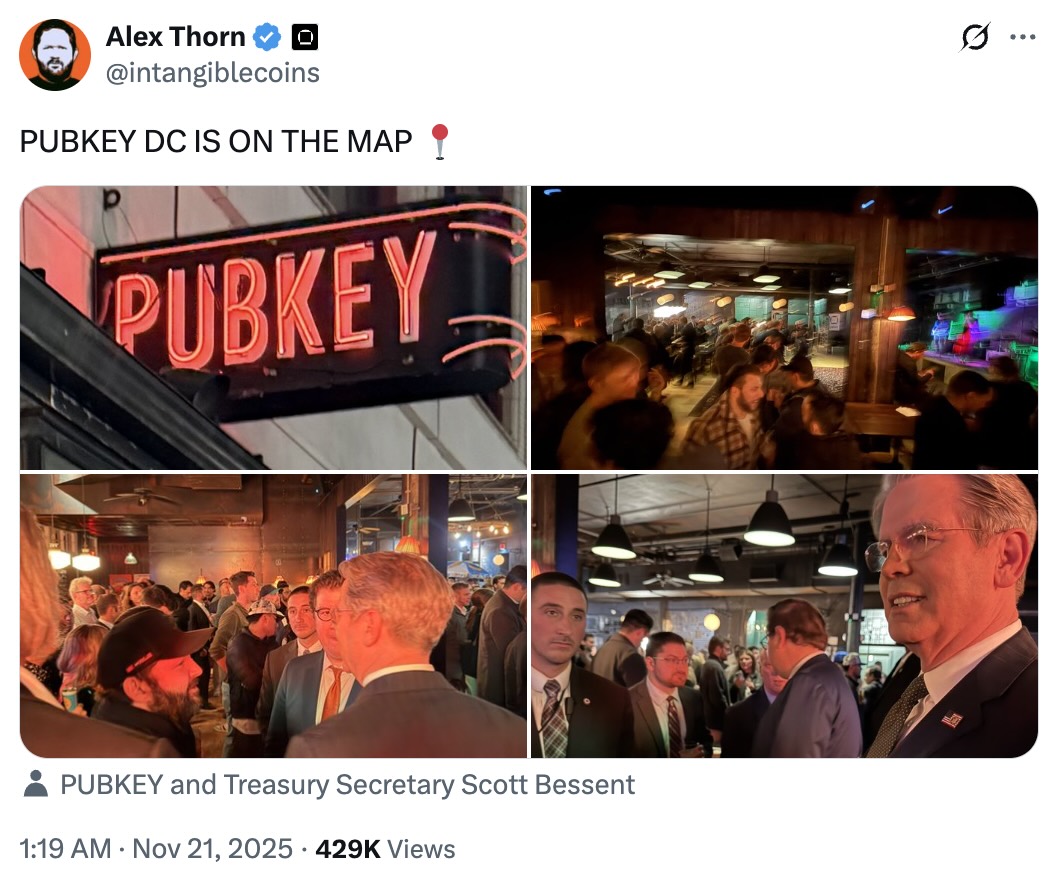
PubKey first launched in New York City in late 2022. The concept is simple: Combine a local watering hole with a love for crypto. It’s seen notable success, particularly after US President Donald Trump made an appearance during his 2024 campaign run. He ordered 50 burgers and 50 Diet Cokes — and paid for them with Bitcoin on the Lightning Network.
His appearance brought PubKey onto the national stage. “We had people traveling from the tri-state area coming into PubKey,” owner Thomas Pacchia recently told Cointelegraph Magazine. “After that, some people traveled across the US or even globally.”
The bar doesn’t endorse a political party. But PubKey’s expansion to the nation’s political hub is no mistake. “Bitcoin certainly deserves an embassy in Washington, DC,” he said.
Related: Institutions lean into crypto despite Bitcoin price slump
Canada approves budget advancing stablecoin policy
Up north, Canadian Prime Minister Mark Carney has had his 2025 budget approved by parliament. Tucked away in the document’s 600-page depths is a section outlining the governance of stablecoins.
Under the budget, stablecoin issuers will need to hold sufficient reserves, set clear redemption policies and implement robust risk management frameworks. Overseen by the Bank of Canada, $10 million will be allocated over a two-year period to ensure smooth operations.
It’s a leap forward for the Canadian stablecoin market. Though the bill is modeled on the United States’ GENIUS Act, there are some differences. For example, Canada’s bill doesn’t ban unlicensed issuing. Instead, it curbs this problem by requiring registration. Any person can become an approved stablecoin issuer with the Bank of Canada — if they jump through the proper hoops.
Related: Canada’s budget promises laws to regulate stablecoins, following US lead
UK’s NCA identifies billion-dollar crypto laundering ring
There is a small bank in Bishkek, the capital of Kyrgyzstan, that may look like any other. Keremet Bank offers mortgages and loans and even celebrates International Women’s Day.
But according to the UK’s National Crime Agency (NCA), it’s owned by money launderers, and they’re using it to wash Britain’s drug money with cryptocurrency.
Last year, on Christmas Day, a company called Altair Holding acquired a 75% stake in Keremet Bank. The NCA has linked the company to George Rossi, a US-sanctioned Ukrainian national and the head of the money laundering network TGR. This network is one of two that the agency has exposed for laundering funds for cybercriminals, drug dealers and firearm traffickers across at least 28 cities and towns in the UK. It has also reportedly helped sanctioned Russians bypass financial restrictions.
“For a fee, the launderers collect ‘dirty’ cash generated from the drugs trade, firearms supply, and organised immigration crime, and convert it to ‘clean’ cryptocurrency,” the NCA said in a report released on Friday.
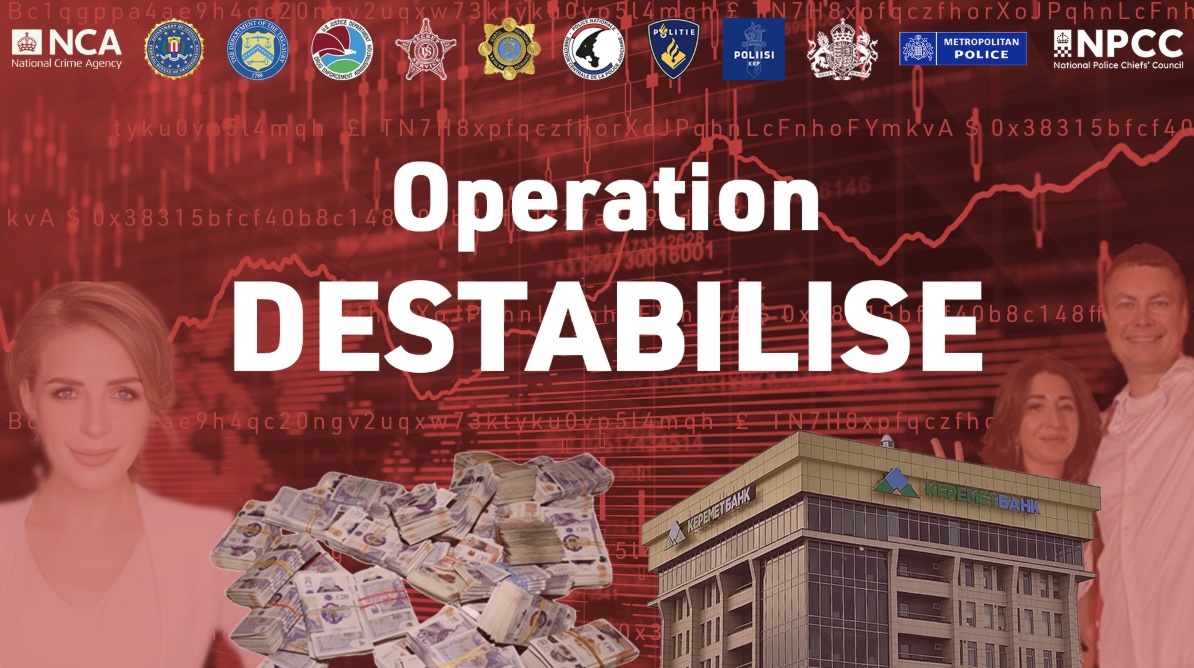
Since TGR bought a controlling stake in Keremet Bank last year, it has facilitated “cross-border payments on behalf of Promsvyazbank, a Russian state-owned bank, which supported companies involved in the Russian military industrial base.”
Essentially, the NCA said it has exposed a profitable conduit used by Russia to avoid sanctions and illegally fund its war in Ukraine. To date, more than 25 million pounds ($33 million) has been seized in cash and cryptocurrency, the agency said, and 128 arrests have been made internationally.
Magazine: Bitcoin whale Metaplanet ‘underwater’ but eyeing more BTC: Asia Express


