
Unwithered by the ongoing bear market, Bitcoin’s (BTC) underlying architecture continues to outperform itself — further securing, decentralizing and speeding up the impenetrable peer-to-peer network. The same holds true for the Bitcoin Lightning Network (LN).
The Bitcoin Lightning Network capacity attained an all-time high of 3915.776 BTC as evidenced by data from Bitcoin Visuals, displaying a commitment to the cause of improving BTC transaction speeds and reducing fees over the layer-2 protocol.
The Bitcoin LN was first implemented into the Bitcoin mainnet in 2018 to address Bitcoin’s infamous scalability issues and has ever since been able to maintain an upward trajectory in terms of expanding its capacity.
The climb, however, saw a temporary disruption on April 18, when the LN capacity dropped by 7.7% — from 3687.051 to 3402.273 BTC in a matter of a week. Showcasing network resilience, the drop was accompanied by a quick recovery back to 3718.351 BTC by May 2.
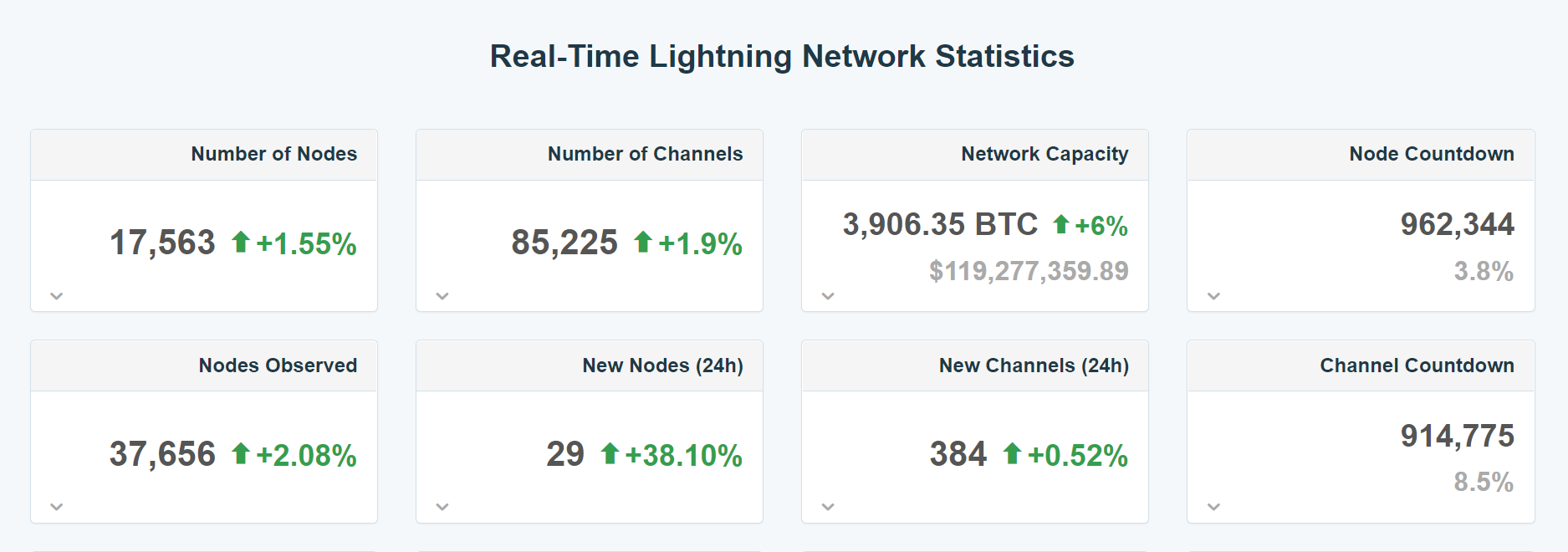
Moreover, statistics data from 1ml shows that all other aspects of the Bitcoin Lightning Network continue to grow parallel to Bitcoin’s global adoption drive.
Related: Layer-2 adoption could spur the next crypto turning point
A Redditor’s data-driven prediction hints at a major disruption that will see the crypto industry move away from bridging between L1 blockchains toward L2s. As explained by the OP:
“L2 adoption is happening now, even if it is slow and in bursts. Behind the scenes, L2’s are improving reliability, decreasing fees, and increasing accessibility. L2’s are still building and improving, and that’s fantastic.”
As Cointelegraph previously reported, L2 scaling solutions take advantage of L1’s security and process multiple transactions into a single package.


