
Bitcoin price traded at $77,541 on Wednesday morning, up +2.2% over 24 hours and +4.3% on the week, after President Trump announced an indefinite extension of the Iran ceasefire and Strategy disclosed a $2.54 billion BTC acquisition – its largest single purchase in 17 months. The two catalysts arrived in close sequence, compressing what had been 46 days of funding rate suppression into a sharp repricing across crypto markets and traditional equities alike.
The analytical question is no longer whether Bitcoin can sustain a move above $75,000; it is whether the current $77,500 print reflects durable demand or a mechanical relief trade that exhausts itself before the $80,000 threshold becomes testable. Those are structurally different outcomes, and the data available Wednesday morning does not yet settle the question cleanly.
DISCOVER: Best crypto to buy right now – CoinSpeaker’s updated guide
Cross-Asset Transmission: Reduced Trump Hormuz Risk Flows Through Oil Into Risk Appetite like Bitcoin
The transmission mechanism here is specific. Trump’s ceasefire extension strategy – framed around what he described as a “seriously fractured” leadership structure in Tehran – removed the immediate probability of resumed strikes while preserving the US Strait of Hormuz blockade. That combination kept oil prices contained: Brent crude held near $90 a barrel rather than spiking toward the $105–$110 range that brief diplomatic breakdowns had threatened over the prior weekend.
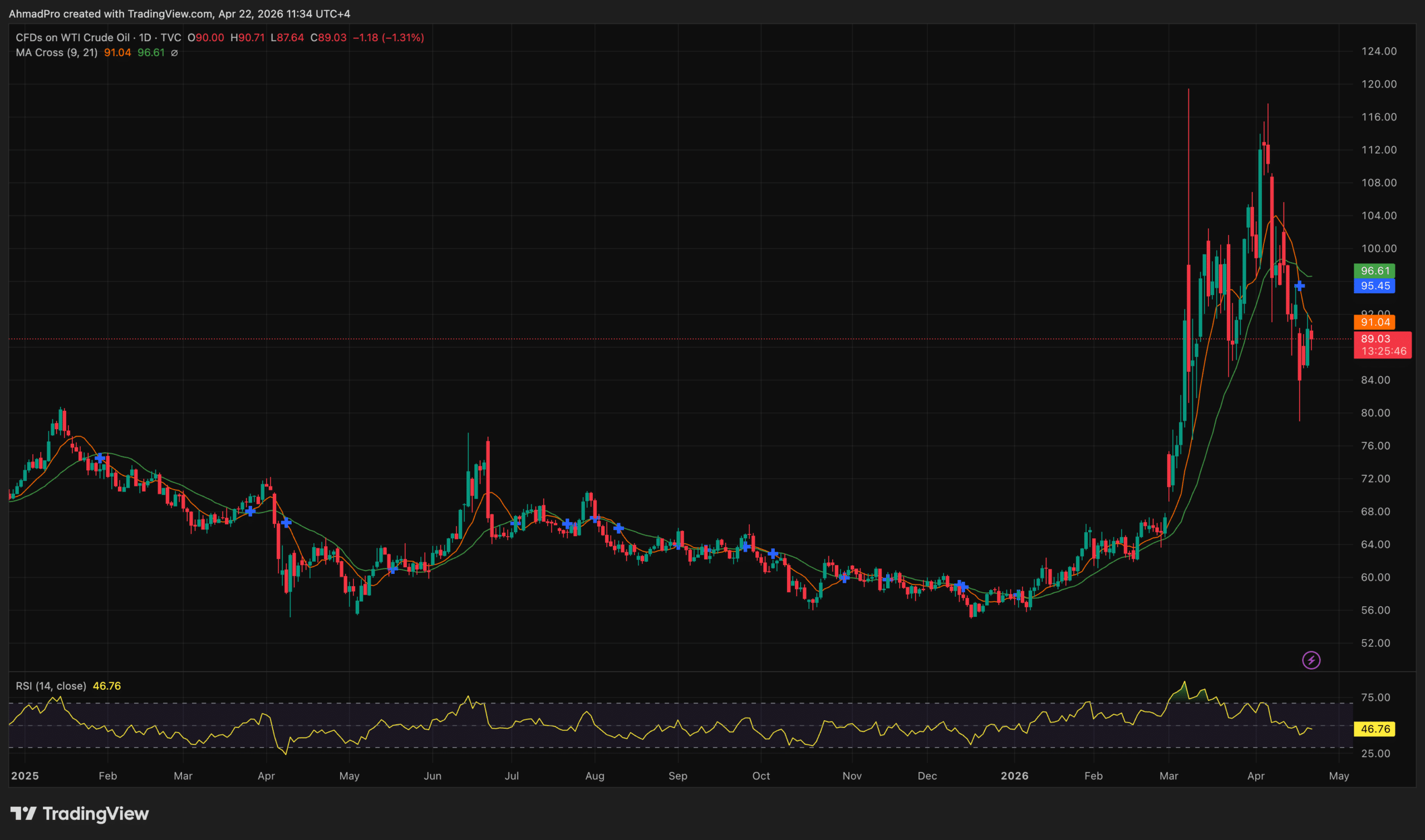
Contained oil pricing reduces near-term inflation expectations, which in turn reduces the risk-off pressure that had been suppressing equity multiples and crypto positioning simultaneously. S&P 500 futures rose +0.5% and Nasdaq 100 futures gained +0.6% in the hours following the announcement, though both underlying benchmarks had closed lower Tuesday as talks briefly wobbled. The MSCI Asia Pacific Index slipped -0.7%, suggesting the transmission was uneven across regions – investors in Asia remain more cautious about how long the Hormuz disruption persists regardless of ceasefire terms.
Within crypto, beside Bitcoin, Ether rose +2.1% to $2,366, BNB climbed +1.3% to $640, and Solana gained +1.8% to $87 post Trump announcement. The breadth of the move across majors is consistent with a genuine risk-on rotation rather than a Bitcoin-specific catalyst. The only red in the top 10 was a marginal -0.1% drift in stablecoins and Tron, which typically underperform in risk-on sessions as capital rotates toward higher-beta assets. Trump’s broader posture as a pro-crypto political figure adds a secondary transmission layer – the administration’s comfort with digital assets reduces regulatory risk premium alongside the geopolitical premium, amplifying the net effect on crypto price.
Bitcoin After Ceasefire: The $77,500 Print and the $80,000 Resistance Overhead
Bitcoin’s current structure positions $75,000 as the immediate support floor and $80,000 as the first confirmed resistance level of consequence. The 46-day funding rate compression that preceded Wednesday’s move is significant: extended periods of suppressed funding typically accumulate short positioning that, when unwound, can accelerate price through resistance levels faster than organic demand alone would support. Whether that dynamic is fully in play depends on whether open interest rebuilds above $77,500 in the hours following the initial spike.
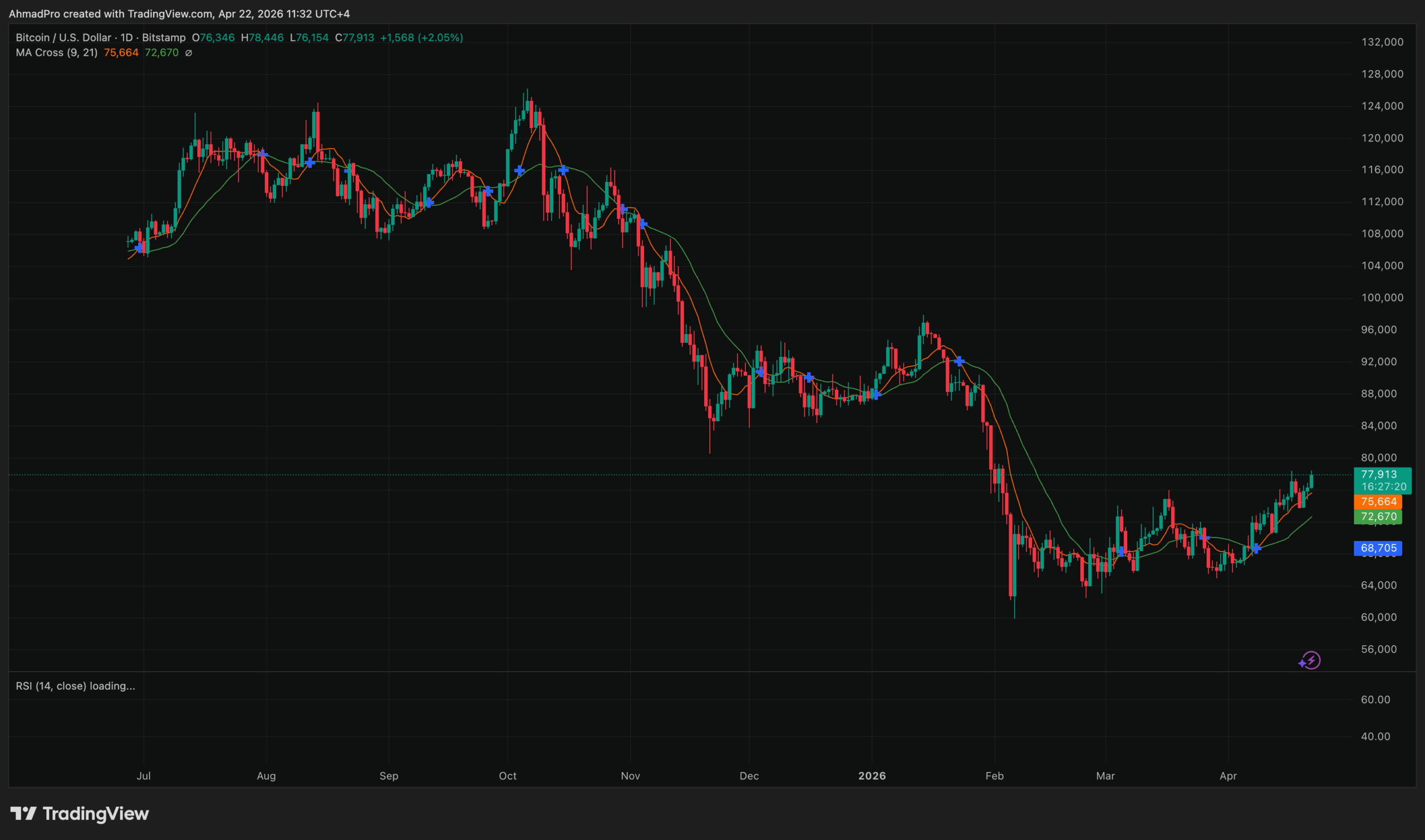
Source: BTCUSD / Tradingview
On the downside, analyst Darkfost has identified the realized price of short-term Bitcoin holders at approximately $69,400 – the level at which recent buyers move from unrealized losses into profit. Bitcoin holding above this level materially reduces the probability of a cascade liquidation if sentiment reverses, because holders sitting on gains are structurally less likely to become forced sellers. The gap between $69,400 and $75,000 provides a meaningful cushion that did not exist during the prior failed attempt at $78,000 ten weeks ago.
Three scenarios present themselves. Bull case: Bitcoin closes above $77,500 through the European session, open interest rebuilds as new longs enter rather than shorts cover, and a clean break above $80,000 confirms the funding rate compression has flipped into a sustained squeeze – with $85,000 as the next meaningful target.
Base case: Bitcoin consolidates between $75,000 and $78,000 as the ceasefire extension is priced in and the market waits for either a finalized US-Iran agreement or the next macro data catalyst, with longer-term technical patterns pointing toward a $90,000 target if the bull trend reasserts.
Bear case: Hormuz blockade news resurfaces, oil retests $105, and Bitcoin reverses below $75,000 – a move that would signal the extension was already fully priced at the open, and the rally requires a fresh catalyst to resume.
EXPLORE: Best Ethereum wallets for 2026 – CoinSpeaker’s updated guide
Disclaimer: Coinspeaker is committed to providing unbiased and transparent reporting. This article aims to deliver accurate and timely information but should not be taken as financial or investment advice. Since market conditions can change rapidly, we encourage you to verify information on your own and consult with a professional before making any decisions based on this content.

Daniel Frances is a technical writer and Web3 educator specializing in macroeconomics and DeFi mechanics. A crypto native since 2017, Daniel leverages his background in on-chain analytics to author evidence-based reports and deep-dive guides. He holds certifications from The Blockchain Council, and is dedicated to providing “information gain” that cuts through market hype to find real-world blockchain utility.


