
Bitcoin surged to a fresh all-time high of $124,500 just hours ago, but the celebration was short-lived as the price quickly retraced to the $121,500 level. The sudden pullback has split market opinion: some analysts interpret the drop as a sign of waning momentum, while others see it as a healthy pause before another breakout attempt.
Related Reading
Adding to the intrigue, key data from CryptoQuant reveals that BTC volatility — measured by the 30-day Price High & Low metric — has compressed to its lowest point in two years. This metric tracks the range between Bitcoin’s rolling 30-day high and low, and its current tight squeeze suggests a rare balance between supply and demand. Liquidity has been clustering above local highs near $120K and below recent lows around $113K, creating a coiled-spring effect in the price structure.
Historically, such volatility compression phases often precede significant range expansions. The question now is whether Bitcoin will break upward, continuing its long-term bull trend, or slip into a deeper correction if selling pressure gains traction. With the market sitting near record highs and volatility at multi-year lows, traders are bracing for what could be the next decisive move in Bitcoin’s 2025 rally.
Bitcoin Volatility Compression Signals Imminent Move
According to top analyst Axel Adler, Bitcoin’s 30-day Price High & Low metric is showing one of its tightest readings in years. The range between BTC’s rolling 30-day high and low has narrowed significantly, while the bands themselves — representing the rolling maximum and minimum prices — have compressed tightly around the current price. This pattern is a textbook sign of volatility contraction.
Adler explains that such compression typically reflects a balance between supply and demand and a period of low realized volatility. In this phase, liquidity tends to concentrate just above local highs, currently around $120,000, and just below local lows, near $113,000. This creates a situation where price movement is contained within a narrow band, with traders positioning themselves on both sides in anticipation of the next breakout.
The coming days will be critical in determining Bitcoin’s short-term structure. If BTC can break above the $120K–$124K zone, it could trigger another leg higher in its uptrend. However, a breakdown below $113K would increase the risk of a deeper correction, potentially shifting market sentiment.
Related Reading
Price Analysis: Testing Critical Resistance Zone
On the 8-hour chart, Bitcoin (BTC) is trading at $121,596, down slightly by 0.14% after hitting $122,609 earlier in the session. The move comes just a day after BTC briefly broke above the key $123,217 resistance level, approaching the $124,000 psychological barrier before pulling back. This zone remains the most significant obstacle for bulls, as it has capped upward moves multiple times.
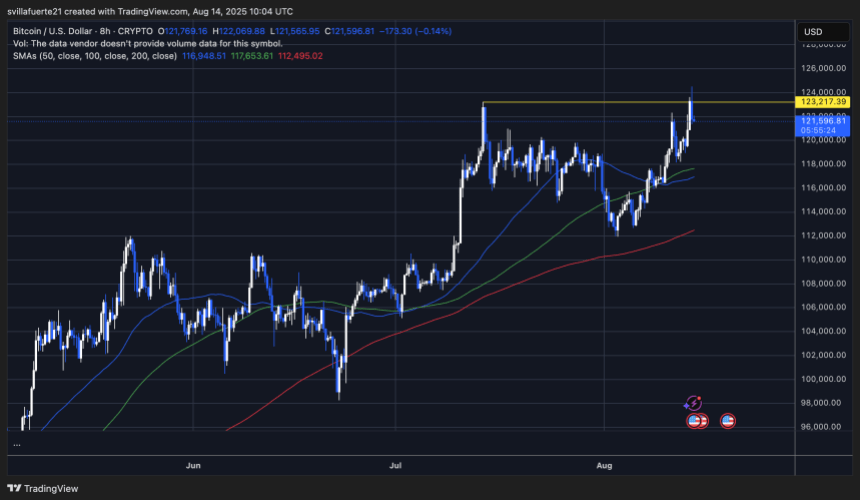
Price action shows BTC maintaining a bullish structure above its major moving averages — the 50 SMA ($116,948), 100 SMA ($117,653), and 200 SMA ($112,495). This alignment signals continued strength in the medium term, with the 50 SMA acting as immediate dynamic support.
Related Reading
The repeated tests of the $123K area suggest that market liquidity is heavily concentrated here. A decisive breakout and sustained close above $124K would likely trigger momentum buying and open the door to new all-time highs. Conversely, a failure to reclaim $123K could lead to renewed selling pressure, with initial support at $120K and deeper support near the $117K–$118K range.
Featured image from Dall-E, chart from TradingView


