
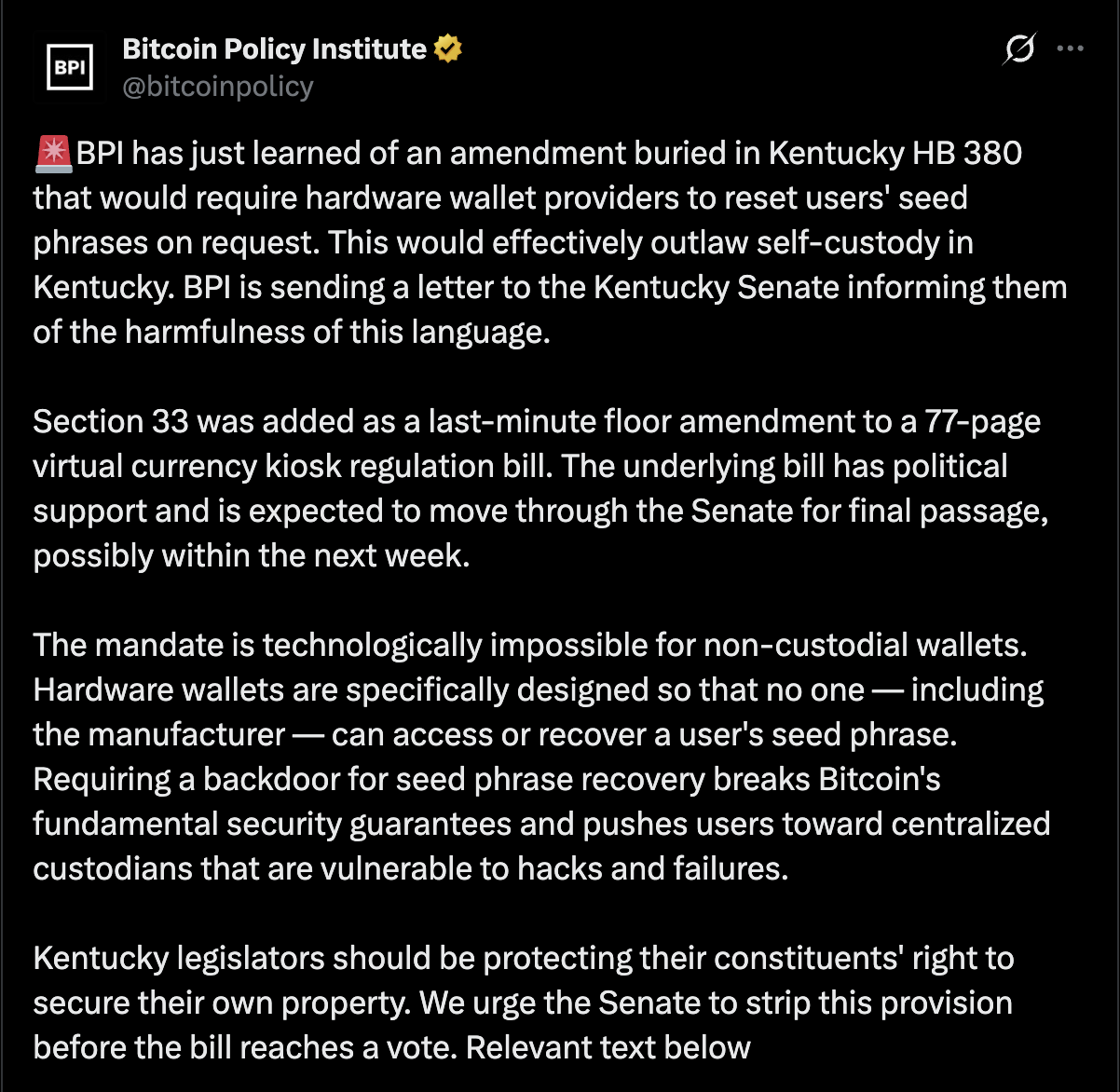
Kentucky House Bill 380, a state-level crypto regulatory bill, includes provisions that would force crypto hardware wallet manufacturers to build a “backdoor” into devices, Bitcoin (BTC) advocacy organization Bitcoin Policy Institute (BPI) has warned.
The provisions require crypto hardware wallet manufacturers to provide recovery options for users’ seed phrases, and were added to the bill in a “last-minute” floor amendment, BPI said. The amended Section 33 of the bill reads:
“A hardware wallet provider shall provide a mechanism for, and assist any person who owns a hardware wallet that was provided by the provider with, resetting any password, PIN, seed phrase, or other similar information that is necessary to access the contents of the hardware wallet.”
The sponsors of the legislation are state Representatives Aaron Thompson and Tom Smith.
The bill also proposes identity verification checks for users requesting a password, seed phrase, or PIN reset from a hardware wallet manufacturer.
“The mandate is technologically impossible for non-custodial wallets. Hardware wallets are specifically designed so that no one, including the manufacturer, can access or recover a user’s seed phrase,” BPI said in response.
The provisions threaten the self-custody of private keys, which is a foundational feature of cryptocurrencies, according to BPI, which added that requirements like this push users toward centralized custodians that are susceptible to hacks and business failures.
Related: BPI targets August for BTC tax relief, but warns time is running out
SEC officials defend the right to self-custody
US Securities and Exchange Commission (SEC) Chair Paul Atkins said he is “in favor” of market participants having self-custody options, especially in cases where intermediaries would impose a financial or operational burden on the user.
In November 2025, Hester Peirce, an SEC commissioner and head of the regulator’s Crypto Task Force, reaffirmed the right to self-custody and financial privacy, saying that both were foundational to freedom.
Peirce asked the hosts of the Rollup podcast in November 2025: “Why should I have to be forced to go through someone else to hold my assets?
“It baffles me that in this country, which is so premised on freedom, that would even be an issue — of course, people can hold their own assets,” she said.
Magazine: Bitcoin’s long-term security budget problem: Impending crisis or FUD?


