
Cardano is preparing a layer-1 upgrade it says will push mainnet throughput from roughly 10–15 transactions per second to hundreds, while keeping the network’s decentralization and security profile intact. At a Tokyo community event on the Midnight Japan Tour, Input Output’s Michael Smolenski and Cardano founder Charles Hoskinson framed Ouroboros Leios as both a scaling step and a broader consensus breakthrough.
Smolenski, Cardano Core product manager at Input Output, told attendees Leios is “an upgrade to layer 1 to make Cardano faster,” with active development underway and a target release “this year in 2026.” He described the current throughput ceiling as suitable for proving out Ouroboros’ design, but insufficient for the next phase of adoption and for the economics of stake pool operators (SPOs).
Cardano’s Leios Eyes 50x Speed Boost In 2026
“Up until now the speed of the network has been around […] 10 to 15 transactions per second,” Smolenski said. “But now we need to move on to higher transaction throughput in order to compete and drive further adoption. Another factor, SPOs, they in the long term need to support the cost of their operations from transaction fees instead of from block rewards […] they need to see network usage of around 50 transactions per second.”
The initial Leios mainnet release is pitched as a “50 times improvement,” with Smolenski translating that into an early move from roughly 10 TPS to around 500 TPS. Rather than sticking to transactions-per-second as the headline metric, he emphasized “transaction kilobytes per second” to account for varied transaction sizes, calling out a target of “300 transaction kilobytes per second” and a confirmation window “between 20 to 80 seconds,” based on prototype results.
Smolenski described Leios as Cardano’s “next generation consensus protocol,” built around additional block types. “There’s a new block. It’s called an endorser block,” he said, adding that existing blocks would be referred to as “ranking blocks.” The practical consequence, in his telling, is the ability to “pack a whole lot more transactions” by bundling them into endorser blocks, alongside other prioritization mechanics he did not detail on stage.
He also stressed that scaling will be incremental to avoid overburdening node operators. The team plans to demonstrate higher throughput in steps, first targeting 500 TPS on mainnet, then proving 1,000 TPS in the near term, with an eventual ambition of 10,000 TPS. “We can’t just go from where we are […] and go up to 10,000 transactions per second because this needs to be done in a strategic manner,” Smolenski said, repeatedly pointing to the need to “bring the SPOs along with us.”
On timeline, he said a first public Leios testnet is targeted “at the end of Q2 this year,” ahead of a mainnet hard fork.
Hoskinson: ‘Not Just TPS’ But The Trilemma
Hoskinson widened the frame, positioning Leios as the culmination of a decade-long research and engineering pipeline. “Ouroboros Leios didn’t begin in 2026 […] Leios actually began in 2016, 10 years ago,” he said, describing “more than two dozen papers,” “dozens of protocols,” and contributions spanning “more than 15 engineering firms” and “168 scientists over a 10-year period.”
“Why Leios is special is it’s not TPS,” Hoskinson said. “It’s actually a resolution of the hardest problem in consensus and blockchain, the blockchain trilemma […] you have decentralization, you have security, and you have scalability […] we’re told you can only pick two.” He then made the core claim: “This protocol is decentralized, secure, and fast.”
Notably, Ethereum co-founder Vitalik Buterin also said the blockchain trilemma has effectively been solved, comments he made just a few weeks ago.
Hoskinson also argued the design is engineered to degrade safely. “If the protocol fails, the protocol fails to what we have today. It collapses to Ouroboros Praos,” he said, referencing a prior network incident he characterized as a soft fork in which “Cardano split into two networks” and later “came back together by itself.”
In the same remarks, Hoskinson repeatedly returned to governance capacity as the longer-horizon advantage, suggesting pure technical differentiation is transient. He pointed to Cardano’s on-chain governance and treasury — “a billion dollars in it […] that you control […] the ADA holders,” he said — as the mechanism to fund upgrades and coordinate change over time.
At press time, ADA traded at $0.2638.
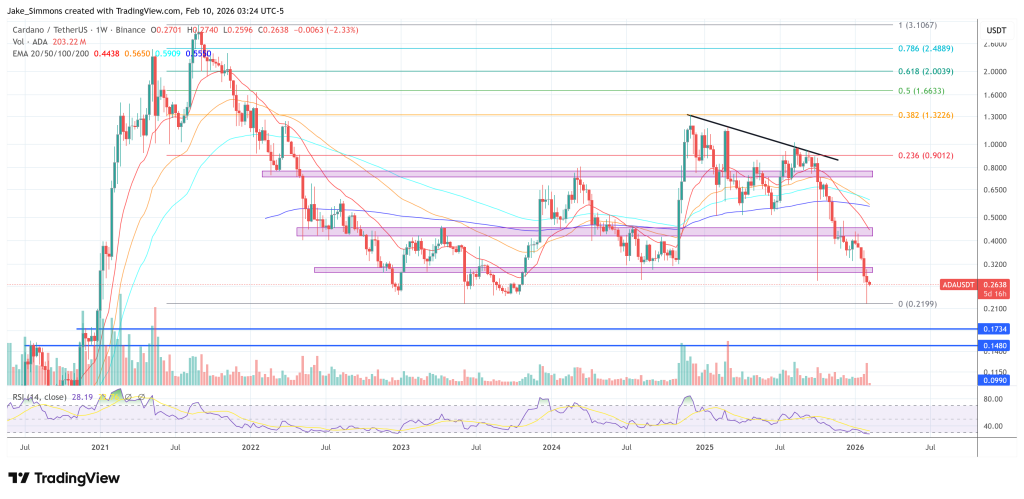
Featured image from YouTube, chart from TradingView.com

Editorial Process for bitcoinist is centered on delivering thoroughly researched, accurate, and unbiased content. We uphold strict sourcing standards, and each page undergoes diligent review by our team of top technology experts and seasoned editors. This process ensures the integrity, relevance, and value of our content for our readers.


