Good Morning, Asia. Here’s what’s making news in the markets:
Welcome to Asia Morning Briefing, a daily summary of top stories during U.S. hours and an overview of market moves and analysis. For a detailed overview of U.S. markets, see CryptoX’s Crypto Daybook Americas.
As Asia begins its trading day, all major cryptocurrencies are down due to market uncertainty as a result of an Israeli attack on Iran.
Early Friday Hong Kong time, Israel’s military conducted multiple airstrikes against Iranian nuclear facilities, sending the price of
and plunging.
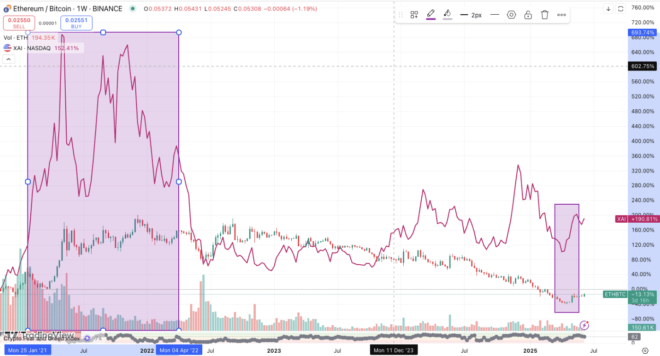
Despite this recent volatility, ETH is still up nearly 40% over the last three months, according to CoinMarketCap, beating the CryptoX 20 index and bitcoin
.
One theme that market observers are tracking is investors’ appetite for risk, and they might be looking at ETH’s rally not just because of the recent infrastructure upgrades but rather as a proxy for how willing they are to invest in altcoins.
Ethereum’s recent outperformance against bitcoin holds significance because ETH often acts as a leading indicator for capital flows into the wider altcoin complex, Charmaine Tam, Head of OTC, Hex Trust, said in a note to CryptoX.
“As investors become more comfortable venturing beyond BTC, altcoins offering compelling narratives and liquidity stand to benefit,” Tam said. “Ethereum’s performance often serves as an early indicator of these broader capital shifts.”
The recent surge in ETH dominance, from around 7 percent to nearly 10 percent, has coincided with a measurable drop in BTC dominance, which fell 2 to 3 percentage points from recent highs, Tam wrote in the note.
That divergence suggests traders are beginning to look past bitcoin ETFs and monetary hedging narratives, instead eyeing newer sectors like DeFi, modular infrastructure, and decentralized AI.
On-chain flows and total value locked (TVL) data support the trend, with assets like Pendle, Bittensor, and Hyperliquid showing strong inflows while Ethereum Layer 2 activity continues to climb.
The significant institutional interest further supports Ethereum’s recent strength, particularly with spot ETH ETFs attracting over $1.25 billion since mid-May, Tam said.
As long as institutional interest remains robust and ETH maintains its position as the anchor for liquidity in emerging ecosystems, the foundation for a sustained altcoin rally becomes increasingly solid, according to Tam.
Let’s see if this market move has legs.
MAS’ Offshore Exchange Ban Was a Long Time Coming
Last week, the Monetary Authority of Singapore (MAS) put the final nail in the coffin for firms using the city-state as a paper base while operating entirely overseas.
In a June 6 update, MAS confirmed that digital token service providers (DTSPs) serving only foreign clients will need to be licensed starting June 30, and Bitget, Bybit, and other exchanges like WazirX are shutting down operations in the Lion City.
To anyone paying attention, this was inevitable. MAS has been telegraphing this move since at least 2023, as CryptoX wrote at the time.
That year, the regulator concluded public consultations stemming from the 2022 Financial Services and Markets Act (FSMA), stating clearly that companies offering crypto services to clients abroad, even if they had no Singaporean customers, would fall under its regulatory umbrella.
If an entity is registered in Singapore, MAS wants oversight. This could stem from the fact that the regulator’s two previous largest headaches—Three Arrows Capital and Terraform Labs—had little connection to the country aside from an address.
Both now bankrupt firms were technically domiciled in Singapore, but their physical presence was negligible.
Terraform Labs famously operated from rented co-working spaces with no significant local operations, while Three Arrows was already quietly relocating its operational base to Dubai even before its spectacular collapse (although the Emirate’s regulator told CryptoX then that the fund never registered in the territory).
At the time, MAS found itself in an unenviable position: bearing reputational damage from these high-profile disasters yet having minimal real-world oversight of the companies behind them (eventually, the fund’s founders were given a multi-year trading ban in Singapore).
While there hasn’t been any official confirmation, the recent updates to the FSMA and MAS’s latest moves could be tied to these episodes.
The new requirement leaves virtually no room for regulatory arbitrage: if companies wish to use Singapore’s respected name, they must submit fully to its regulatory oversight.
This closure marks a significant step in a broader global shift towards tighter crypto oversight.
Quranium Debuts Quantum-Safe Wallet as Industry Braces for Quantum Threats
Quranium, the team behind a quantum-secure Layer 1 blockchain, has launched QSafe Wallet, a crypto wallet built to withstand the looming threat of quantum computing.
Designed with post-quantum encryption in mind, the wallet aims to future-proof digital asset storage before quantum threats can compromise today’s cryptographic standards.
QSafe is built using SLHDSA and ML-KEM, two algorithms selected by the U.S. National Institute of Standards and Technology (NIST) for their post-quantum resilience.
It supports Bitcoin, Solana, EVM-compatible chains, and Quranium’s native chain. Unlike most wallets still using ECDSA and SHA-256, QSafe encrypts backups and signs transactions with quantum-resistant tools by default.
The threat is no longer purely hypothetical. Cryptography researchers estimate that breaking ECDSA would require around 1,500 logical qubits. While current quantum systems remain well below that threshold, development is accelerating.
“QSafe isn’t just reacting to the quantum threat, it’s architected to withstand it,” Dhiman said. “You don’t hire a security guard after the theft has happened. You hire one to prevent it. QSafe is designed to protect your assets before quantum threats ever reach your keys.”
Market Movements:
- BTC: Bitcoin is down 4.7% and trading at $103.3K due to geopolitical tensions from a recent Israeli attack on Iranian nuclear facilities in Tehran.
- ETH: ETH remains under pressure within a descending channel after repeated rejections at $2,770, culminating in a sharp sell-off to $2,694, even as institutional demand holds firm with U.S. spot ETFs recording 18 consecutive days of inflows, including over $240 million on June 11.
- Gold: Gold surged over 3% to $3,426.95, hitting a one-week high as Middle East tensions and soft U.S. data boosted expectations of Fed rate cuts.
- Nikkei 225: Asia-Pacific markets fell Friday after Israel launched a military strike on Iran’s nuclear program, with Japan’s Nikkei 225 down 1.28% and the Topix losing 1.22%.
- S&P 500: The S&P 500 rose 0.38% to close at 6,045.26 on Thursday, driven by a 13% surge in Oracle shares after strong earnings and bullish cloud growth guidance lifted tech sector sentiment.