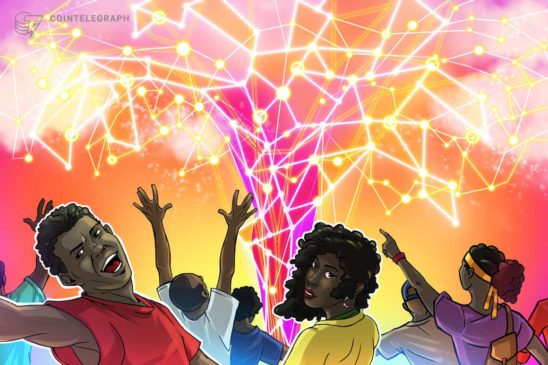
February is Black History Month, and it’s worth recounting that cryptocurrency and blockchain technology have already had a significant impact on the African-American community.
Peoples of color own cryptocurrencies at consistently higher levels than white people, surveys show, while anecdotal evidence suggests crypto has also unleashed a wave of innovation and entrepreneurial energy in the Black community — from New York City’s new mayor converting his first paycheck into crypto to basketball star Kevin Durant launching a new special-purpose acquisition company to focus on cryptocurrencies and blockchain.
And all this may just be scratching the surface. “Blockchain has the potential to be a beacon of light in the story of Black economic empowerment,” Marco Lindsey, associate director of diversity, equity and inclusion at the University of California Berkeley’s Haas School of Business, told Cointelegraph.
Cryptocurrencies and blockchain enterprises with their special qualities that can turn users into owners and owners into users align with historic Black aspirations such as financial independence and security, University of Kansas professor and historian Nishani Frazier told Cointelegraph, adding:
“They can enable the Black community to lift itself up in the philosophical sense of Black empowerment.”
These “powerful possibilities,” as Frazier described them, are exciting — and not just in the United States. In the global context, crypto continues to be, at least in part, about disenfranchised peoples participating in mainstream economic life, often for the first time.
Banking the unbanked
It’s sometimes forgotten, after all, that 1.7 billion people globally remain unbanked, underbanked or lack access to traditional financial systems, Cleve Mesidor, public policy advisor at the Blockchain Association, told Cointelegraph. For this group, sometimes living in countries with high inflation and lacking confidence in their local fiat and central bank, cryptocurrency represents “economic empowerment and an opportunity for financial freedom.”
Cryptocurrencies and blockchain technology “allows greater access to populations typically left out of traditional markets,” agreed Lindsey. It enables “anyone with an internet connection and some capital to invest” to participate in a vital, emerging technology scene, including seed-stage investment opportunities.
It’s natural to celebrate these developments — especially during Black History Month — but by the same token, one can’t ignore the “flip side,” either, said Frazier. “As much as I enjoy cryptocurrency as a Black person, I can not afford to live in a utopian bubble, and say, ‘Cryptocurrency: Hurray! Equality!’ It’s very complex.”
The technology can be opaque, even for those with technical backgrounds, and crypto remains an extremely volatile investment. Hackers and fraudsters populate the cryptoverse as well. The Black financial experience in America, too, is rife with exploitation.
Frazier recalled that years ago, insurance companies wouldn’t provide insurance to Black people, especially in the U.S. South. Some larger companies eventually began to offer “penny insurance” — where a person might “pay a little at a time” for a policy — burial insurance, for example.
But “those companies were notorious for taking your money and disappearing,” recalled Frazier. “They preyed upon the Black community.” Her point is that even in these more enlightened times; crypto is still risky; people can still get hurt; and one can’t overlook the downside of things.
Others, like The New School economist Darrick Hamilton, have noted that Bitcoin (BTC) is a high-risk, high payoff alternative. “In the end, it’s a casino,” he told Time Magazine.
Lindsey agreed about the risks and added that vigilance will be needed to maintain inclusion moving forward. An ongoing education process is required, including a focus on individuals and small businesses from underserved communities. Otherwise, “the industry runs the risk of replicating the inequities we see in more traditional sectors.”
“More diverse investors”
As noted, surveys reinforce the notion that crypto resonates with people who, for various reasons, have been excluded from the dominant economic system. A Harris poll last year found that 23% of African-Americans own cryptocurrency, for example, compared with only 11% of white Americans.
According to researchers from the National Opinion Research Center (NORC) at the University of Chicago, “the average cryptocurrency trader is under 40 (mean age is 38) and does not have a college degree (55 percent). Two-fifths of crypto traders are not white (44 percent), and 41 percent are women. Over one-third (35 percent) have household incomes under $60,000 annually.”
“Cryptocurrencies are opening up investing opportunities for more diverse investors, which is a very good thing,” said NORC’s Angela Fontes, while Lindsey added, “African Americans are already early adopters in the sense that we invest in crypto at a rate twice that of our white peers.”
This user profile is a departure from that of the typical stocks-and-bonds investor, Campbell Harvey, a finance professor at Duke University’s Fuqua School of Business, told Roll Call. Crypto users tend to be younger and more likely to include Latinos or Black people. “This idea of bypassing the traditional financial institutions is quite intriguing for a segment of the population that’s largely not welcome in our traditional centralized finance,” Harvey said.
Lindsey echoed this last point. “In the [U.S.] banking industry, African Americans for many years were not given access to business or home loans despite being just as financially solvent as many of their white counterparts,” while in other instances:
“African-American borrowers were charged significantly higher interest rates than whites. This caused many African Americans to lose trust in the traditional banking and investing system.”
According to Frazier, this movement toward crypto and blockchain is consistent with the “long arc of Black history with aspirations to be financially independent, financially secure” — and also the desire to be entrepreneurs.
Back in the late 1960s, she noted, the Congress of Racial Equality, among others, was agitating at the community level for the idea that laborers could also be owners of a home or a business — i.e., developing a second income and along with some financial security.
Thus, emerging technologies such as Web3, decentralized finance and decentralized autonomous organizations — that break down traditional barriers among workers, consumers and shareholders — resonate with many African Americans, including Frazier’s 80-year-old father, who for years fought for economic development in Cleveland, Ohio. “He gets it [crypto],” she told Cointelegraph.
“Our message has been, ‘Become early adopters and change the playing field by being producers, not consumers,’” added Mesidor, who also leads the National Policy Network of Women of Color in Blockchain.
White and male — still?
Still, inclusion is not found uniformly through the cryptocurrency world. The software development area remains — to a significant degree — the province of white males, for instance.
“Yes, it is a concern,” commented Lindsey. “It is extremely homogeneous, particularly at the leadership levels.” Tech leaders must be ready to hire managers who are prepared to work with affinity groups of color to develop new talent, and then train talent for those anticipated new roles, he said, further explaining:
“The predominately white male tech sector leans too heavily on nepotism to find new talent and often lacks creativity in imagining what a qualified candidate might look like.”
Many candidates of color have transferable skills and real-world experience that could greatly benefit an organization, Lindsey added, but “they are overlooked because they don’t fit the traditional mold.”
Meanwhile, Mesidor’s Women of Color in Blockchain group is pressing to develop not just crypto users but also software and hardware developers, as well as miners and stakers. Communities of color have also been encouraged to create crypto merchant accounts for e-commerce businesses and nonprofits to access a new consumer base. As Mesidor told Cointelegraph:
“They are leveraging Web3 and decentralized autonomous organizations and capitalizing on nonfungible tokens to protect intellectual property and monetize their work.”
Black entrepreneurs need more resources to build out what they’ve begun, said Mesidor, including access to capital for micro-enterprises and investment in skills training. These are “vital to ensure America stays competitive in the innovation economy.”
The African-American community has been actively engaged in the education challenge, according to Mesidor. “Over the last decade, it has been innovators of color in crypto that have launched education campaigns and built products and services to dismantle long-standing economic inequities in urban and rural areas here in America,” she continued. “The efforts of Black and Latinx industry leaders is the reason why crypto adoption in communities of color leads the nation by double digits.”
Assuming leadership roles
In sum, those who have historically been shut out of centralized, legacy finance — who can’t get a loan, or buy a house, or start a business — and “who may not have even had official government-issued identification” now have access to “new instruments for payments, sending money (remittances) and the capacity to transact in the global marketplace for the first time,” Mesidor noted.
But more needs to happen before real change occurs. “The Black community will need to quickly recognize the value and opportunity that blockchain provides and get involved in the industry at all levels,” said Lindsey, while leaders in the crypto and blockchain space will have to ensure “that Black and brown communities have equal access to not only the technology but also access to leadership roles, market trends, data and analytics.”