While the facts surrounding this global IT outage are still being determined, one thing is clear: centralization can have serious consequences.
On June 19, the world was rocked by an extensive and unprecedented outage — with countless Windows computers rendered useless by the dreaded “blue screen of death.”
The disruption proved widespread, with businesses and consumers in India, Germany, Australia, Spain, the U.K., and the U.S. just some of those affected.
Flights were grounded, supermarkets were unable to accept cash, TV news channels fell off the air, and some hospitals even declared critical incidents.
Six U.S. states saw their 911 lines go down, banking websites were out of action, and governments scrambled emergency teams to deal with the fallout.
At this stage, it doesn’t seem like a malicious cyberattack was to blame for this staggering fault that’s brought many of the digital services we all take for granted to their knees.
Instead, it appears to all be linked to a software update from an IT security firm called CrowdStrike — a company that’s meant to prevent breaches and hacks from happening.
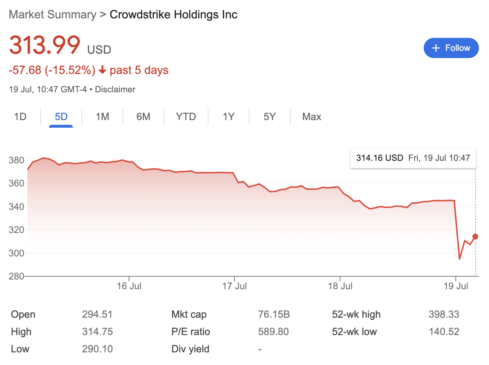
Microsoft was quick to claim that it wasn’t to blame — and when markets opened on Wall Street, CrowdStrike’s share price was down 15%, wiping $12.5 billion off the company’s value.
But there’s a few people who will be feeling pretty smug that they haven’t been caught up by the chaos: primarily Mac and Linux users who were able to keep working as normal.
It’s also telling that crypto firms were unaffected — and while the facts surrounding this outage are still being determined, one thing is clear: centralization can have serious consequences.
The fact that so many critical pieces of infrastructure were reliant on the same software painfully exposes what can happen when one minor thing stops working as it normally does.
By contrast, blockchains are decentralized — meaning there’s no single point of failure, and blocks could be verified by miners and validators as usual.
We’ve gradually started to see a small number of businesses start to embrace blockchains, and that number may increase following today’s debacle.
Reaction from the crypto community was swift and brutal — with X CEO Elon Musk leading the charge by describing it as the “biggest IT fail ever.”
And, somewhat inevitably, there’s also been a surge in activity surrounding memecoins — with the catastrophic error leading to a flurry of new tokens being created.
What were they called, we hear you ask? CrowdStrike and bluescreenofdeath.
Will lessons be learned?
It’s fair to say that this is the biggest outage since at least 2017, when the WannaCry ransomware attack hit more than 300,000 computers.
But for many customers with old-fashioned bank accounts, such disruption and technical issues happen with pretty alarming regularity.
Banking apps and websites have been known to fall over at short notice — often coinciding with payday — leaving countless consumers unable to pay bills.
By comparison, Bitcoin has managed to achieve 100% uptime over the past 11 years — with just two minor bouts of disruption reported since launch in 2009.
The bigger worry now is that this is an outage that might not be fixed quickly, with CrowdStrike admitting that efforts to sort the issue out will take “some time.”
Computers that suffered the dreaded blue screen of death may need to be worked on by specialists — and according to Microsoft, one surreal fix that seems to address the problem involves rebooting PCs 15 times.
Meanwhile, there’s going to be a lasting fallout for businesses. Some workers haven’t received their salaries on time — and it could take many days to untangle the impact on the aviation sector, with passengers delayed and planes in the wrong place.
That’s of particular annoyance to travelers over in the U.K. Why? Because all of this coincided with what was expected to be the busiest day of the year for air travel as the summer holidays for school children begin.
There’s little doubt that governments and large corporations will be hoping to learn lessons from this outage — and ensure there are contingency plans in place should something like this happen again.
Given we’re in an increasingly digitized and interconnected world, that now seems like a matter of when, not if.


