
The latest Glassnode report focuses on the topic of the day: bitcoin mining. While bitcoin’s price has been suspiciously flat for a while, the difficulty adjustment came in and registered an all-time high. Do the miners know something we don’t? Or is there a transfer of power going on behind the scenes? Glassnode poses a working theory on their latest The Week On-Chain. To begin with, Glassnode puts the difficulty adjustment into perspective:
“Bitcoin hashrate has reached a new all-time-high of 242 Exahash per second. To give an analogy for scale, this is equivalent to all 7.753 Billion people on earth, each completing a SHA-256 hash calculation approximately 30 Billion times every second.”
The thing is, we’re in a bear market. The sentiment is fearful. There’s trouble brewing everywhere in the world and bitcoin has been boring for a while now. What could be the reason for a hashrate all-time high? Is it, as Glassnode theorizes, “a new dynamic as more of the hashpower is held by better capitalised publicly traded mining companies”? Or is it just the game theory behind bitcoin at work? Remember that mining revenue is also down and the cost to produce one bitcoin is going up in tandem with electricity prices.
Making the situation more volatile, the miner revenue’s bitcoin is at a low point. This “should, in theory, create elevated income stress on the mining industry.” Add bitcoin’s stable prices to that equation and, what do we have? “It is extremely rare for BTC prices to stay so stationary for long, suggesting heightened probabilities of volatility on the horizon.”
Bitcoin Hashrate All-Time High | Source: The Week On-Chain
Bullish Signal: Bitcoin Hash-Ribbons Unwind
According to Glassnode, “the Bitcoin hash-ribbons commenced an unwind in late August, providing an indication that mining conditions were improving, and hashrate was coming back online.” What does this mean and why is it bullish, though? “Almost all historical hash-ribbon unwinds have preceded greener pastures in the months that followed.”
According to Glassnode, since bitcoin’s price is still flatlining, the “hashrate rise is due to more efficient mining hardware coming online and/or miners with superior balance sheets having a larger share of the hashpower network.” That’s the base of Glassnode’s takeover theory.
Glassnode Proposes “The Mining Halving” Concept
Another of their wild theories, Glassnode poses that “a 66% increase in Difficulty and Hashrate since Oct-2020 corresponds to an approximate halving in revenue per hash.” And to support that, they provide these numbers: “the revenue earned per Exahash has been in a persistent and long-term downtrend, with the BTC-denominated reward currently at an all-time-low of 4.06 BTC per EH per day.”
So, if miners are getting destroyed by market conditions, why is the hashrate recording all-time highs? The answer might lie with the Puell Multiple, “which is a cyclical oscillator that compares the current daily mining revenue to their yearly average.” According to this indicator, the mining business is actually gaining ground against previous performance.
“The Puell Multiple hit the current lows of around 0.33 in June, indicating that miners were earning just 33% of their yearly average revenue. It has since recovered to around 0.63, implying a degree of stress relief, and adjustment to this new pricing regime.” According to Glassnode, this relief might mean that “a true bear market low is established.”
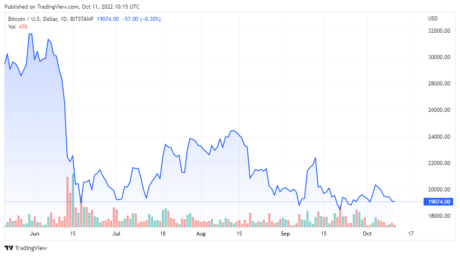
BTC price chart for 10/11/2022 on Bitstamp | Source: BTC/USD on TradingView.com
Glassnode Thinks There’s Still Capitulation Risk
Let’s be clear, bitcoin is walking a tightrope at the moment. The market is about to break and the pendulum could swing either way. Even though there are reasons to be optimistic, the smart investor should prepare for the worst. “By numerous models, we estimate that the average cost of BTC production hovers just below current prices, such that any significant price decline could turn an implied income stress, into acute and explicit stress.”
To assess the risk, Glassnode determined “the aggregate size of miner balances” to 78.4K BTC. The owners of those reserves “may come under income stress,” but “It is extremely unlikely this full amount would be distributed.”
And that’s where we stand at the moment.
Featured Image by Icons8_team from Pixabay | Charts by TradingView and The Week On-Chain


