
A recent warning from the Financial Action Task Force (FATF) about the rise of stablecoin-related crimes does not pose a threat to the cryptocurrency industry, according to executives at blockchain intelligence firms.
The FATF’s call to address rising illicit stablecoin activity reflects the need for close monitoring and analysis rather than aiming to curb their growth, according to executives at Chainalysis and Asset Reality.
The global financial crime watchdog sounded the alarm on stablecoins last Thursday, asking regulators to focus on mitigating the risks behind their potential mass adoption.
“That’s not anti-crypto. It’s a recognition that credibility and growth depend on regulation that actually works,” Asset Reality co-founder Aidan Larkin told Cointelegraph.
Stablecoins make up 63% of illicit crypto transfers
“Stablecoins are the dominant form of cryptoasset for transacting value as well as for undertaking illicit activity,” Chainalysis policy adviser Jordan Wain said. He cited data from the “2025 Crypto Crime Report” by Chainalysis, which identified that 63% of all onchain illicit transaction volumes were denominated in stablecoins.
According to Wain, the FATF’s alarm on stablecoins aims to promote “more uniform licensing and supervision of stablecoin issuers” across countries, deployment of real-time monitoring, and closer international collaboration to track, identify and disrupt illicit flows.
“[The] FATF isn’t calling for a ban on stablecoins. It is calling for visibility and better enforcement,” Asset Reality’s Larkin said, adding that this fits in with the broader strategy announced in 2023 for increased focus on asset recovery.
“That means applying the same AML [Anti-Money Laundering] standards used in traditional finance to the digital world,” Larkin added.
Tracking crimes is only part of the equation
Larkin said that applying advanced blockchain intelligence tools is not enough for mitigating risks behind a mass adoption of stablecoins.
“Monitoring onchain behavior is only part of the equation,” he said, adding:
“Enforcement in the form of secondary sanctions has been debated by politicians in multiple jurisdictions to place more onus and responsibility on those crypto entities that knowingly facilitate sanctions evasion and use secondary sanctions to pressure compliance […]”
Chainalysis’ Wain also highlighted stablecoins’ inherent transparency and traceability, often making them a “poor choice” for any criminal activity. He stressed that centralized stablecoin issuers also retain the ability to freeze funds when they become aware of their illicit use.
Related: Tether blocks $12.3M in USDT tied to suspicious Tron addresses
“We have seen this capability used to great effect,” Wain said, referring to Tether freezing and seizing $225 million in its USDt (USDT) stablecoin connected to scam activity at the request of the US authorities in 2023.
ZachXBT flags millions in Circle’s USDC tied to DPRK
Following the FATF’s call for closer scrutiny of stablecoin use by the Democratic People’s Republic of Korea (DPRK), some blockchain investigators have been unpacking onchain data in search of insights.
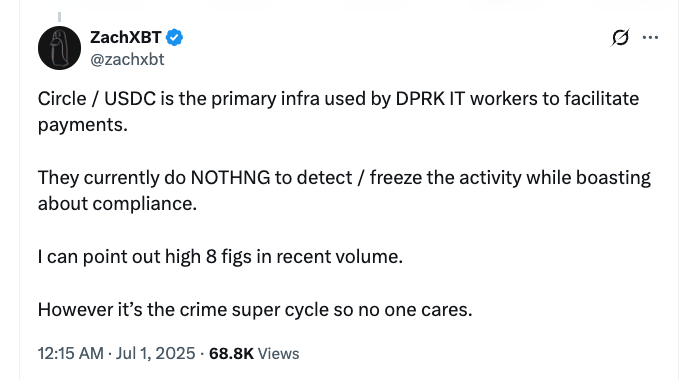
Crypto sleuth ZachXBT took to X on July 1 to claim that the public stablecoin issuer Circle and its USDC (USDC) stablecoin are the “primary infra used by DPRK IT workers to facilitate payments.”
“I can point out high eight figs [figures] in recent volume,” he said, adding that Circle “currently does nothing to detect or freeze the activity while boasting about compliance.”
Cointelegraph approached Circle for comment regarding the post by ZachXBT but did not receive a response at the time of publication.
Circle froze $57 million in USDC on Solana tied to the Libra team at the request of a US federal court in May.
Related: North Korea crypto hackers tap ChatGPT, Malaysia road money siphoned: Asia Express


