
Aave has shed more than 23% of its value since Friday, and the protocol that bills itself as DeFi’s most trusted lender is now managing the fallout from one of the most disruptive exploits in its history — even though its own code was never touched.
Related Reading
The attack unfolded through a bridge vulnerability rather than a flaw in Aave itself. Attackers exploited Kelp’s bridge to obtain $292 million in stolen rsETH, then used it as collateral on Aave V3. Because Aave had accepted rsETH as a legitimate collateral asset, the protocol had no way to reject the deposits in real time. By the time the damage was visible, the bad debt was already embedded in the system — approximately $196 million concentrated in the rsETH-wrapped ether pair on Ethereum.
The market reaction was swift and unambiguous. Total value locked on Aave dropped by roughly $6.6 billion as users moved to withdraw funds. Triggering the kind of confidence crisis that lending protocols fear most. A run on liquidity does not require the smart contracts to be broken — it only requires users to believe the risk is no longer worth taking.
The uncomfortable reality for Aave is that being technically not at fault has done little to stop the damage. The bad debt is real, the TVL is gone, and the protocol now faces questions it cannot answer with code.
On-Chain Data Confirms What the Price Already Suspected
A CryptoQuant report tracking Aave’s exchange reserves removes any ambiguity about what holders are doing. Spot trading reserves have spiked sharply — a pattern that in on-chain analysis almost always reflects distribution: holders moving tokens to exchanges with the intention of selling rather than holding through the uncertainty.
The underlying cause is clear. The $292 million rsETH exploit created approximately $200 million in bad debt on Aave V3 — a figure large enough to push the protocol’s utilization rate to 100%. When utilization hits that ceiling, the mechanics of the lending protocol work against users who want to exit. Borrowers struggle to repay, withdrawals face friction, and the feedback loop can accelerate the very panic it is trying to contain. The $6.6 billion TVL outflow is the market’s answer to that dynamic.
Aave remains the largest lender in DeFi by total value locked, and that scale provides some structural resilience. But the current situation is exposing something that size alone cannot fix: the protocol’s dependence on the integrity of the assets it accepts as collateral.
In the coming days, the critical variables are the pace of bad debt resolution and whether TVL stabilizes or continues declining. If the protocol can contain the $200 million hole without a governance crisis or further withdrawals, recovery becomes possible.
If utilization stays elevated and confidence continues eroding, a second wave of exits could extend the damage well beyond what has already occurred. For anyone with active positions, the next 48 to 72 hours will be the most telling.
Related Reading
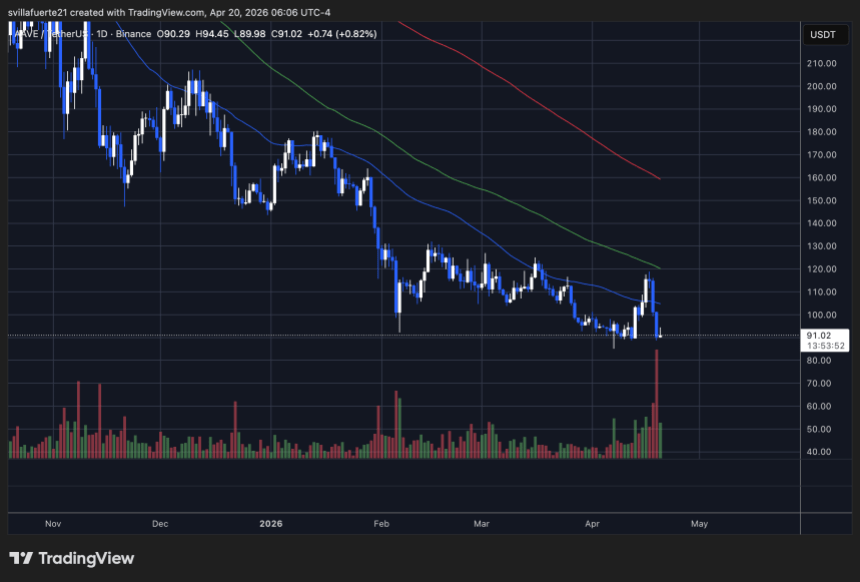
AAVE Faces Rejection As Downtrend Remains Intact
AAVE remains structurally weak despite the recent bounce, with price action still embedded in a clear downtrend that has persisted since late 2025. The chart shows a consistent pattern of lower highs and lower lows, reinforced by the positioning below all major moving averages. The 200-day moving average, sloping downward above price, continues to act as a long-term ceiling, confirming that broader momentum has not shifted.
Related Reading
Price is now sitting near a local support zone around $90, which has held multiple times in recent sessions. However, repeated tests of support typically weaken it. If this level breaks decisively, it opens the path toward lower liquidity zones, potentially accelerating downside.
For any constructive shift to develop, AAVE would need to reclaim the $110 area and hold above short-term moving averages. Until then, the structure remains bearish, and rallies continue to look corrective rather than the start of a sustained recovery.
Featured image from ChatGPT, chart from TradingView.com


