
Reason to trust
Strict editorial policy that focuses on accuracy, relevance, and impartiality
Created by industry experts and meticulously reviewed
The highest standards in reporting and publishing
Strict editorial policy that focuses on accuracy, relevance, and impartiality
Morbi pretium leo et nisl aliquam mollis. Quisque arcu lorem, ultricies quis pellentesque nec, ullamcorper eu odio.
Jack Mallers, founder of Strike, argued in a video shared on X that a structurally higher Bitcoin price is emerging as a necessary component of US fiscal management, linking the growth of stablecoins to demand for US government debt. Framing the newly introduced GENIUS Act stablecoin legislation as “a seminal moment for digital assets and global dollar dominance,” Mallers said that while the bill “has nothing to do with Bitcoin directly,” it is indirectly significant because stablecoin expansion and Bitcoin appreciation are, in his view, intertwined.
Bitcoin And Gold Must Rise To Avert US Fiscal Crisis
Displaying a chart of Tether’s market capitalization alongside Bitcoin’s price, Mallers told viewers: “In the green, what you’re looking at is Tether, Market Cap. And in the orange, what you’re looking at is Bitcoin… The currency pair that does the most volume against this asset class is USDT, is Tether… If you want stablecoins to grow, Bitcoin grows.” He then connected that relationship to federal financing: stablecoin issuers, especially Tether, hold large amounts of US Treasuries; therefore, a larger stablecoin float would translate into incremental structural demand for US debt.
Related Reading
Mallers described the United States as fiscally “trapped,” asserting: “We know that the US cannot raise rates and they cannot cut spending. So we are trapped. The next logical step is we then need to devalue the dollar. It’s the only way out.” The policy question, he continued, is what assets the dollar should be allowed to depreciate against. “Do not debase the dollar against housing… Don’t debase the dollar against eggs… My recommendation, debase it against Bitcoin and gold.”
Projecting a scenario in which Bitcoin reaches $500,000—“That’s 5x from here”—Mallers claimed such a move would force stablecoin capitalization to “5x,” producing “five times the amount of demand for US debt” at a moment when, he said, traditional foreign and domestic buyers are fatigued: “China doesn’t want your debt… Hedge funds don’t want your debt. Who’s the buyer of last resort? The Fed.”
He likened the prospective alignment of Treasury financing needs, Federal Reserve balance-sheet expansion, and stablecoin reserve composition to a previous historical episode: “The last time the Fed and the US government got married… was to help finance around the world wars. And the Fed’s balance sheet grew 10 times… largely in… T-bills, the things that stablecoins buy.”
Related Reading
With US debt-to-GDP “at 130%,” Mallers argued, reduction in real terms requires monetary debasement channeled into politically acceptable asset inflation. He extended the narrative into politics, highlighting that “The president and his family just bought $2 billion worth of Bitcoin” and policy moves such as opening “US retirement market to crypto investments.”
According to Mallers, positioning Bitcoin and gold inside retirement accounts will allow policymakers to “debase the dollar and get reelected,” because Bitcoin holders would not resist the erosion of purchasing power: “Debase the dollar all you want… I don’t care because I own Bitcoin.”
He concluded by restating the mechanism he sees emerging from the bill: “Stablecoins are the new way to finance the government, but they grow as Bitcoin grows. One way to grow stablecoins is to grow Bitcoin… One way to solve the Fed and the Treasury’s problem of getting remarried is to grow Bitcoin. It could not be more obvious.”
At press time, BTC traded at $118,055.
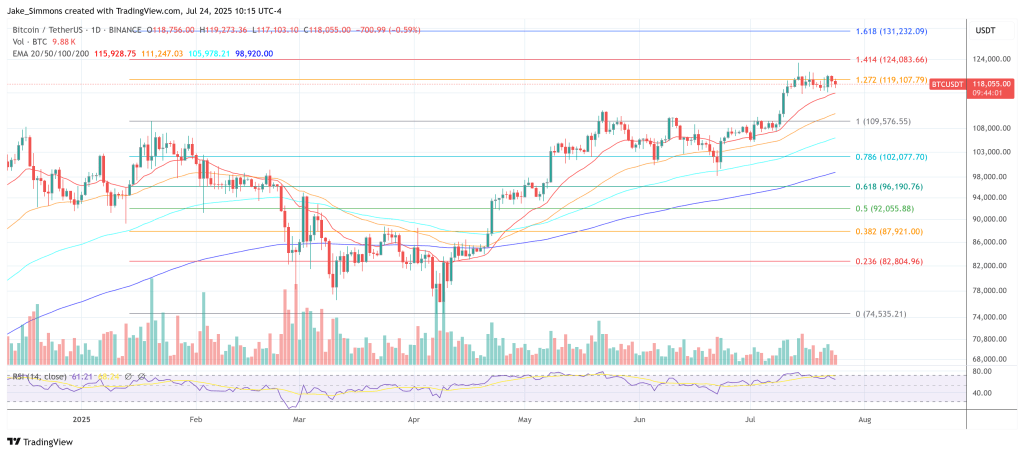
Featured image created with DALL.E, chart from TradingView.com