
Salvadoran President Nayib Bukele raised eyebrows among industry observers on March 4 when he said that his government’s Bitcoin purchases won’t stop, despite a requirement from the International Monetary Fund (IMF).
El Salvador struck a $1.4 billion loan deal with the IMF in January on the condition that it walk back Bitcoin (BTC) adoption and declassify it as compulsory legal tender.
On March 3, the IMF released a report outlining the terms of the agreement, noting that it would prohibit the public accumulation of Bitcoin — i.e., the government or government-controlled entities couldn’t buy Bitcoin or mine it. Bukele, seemingly defiant, said his country would continue accumulating Bitcoin anyway.
The apparent conflict between Bukele’s Bitcoin plans and the IMF’s terms has raised questions about the future of El Salvador’s Bitcoin accumulation and the potential fallout from a conflict with the lender.
Source: Nayib Bukele
Bukele’s recent Bitcoin buy doesn’t necessarily “conflict” with IMF deal
Among the many details contained within the collection of documents the IMF published on March 3, one particular clause caught the eye of Bitcoiners, namely that there will be “there will be no voluntary accumulation of Bitcoins by the public sector in the context of the program.”
Bukele took to X on March 4, stating that Bitcoin accumulation is “not stopping” as the country bought another coin to add to its national reserves.
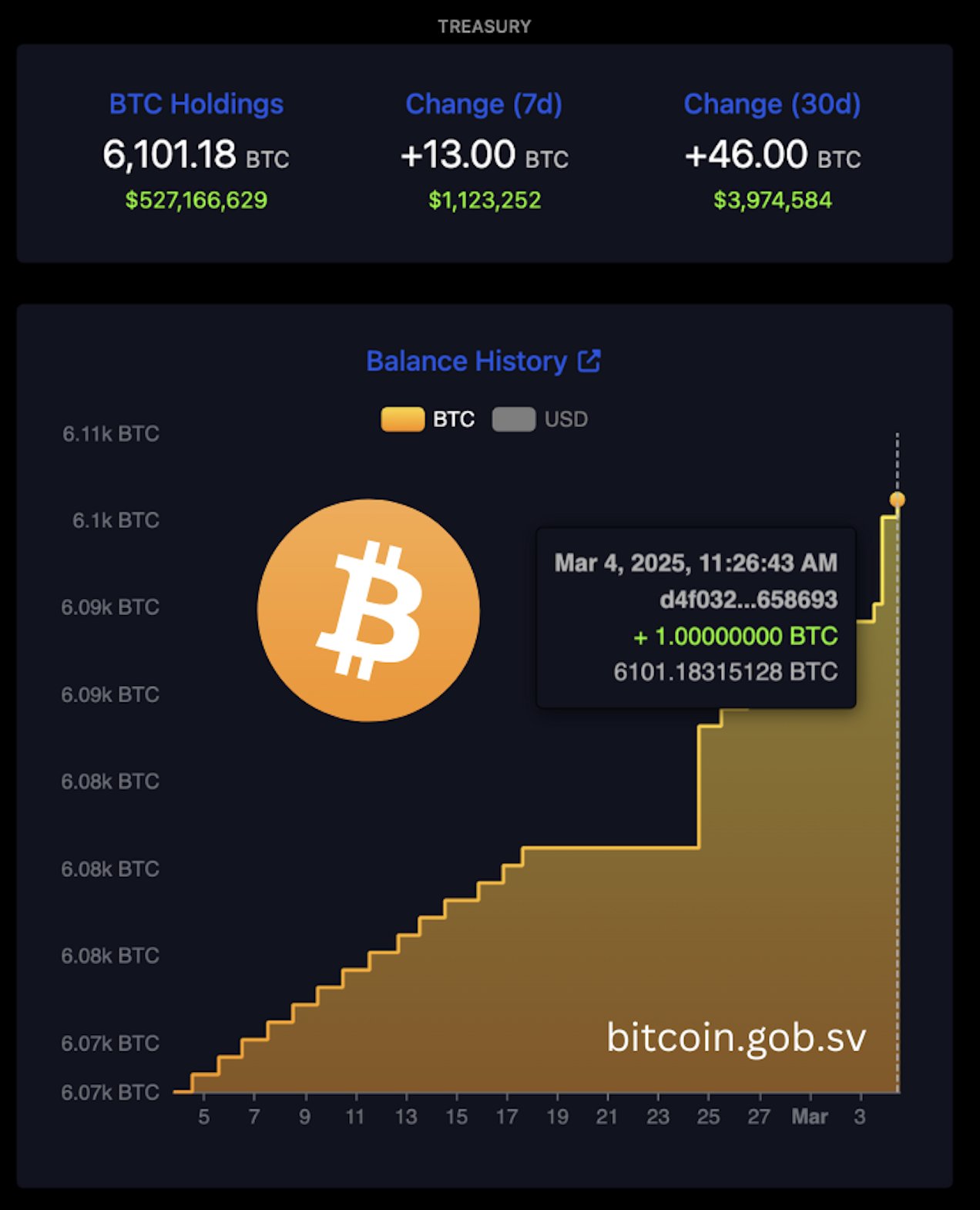
El Salvador buys another Bitcoin for its reserve on March 4. Source: National Bitcoin Office of El Salvador
The apparent contradiction caught the eye of Samson Mow, CEO of Bitcoin adoption advocacy organization Jan3, who stated in a March 5 post that the “two things seem to be in conflict with one another.”
The IMF’s requirement on public Bitcoin investment — and Bukele’s subsequent remarks — came as a shock to many.
But as John Dennehy, an El Salvador-based Bitcoin activist and educator, noted in a March 4 X Space with Cointelegraph, the changes the IMF required for the law have not yet gone into effect.
“The law, which was passed on Jan. 29 and published in the official gazette the next day, which rescinded Bitcoin as legal tender, goes into effect on April 30,” he said.
Related: Bitcoin, crypto firms move to El Salvador, but success rides on banking access
Unseen Finance, an anonymous finance commentator who claims to have previous experience at the IMF and in investment banking, said the Bitcoin purchases could be leftovers.
They suggested there could be “some remaining pools of funds, maybe allocated in the government in some subaccounts of different agencies, entities, maybe even some state-owned-enterprises, that had kind of been pre-allocated and set aside.”
Unseen Finance said in separate comments to Cointelegraph that El Salvador could be buying “a last few additional Bitcoin” as a way of appeasing the “‘whining’ Bitcoin posse out there and as some semblance of ‘save face.’”
According to Reuters, the IMF itself said that the purchase did not break the terms of the agreement, stating it had consulted the Salvadoran government on the matter.
“We consulted with the (Salvadoran) authorities, and they have assured us that the recent increase in Bitcoin holdings in the Strategic Bitcoin Reserve Fund is consistent with agreed program conditionality,” the IMF told Reuters.
Why did El Salvador make a deal with the IMF?
Despite claims of Bukele “defying” the IMF in a bid to stand up for Bitcoin adoption, commentators have noted that the Salvadoran government approached the IMF itself and agreed to the terms of the loan.
“El Salvador approached the IMF for the loan and not the other way around. Let me make that 100% clear. Policy will follow the text of the [loan agreement], nothing else,” said Unseen Finance.
With such strong rhetoric and publicity surrounding the country’s Bitcoin efforts, many market observers have questioned why exactly Bukele made the deal.
Dennehy said that “the rationale for entering into this agreement in the first place, as is made pretty clear by this document, is because they had to.”
He claimed that El Salvador’s national debt has increased “pretty significantly” over the last five years, but Salvadorans are “under the impression that the debt has either been steady or been decreasing.”

El Salvador’s national debt as a percentage of GDP. Source: World Bank
According to Dennehy, the government has “done a great job marketing” a debt buy-back, which it paid for by taking on mostly new debt at higher interest rates.
Unseen Finance said the economy was in “dire straits [and] continues to be in such dire straits. You know, poverty rising. A lot of elements.”
Related: Bitcoin isn’t a worthy reserve asset, Swiss National Bank president says: Report
The precarious economic situation, and the importance of the loan, means El Salvador can’t risk running afoul of the IMF. Unseen Finance said the government isn’t playing games or “pushing boundaries” with the IMF.
“They have no questions, and there is no absence of clarity, and they full well know that any clear step over that line will cause irreparable damage to the country. There is no choice.”
The impending deadline of April 30, the nominal amount of the recent Bitcoin buys, and the IMF’s comments to Reuters suggest that El Salvador has not violated the agreement and that the purchases aren’t a dealbreaker.
Still, per Unseen Finance, “regardless of the nominal activity, the IMF will have some sharp questions for these little games.”
Bukele’s exact intentions aren’t yet clear, but it appears he has little to gain from going head-to-head with the IMF over Bitcoin.
Magazine: Meet lawyer Max Burwick — ‘The ambulance chaser of crypto’


