
TL;DR
Spotting the next big crypto project before it explodes demands data, discipline and a sharp eye for real signals. This guide explores how to identify early winners by analyzing onchain metrics, tokenomics, dev activity and community traction while avoiding the common traps of hype-driven pumps and red-flag projects.
Despite the crypto space being crowded, fast-moving and full of noise, some investors manage to consistently find promising projects while they’re still under the radar.
So, how do they do it?
Crypto trendspotters know how to read onchain data. They understand tokenomics. They read GitHub commits and follow the money. It takes more than jumping on the hype bandwagon ahead of the crowd.
This guide breaks down how to find crypto projects with real potential using lessons from past winners like Solana, Arbitrum, Chainlink and even memecoins like Pepe. Along the way, it will highlight the tools that matter, red flags to avoid and the difference between organic growth and manufactured buzz.
How the real winners took off
Solana
When Solana launched in 2020, few outside of developer circles had heard of it. But it had one big edge: speed. Solana’s proof-of-history tech made it one of the fastest chains around, and it quickly became a magnet for builders, especially in DeFi and NFTs. By 2021, its ecosystem exploded with apps like Serum and Magic Eden.
Early adopters who paid attention to onchain growth — like wallet activity and DEX volume — could see something brewing. Solana (SOL) went from under $1 to $50+ in less than a year.
Arbitrum
Arbitrum launched in 2021 as an Ethereum layer 2, but its big moment came with the Arbitrum (ARB) token airdrop in March 2023. At launch, Arbitrum was already processing more transactions than many layer 1s and had billions in total value locked (TVL) in decentralized applications (DApps).
Smart investors were watching. Even before the token, the signs were there: user activity, rising liquidity and growing app adoption. When ARB dropped, the pump stuck because the foundation was real.
Chainlink
Chainlink is a classic example of a project with long-term utility. It doesn’t have flashy branding or meme power, but it does one thing incredibly well: feed real-world data into smart contracts.
By 2024, it had become the backbone of much of DeFi, gaming and even tokenized real-world assets. If you were watching closely in 2019-2020, you saw LINK (LINK) getting integrated everywhere. That kind of early utility often flies under the radar — until price action catches up.
PEPE Coin (PEPE)
Let’s not pretend memes don’t matter. Pepe (PEPE) launched in 2023 with no roadmap, no utility and no VC backing. But it hit a nerve, and the internet ran with it. The coin hit a billion-dollar market cap within weeks.
That kind of run is rare — and risky. But for traders tracking social sentiment, wallet distribution and community activity, the early signals were all there. PEPE didn’t promise anything, but it delivered returns by becoming a viral moment.
How to find crypto gems early
So, how do you separate the next Solana from the next rug pull? Here’s how serious trendspotters approach it.
1. Start with onchain metrics
Public blockchains are transparent. Use that to look at:
If users and capital are moving in — before the token moons — that’s a great sign. Tools like Dune Analytics, Nansen and DefiLlama are your best friends here.
2. Understand the tokenomics
Ask questions like:
-
What’s the total supply? How much is circulating?
-
Are there upcoming unlocks or vesting cliffs?
-
Who holds the tokens, and how concentrated are the top wallets?
-
Is there utility? Does the token do anything?
Tokens with capped supply, smart incentives (like staking or burn mechanisms) and fair distribution models tend to do better long-term.
3. Check developer activity
Is the team actually building?
GitHub is a goldmine. Look at how often code is pushed, how many contributors are active, and whether the repo looks alive. No updates for months? Big red flag.
You don’t need to read code — just track commits and releases. Projects with real traction are always shipping.
4. Look for ecosystem signals
Are other developers building on top of it? Are DApps launching? Is liquidity growing? Are users coming back week after week?
Ecosystem growth is hard to fake, and it’s often the strongest early indicator that a project has legs.
5. Follow the community
X, Discord, Telegram, Reddit — yes, it’s noisy. But it’s also where trends start. Look beyond the price talk:
-
Are people actually using the product?
-
Are devs answering questions?
-
Is the tone constructive or just hype?
Use LunarCrush or Santiment to track social momentum, but always double-check it with onchain data.
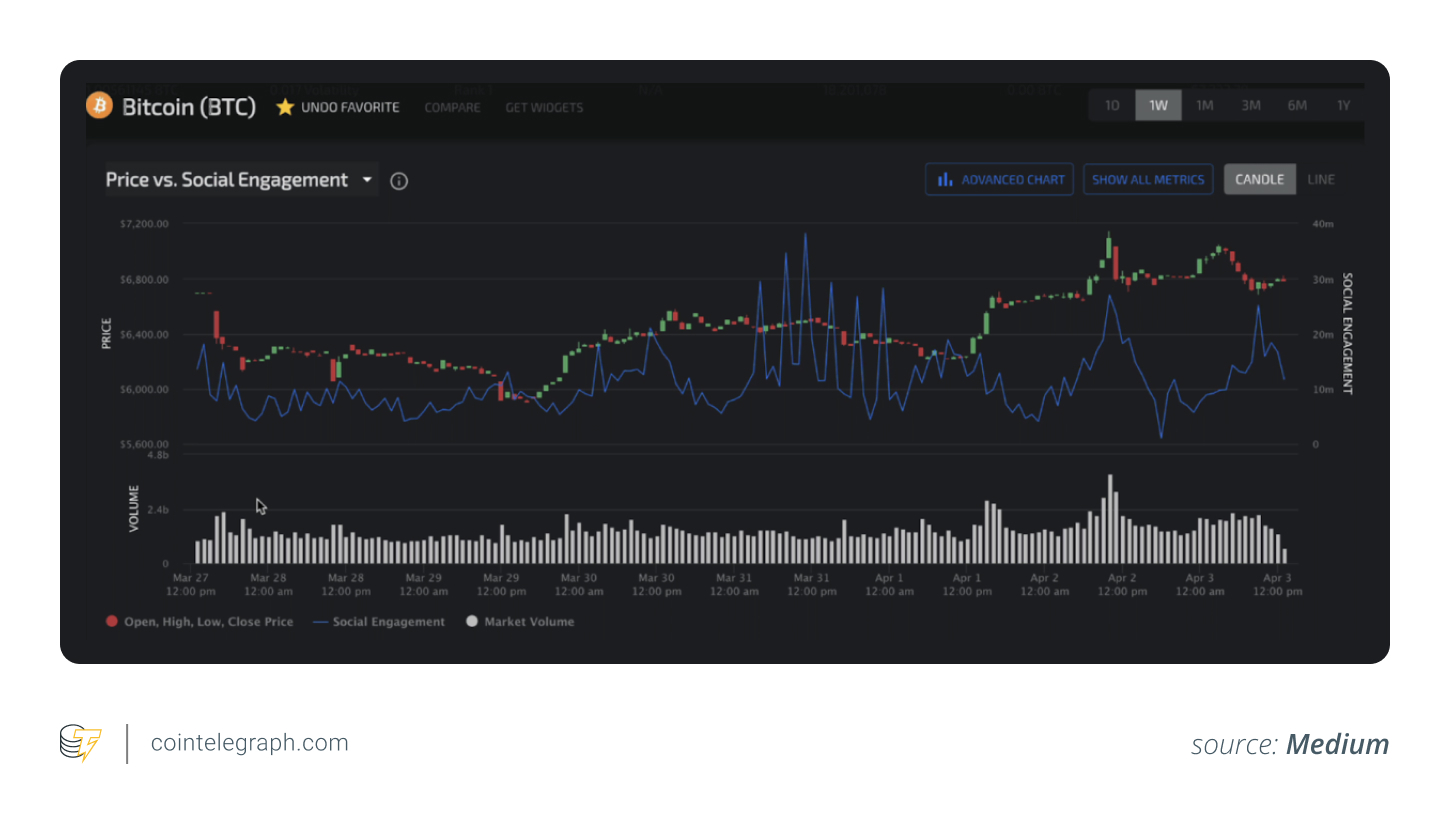
Key tools to spot crypto trends
Here’s a quick rundown of the top platforms used by smart crypto trendspotters:
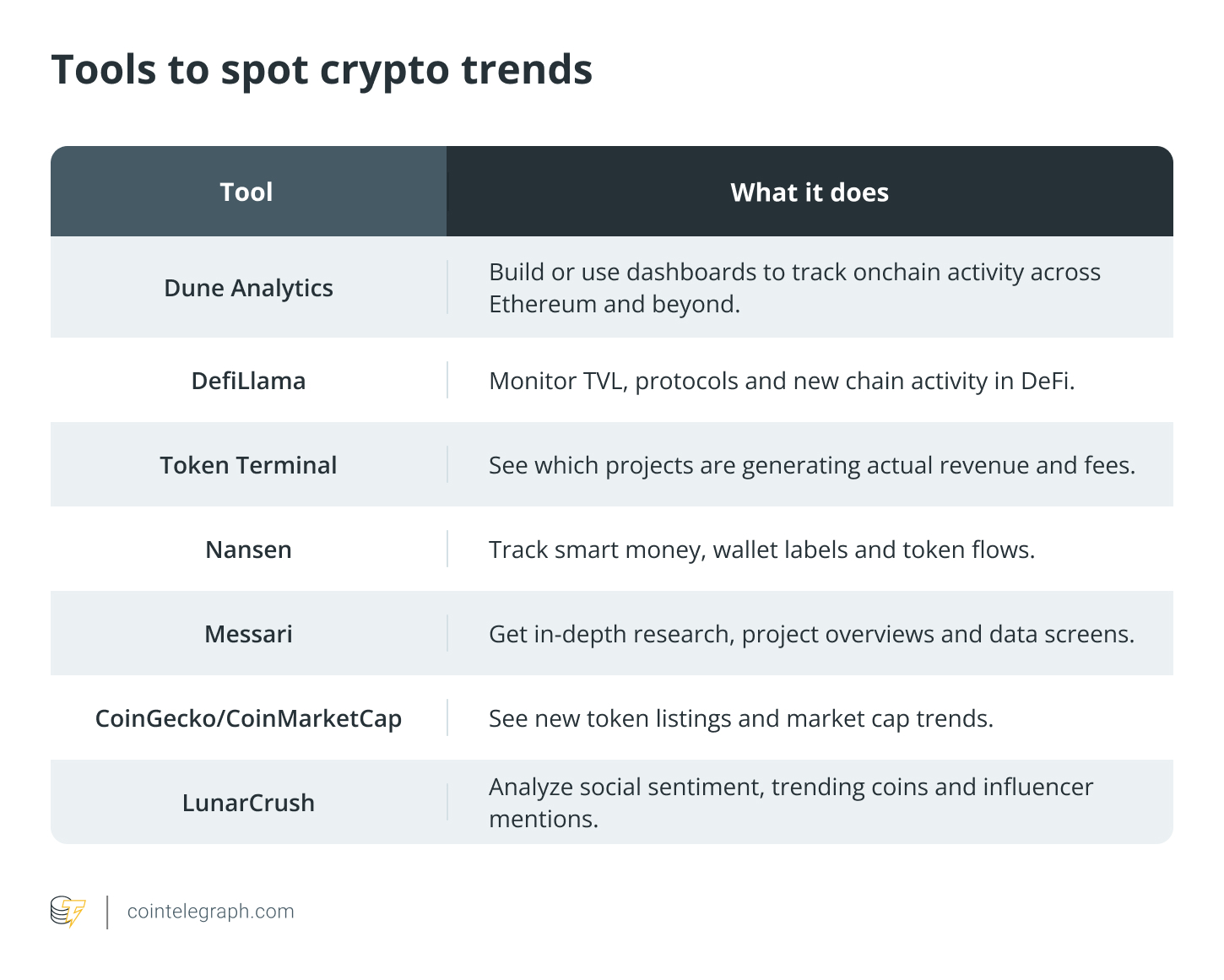
Top tip: Don’t just use one tool. Great traders cross-reference everything.
Crypto trend analysis 2025
A coin might be flying, but is it because people are actually using it or just talking about it? Learning to tell the difference can save you from making a bad investment.
Signs of real traction
-
Steady user growth and TVL over time: If users are showing up before a token pumps — and the numbers keep climbing week over week — that’s usually a sign of substance. You’ll often see this in DeFi protocols or layer 2s gaining trust slowly, not overnight.
-
Code commits and product updates: A live GitHub with regular commits, active devs and visible progress means the team is building. This shows momentum and long-term focus — not just a marketing push.
-
More tokenholders, less whale control: When new holders join steadily — and supply isn’t all locked up by the top five wallets — it’s a healthier setup. Distributed ownership reduces the risk of rug pulls or coordinated dumps.
-
New integrations and ecosystem activity: If other apps are integrating the token or building on the protocol, it usually means the tech is solid and useful. This kind of network effect compounds fast and often precedes a breakout.
-
Liquidity that builds slowly: Gradual increases in liquidity and trading volume tend to reflect real interest. If liquidity sticks around (rather than vanishing after a pump), it’s usually organic.
Signs of manufactured hype
-
Sudden spikes in social mentions or trading volume with no news: If the project is everywhere on X overnight, but there’s no product update, launch or roadmap shift, be skeptical. It’s likely a coordinated shill.
-
Influencer spam and recycled talking points: When you see multiple anonymous influencers posting the same meme or catchphrase, that’s a signal someone’s trying to manufacture buzz.
-
No dev activity or roadmap: If there’s no GitHub, no changelog and the team isn’t shipping anything, it’s probably just a hype machine.
-
Anonymous team, outrageous promises: Combine a mystery team with claims like “100x guaranteed,” and you’re likely looking at a cash grab. Real builders let the work speak for itself.
Rule of thumb: If the price is moving and everything else — users, devs, integrations — is standing still, you’re looking at hype. But when those fundamentals are quietly ticking up in the background? That’s when it’s worth a closer look.
More red flags
Some projects look great on the surface — slick websites, trending hashtags, a fast-moving chart — but fall apart under the hood. Here are some more red flags to watch out for:
-
High holder concentration: If most of the token is sitting in a handful of wallets, it doesn’t take much for a price crash. Whales often buy early and dump on retail.
-
Unverified token contracts: A token that hasn’t been verified on Etherscan or BscScan might hide functions that allow minting, blocking wallets or draining liquidity. Always check the contract or look for an audit.
-
No liquidity lock or audit: If the devs control all the liquidity provider tokens and there’s no lock or time-locked contract, they can pull the rug at any moment. Similarly, no third-party audit? That’s a gamble.
-
Big token unlocks coming up: Large unlocks for insiders or early investors can trigger huge sell-offs. If you’re holding during a major vesting event, you could be exit liquidity. Know the schedule.
Top tip: Before you click buy, ask, Who stands to gain the most if this pumps? Who gets hurt if it dumps? If the answer points to a few insiders with heavy bags and zero accountability, walk away.
How to spot crypto trends before the crowd
The best early investors are the mechanics looking under the hood. They study token structures and unlock schedules, join communities early to catch signals firsthand, and follow the builders to see who’s actually shipping.
Most importantly, they cross-check everything: on-chain data, social sentiment, developer activity, and liquidity. Tools like Dune, DefiLlama, Nansen and GitHub help them separate noise from substance — and spot winners before the crowd does.
Crypto rewards those who are curious, critical and a little bit contrarian. The crowd usually shows up late. If you want to find gems before they moon, you’ll need to think independently, dig deeper, and act before the narrative forms.
It’s not easy. But it’s doable. And the more you practice spotting early signals — the real ones, not the noise — the more second nature it becomes.
This article does not contain investment advice or recommendations. Every investment and trading move involves risk, and readers should conduct their own research when making a decision.


