
Iran is reportedly considering a plan to exercise control over the Strait of Hormuz through an “insurance-based model,” with some speculating, based on an unverified website, that it could be paid in Bitcoin.
On Saturday, Fars News Agency, an Iranian news outlet closely affiliated with the Islamic Revolutionary Guard Corps, reported that the Iranian Ministry of Economic Affairs plans to manage the Strait of Hormuz through insurance, citing a state document it obtained.
However, other reports say Iran is looking to take payments for the “insurance” in Bitcoin through a website called “Hormuz Safe,” with a widely circulated screenshot of the purported site selling “Secure Digital Insurance for Maritime Cargo.”
Source: Dennis Porter
Control over the Strait of Hormuz has been the leading issue in the US-Iran war. The shipping lane handles about one-fifth of the global oil trade. Many ships have been prevented from transiting the strait after the US started launching airstrikes in Iran in late February.
Media reports state that Iran collected its first revenue from tolls imposed on ships transiting the Strait last month. Prior to the US-Iran war, no such measures were in place.
Fars News said the insurance platform seeks to distinguish between transit vessels from different countries.
“Under the Economy Ministry’s plan, managing the Strait through an insurance framework would enable the issuance of various marine insurance policies as well as certificates of financial responsibility,” Fars News said, adding it could generate over $10 billion in revenue for the country.
There is no guarantee that Iran will go ahead with the insurance proposal, and the website purporting to offer “Iranian Digital Insurance” could be fake. The website was down at the time of writing.
Scammers have previously defrauded shipping companies operating in the Strait of Hormuz by demanding payment in cryptocurrency for safe passage.
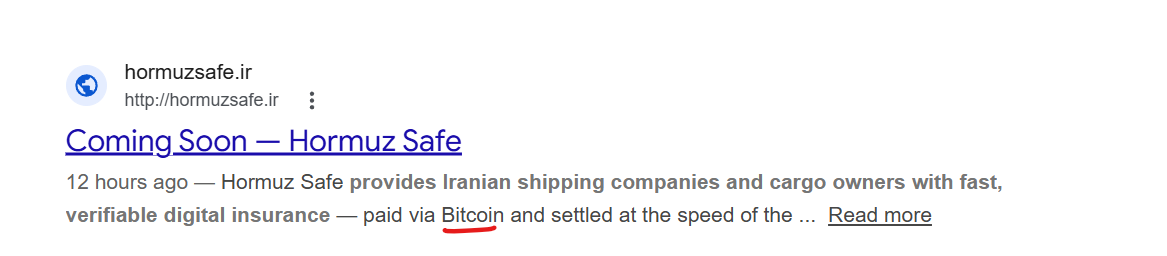
Description of Hormuz Safe seeking to accept shipper tolls in Bitcoin. Source: Google
US authorities recently seized Iranian USDT
Demanding insurance payments in Bitcoin could make sense, given that US authorities froze $344 million worth of USDT tied to Iran last month.
Earlier reports said Iran had been accepting oil tolls in US dollar-denominated stablecoins such as Tether USDt (USDT), as well as Bitcoin and fiat currencies such as the Chinese yuan, with USDT reportedly the preferred cryptocurrency.
Related: UAE investors buy AI dip, keep crypto exposure despite conflict
Industry leaders have touted Bitcoin as a more appropriate cryptocurrency for sanctioned countries because it is sufficiently decentralized and has no issuer capable of freezing funds.
In early April, a spokesperson for Iran’s Oil, Gas and Petrochemical Products Exporters’ Union said certain ships would be able to pass through the strait provided that they pay a tariff of $1 per barrel of oil in Bitcoin.
“Once the email arrives and Iran completes its assessment, vessels are given a few seconds to pay in Bitcoin, ensuring they can’t be traced or confiscated due to sanctions,” they said at the time.
Magazine: Adam Back says current demand is ‘almost’ enough to send Bitcoin to $1M


