
Crypto’s latest sell-off isn’t just a price story. It’s showing up on balance sheets, inside spot exchange-traded funds (ETFs) and even in how infrastructure gets used when markets turn.
This week, Ether’s (ETH) slide is leaving treasury-heavy companies nursing massive paper losses, while Bitcoin (BTC) ETFs are giving a new wave of investors their first real taste of downside volatility.
At the same time, extreme weather is reminding miners that hash rate still depends on power grids, and a former crypto miner-turned-AI darling shows how yesterday’s mining infrastructure has quietly become today’s AI backbone.
This week’s Crypto Biz newsletter breaks down BitMine Immersion Technologies’ widening paper losses, BlackRock Bitcoin ETF investors slipping underwater and the impact of a US winter storm on public miner production.
BitMine’s ETH paper losses widen
BitMine Immersion Technologies, chaired by Tom Lee, is facing mounting paper losses on its Ether-heavy treasury as ETH slid below $2,200 during the latest crypto sell-off.
The decline has pushed the company’s unrealized losses past $7 billion, underscoring the risks tied to balance sheets built around volatile digital assets.
BitMine currently holds about $9.1 billion worth of Ether, including a recent purchase of 40,302 ETH, leaving the company highly exposed to further price swings.
While the losses remain unrealized unless assets are sold, they highlight the fragility of crypto treasury strategies when markets turn lower. Lee has pushed back on the criticism, arguing that unrealized losses are inherent to ETH-holding companies. “BitMine is designed to track the price of ETH,” he said, adding that in a downturn, ETH weakness is to be expected.
BlackRock Bitcoin ETF holders slip underwater
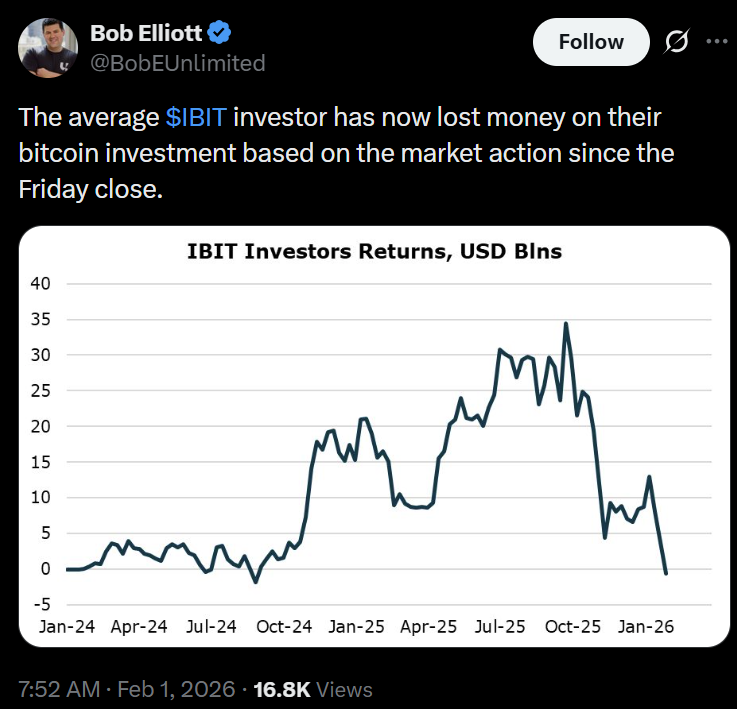
As Bitcoin crashed below $80,000, aggregate returns for investors in BlackRock’s iShares Bitcoin Trust (IBIT) turned negative, highlighting the depth of the recent selloff and its impact on investor portfolios.
According to Unlimited Funds chief investment officer Bob Elliott, the average dollar invested in IBIT is now underwater. Bitcoin has since extended its decline below $75,000, adding further pressure to returns.
IBIT was one of BlackRock’s most successful ETF launches, becoming the asset manager’s fastest fund to reach $70 billion in assets. Those investors are now getting a firsthand lesson in Bitcoin’s volatility, especially when price action moves decisively to the downside.
US winter storm slams Bitcoin production
A powerful winter storm sweeping across the US in late January forced Bitcoin miners to sharply curtail production, underscoring how sensitive mining remains to energy grid stress during extreme weather.
New data from CryptoQuant shows daily output from public miners averaged about 70 to 90 BTC before the storm, then plunged to just 30 to 40 BTC at the height of the disruption. The drop was abrupt, reflecting widespread shutdowns as miners reduced load or went offline to avoid strain on local power grids.
The slowdown proved temporary. As weather conditions improved, production began to recover, highlighting the flexibility miners retain but also the volatility introduced by grid-dependent operations.
The CryptoQuant data tracks publicly listed miners, including CleanSpark, MARA Holdings, Bitfarms and Iris Energy, offering a snapshot of how large-scale US mining operations respond when power becomes scarce.

CoreWeave shows how crypto infrastructure became AI’s data center backbone
CoreWeave’s evolution from crypto miner to AI infrastructure provider offers a clear example of how mining-era hardware is being repurposed for the AI boom, highlighting how computing resources migrate across technology cycles.
According to The Miner Mag, Ethereum’s shift from proof-of-work to proof-of-stake sharply reduced demand for GPU-based mining, pushing CoreWeave and similar operators to pivot toward AI and high-performance computing.
While CoreWeave no longer operates as a crypto company, its transition has become a blueprint for other miners exploring diversification, including HIVE Digital, Hut 8 and MARA Holdings.
CoreWeave’s pivot gained new prominence after Nvidia agreed to a $2 billion equity investment in the company, reinforcing the idea that infrastructure built for crypto mining is now forming a critical layer of AI’s data center backbone.
Crypto Biz is your weekly pulse on the business behind blockchain and crypto, delivered directly to your inbox every Thursday.


