
Ethereum has reclaimed the $1,650 level after the massive drop that defined last week’s market action — a recovery attempt that has provided some relief after a correction that tested the resolve of even the most conviction-driven holders. The bounce is welcome — but data from Arkham Intelligence has surfaced the trading history of a wallet that made the drop look like exactly what it was: an anticipated event rather than a surprise.
Related Reading
The wallet — identified as belonging to an Ethereum OG, a holder whose history with the asset extends back to the earliest phases of its existence — executed a series of exits before the crash that, in retrospect, represent one of the most precisely timed large-scale risk reductions visible in the on-chain data.
Before the breakdown, the wallet sold 60,000 ETH worth approximately $117.25 million and 9,442 wstETH worth approximately $24 million — both at an average price of $2,040. In the same period, the wallet also sold 600 WBTC worth approximately $47.12 million at an average price of $78,538.
The combined exit totaled approximately $188 million across three separate assets — all executed at prices that now look prescient given where both Ethereum and Bitcoin have traded since. The wallet did not reduce risk after the crash. It reduced risk before it — and the precision of that timing is the detail that makes the Arkham data worth examining in full.
The Trade Executed Perfectly
The Arkham data reveals the second half of the strategy that makes the full sequence remarkable. After exiting approximately $188 million across ETH, wstETH, and WBTC before the crash, the wallet waited — and then rebuilt the entire position at the prices the crash delivered.
On the Bitcoin side, 611 WBTC was repurchased at an average price of $63,280 — compared to the $78,538 average at which the position was sold. The difference between those two prices represents approximately $9,300 per coin captured across 611 tokens — roughly $5.7 million in realized spread on the Bitcoin leg alone.
Ethereum OG Whale timing the market | Source: Arkham
On the Ethereum side, 60,088 ETH and 10,000 wstETH were repurchased at an average price of $1,606 — compared to the $2,040 average at which the combined position was liquidated. The $434 difference per ETH across approximately 70,000 tokens represents roughly $30 million in additional value captured through the round trip.
The complete trade — sell the top, wait through the crash, buy the bottom — executed across three assets simultaneously and totaling nearly $160 million in repurchased exposure, describes a level of market timing and conviction that the on-chain data makes impossible to dismiss as coincidence.
This was not luck. It was a plan — and the Arkham data shows every step of it.
Related Reading
Ethereum Price Tests New Cycle Lows As Breakdown Accelerates
Ethereum remains under intense selling pressure after losing the critical $1,800 support zone and collapsing toward the $1,500–$1,600 range. The daily chart shows a clear bearish market structure, with ETH trading below the 50-day, 100-day, and 200-day moving averages, all of which continue to slope downward. This alignment confirms that momentum remains firmly in favor of sellers despite the recent rebound attempt.
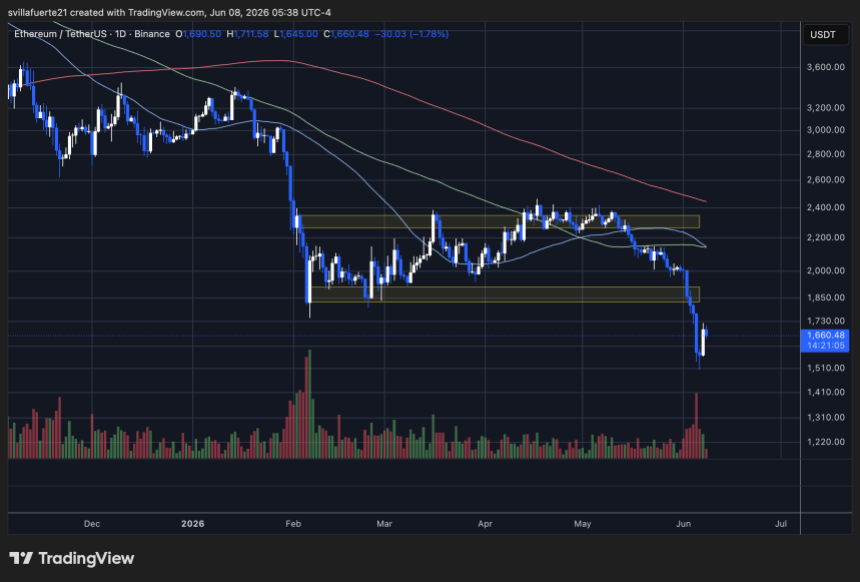
Ethereum loses key support level | Source: ETHUSDT chart on TradingView
The most significant technical development is the decisive breakdown below the February support zone around $1,800–$1,900. That area acted as a major demand region for nearly four months, repeatedly absorbing selling pressure during March, April, and May. Its failure signals that buyers have lost control of one of the most important support levels of the current cycle.
Related Reading
While ETH has managed a modest bounce from the recent low near $1,520, the recovery remains weak relative to the magnitude of the selloff. For bulls, the first challenge is reclaiming $1,800, which now acts as overhead resistance after the breakdown.
As long as Ethereum remains below that former support zone and below its major moving averages, rallies are likely to be viewed as relief bounces rather than trend reversals. The current price structure suggests the market is still searching for a durable bottom after recording its lowest levels since the February capitulation event.
Featured image from ChatGPT, chart from TradingView.com


