
This week’s Asia Express features a Q&A on how Singapore’s crypto landscape has shifted since the licensing deadline.
Before the summer of 2025, Singapore was a key base for cryptocurrency companies engaging in regulatory arbitrage.
While the city-state barred unlicensed companies from serving local users, many businesses sidestepped the rules by simply blocking Singaporean customers and serving overseas ones.
That changed after regulators forced companies to either obtain a license or find a new home. StraitX CEO Tianwei Liu’s company is the major player in stablecoin payments on the island and issues XSGD and XUSD. He tells Magazine that the directive reduced speculative retail activity while leaving more serious institutional players behind.
Magazine spoke with Liu about how Singapore’s crypto landscape has shifted since the licensing deadline, and how stablecoin adoption is expanding across Asia.
The following conversation has been edited for clarity and length.
Magazine: Has Singapore’s regulatory tightening affected the crypto scene on the ground?
Liu: From an insider perspective, MAS has been very consistent.

They have never used the term “crypto hub.” They talk about being a digital asset hub or a blockchain hub. The focus is on real-world applications, not speculative activity. They want companies to build useful applications that solve real-world problems.
Speculative activity has always been discouraged. That’s part of Singapore’s broader philosophy. If you compare SGX to Hong Kong Exchange, Singapore is more conservative. It avoids speculative instruments like high-leverage and margin-heavy products.
This carries over into crypto as well.
The situation where companies were asked to leave was not sudden. There were about three years of public consultations. Companies were given early notice and time to comply.
The issue was companies that wanted to base themselves in Singapore but not be regulated there, while serving overseas customers. That was a loophole that got patched.
They were told clearly: either get regulated and operate properly, or leave.
Magazine: What has actually changed for the local crypto ecosystem?
Liu: Some players have left, especially more aggressive exchanges and projects focused on speculative activity. But this is not just Singapore. This is happening globally.
If you look at previous cycles, there were ICOs, then [non-fungible tokens], and now those groups are much less active. Even in places like Dubai, where people thought those players would move, they are no longer as prominent.
So this is more of an industry-wide shift than something specific to Singapore.
At the same time, the ecosystem has strengthened.
We are seeing more institutional adoption. Banks and major companies are coming in and using these technologies in production.
Companies like Grab and major banks are integrating these systems. This is not theoretical. It is happening every day.
Read also
Magazine: Has the energy changed compared to before?
Liu: It depends on how you define energy. If you are talking about speculative hype, then yes, that has gone down.
But if you are talking about real-world adoption, it has increased significantly.
From our perspective, the growth has been very strong. We’ve seen about 40x growth in transaction volume and 80x growth in cards issued over the past 12 months.
So the industry has shifted. It is less about hype cycles now and more about real applications and real usage.
Magazine: How do you see Singapore compared to Hong Kong as crypto hubs?
Liu: We call it healthy competition.
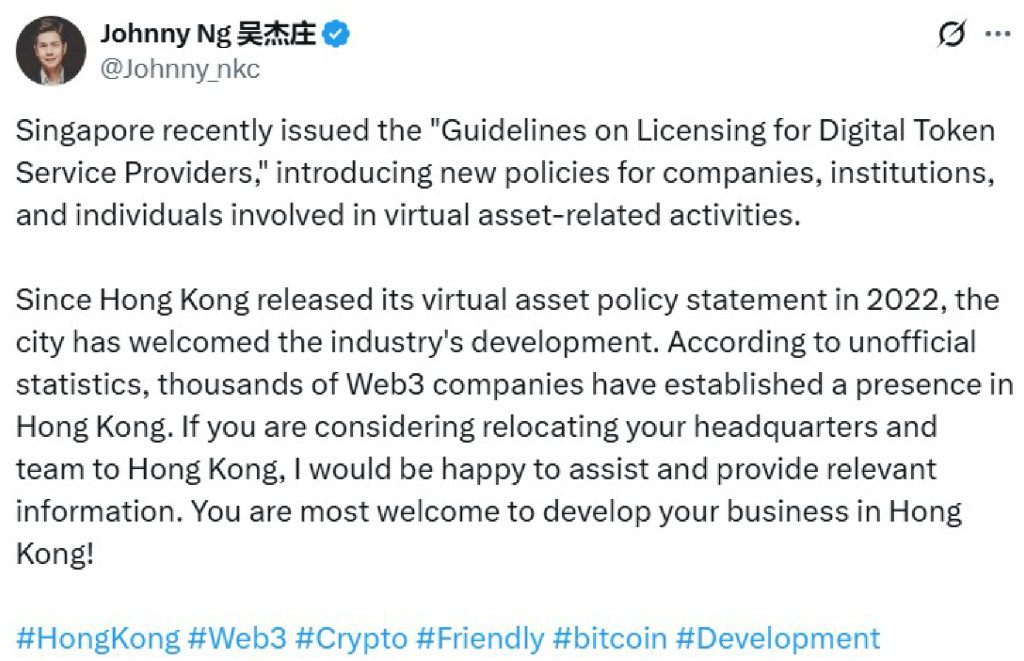
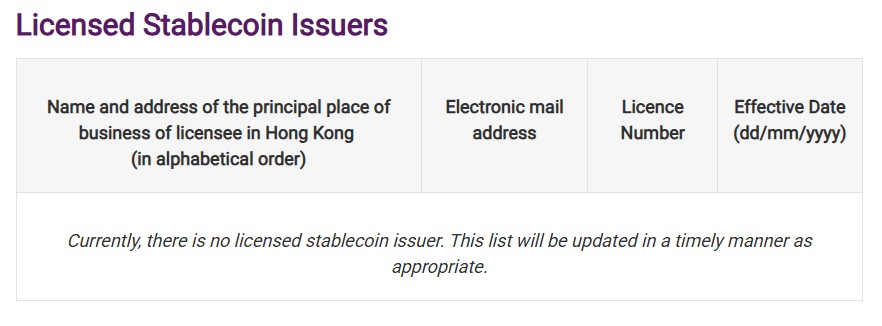
Singapore has been very consistent in its approach. Hong Kong said they wanted to move faster and even go one step ahead by opening up to more applicants, but they have missed their own stablecoin license timelines, which makes it a bit inconsistent. [The first licenses were subsequently issued this week]
From Singapore’s side, they have been very clear about what they want to deliver. They define the framework, select a small number of operators that can already operate, and then decide when to allow more participants.
A lot of this also depends on how other regulators move. Singapore was ahead, then Hong Kong said they wanted to move aggressively, so now Singapore is also observing how things develop globally.
So where we are right now is that Singapore already has a functioning regime with a limited number of operators, while Hong Kong is still in the process of getting there.
Magazine: When you say regulated stablecoin in Singapore, what does that mean?
Liu: Singapore has a regime that governs what they classify as well-regulated stablecoins.
Stablecoins can mean different things globally. You have crypto-backed stablecoins. You have ones that claim to be 1:1 but may not be fully backed. There are different levels of transparency and requirements.
Singapore is more specific. They provide clear guidelines on what it takes to be considered a well-regulated stablecoin. This framework was introduced around 2023 during the Singapore FinTech Festival.
Singapore is seen as a tier-one jurisdiction with strong regulatory credibility and banking infrastructure. There is also a stable government, which means policies tend to be consistent over time.
Read also
What they’ve done is provide clear guidelines, and then they grant exemptions to a small number of companies that meet those requirements. Those companies are allowed to operate immediately, not in sandbox, but in production.
At the same time, they have not yet opened applications to new players.
Right now, there are only three entities that have this capability. We are two of them across different structures, and the third is Paxos.
There are separate regimes for SGD and USD stablecoins. Those have been defined, but new applicants are currently not allowed.
Magazine: What kind of real-world use cases for stablecoins are you seeing?
Liu: We’ve been involved in some of these early pilots with regulators, in what used to be called Project Orchid and now Project Bloom. We are part of the pioneer community and have been spearheading these projects.
We have cross-border initiatives, especially QR code-based payments across Asia Pacific. There is now the capability for Alipay wallet users to come to Singapore and scan and pay at any merchant QR code.

To the end user, the vision is very simple. They just scan and pay, which they are already used to in Asia. But behind the scenes, every transaction is utilizing a Singapore dollar stablecoin on a public blockchain like Avalanche.
This is already happening every single day.
Since inception, XSGD has processed close to $10 billion in on-chain transactions. Our U.S. dollar stablecoin, which we launched more recently, has done about $40 billion in transactions in a short time frame.
We are also expanding this. For example, we just announced that Thai travelers coming to Singapore can scan and pay at merchant QR codes with the same backend infrastructure. Users don’t need to know anything about crypto.
Magazine: What is the fastest-growing use cases related to stablecoins?
Liu: One of the fastest-growing categories we are seeing is stablecoin-backed Visa or debit cards.
This is driven by real demand. In many emerging markets, people want access to US dollars. For those users, having a dollar-denominated account is a big draw. If you combine that with a Visa card that can be used at around 175 million merchants, it becomes a game changer.
We are seeing strong adoption in places like the Philippines, Thailand, Vietnam and also in emerging markets like Colombia and Venezuela. These are markets where local currencies are depreciating, and users are looking for alternatives.
Subscribe
The most engaging reads in blockchain. Delivered once a
week.


Yohan Yun
Yohan (Hyoseop) Yun is a Cointelegraph staff writer and multimedia journalist who has been covering blockchain-related topics since 2017. His background includes roles as an assignment editor and producer at Forkast, as well as reporting positions focused on technology and policy for Forbes and Bloomberg BNA. He holds a degree in Journalism and owns Bitcoin, Ethereum, and Solana in amounts exceeding Cointelegraph’s disclosure threshold of $1,000.
Disclaimer
Cointelegraph Magazine publishes long-form journalism, analysis and narrative reporting produced by Cointelegraph’s in-house editorial team with subject-matter expertise.
All articles are edited and reviewed by Cointelegraph editors in line with our editorial standards.
Content published in Magazine does not constitute financial, legal or investment advice. Readers should conduct their own research and consult qualified professionals where appropriate. Cointelegraph maintains full editorial independence.


