
Strategy’s sale of 32 Bitcoin shouldn’t have mattered. The company still holds hundreds of thousands of BTC, and the transaction barely moved the needle on its balance sheet. Yet the market reaction was swift, exposing how much of the Bitcoin treasury trade had been built on a simple assumption: companies buy Bitcoin… and they never sell it.
Elsewhere in crypto this week, JPMorgan CEO Jamie Dimon escalated his fight against the industry’s preferred market structure bill and a French Bitcoin treasury company pushed the limits of capital formation by asking shareholders to approve a massive $122 billion fundraising mandate.
Strategy’s Bitcoin sale tests treasury trade
Michael Saylor’s Strategy rattled the market after disclosing the sale of 32 Bitcoin — its first reported BTC liquidation outside a 2022 tax-related transaction.
The sale itself was tiny relative to the company’s massive holdings, but it challenged the long-standing narrative that Strategy would only accumulate Bitcoin and never sell. Shares of MSTR fell sharply following the disclosure as investors reassessed the assumptions underpinning the Bitcoin treasury model.
“The market learned that Strategy is no longer read as a pure one-way accumulation vehicle,” Delphi Digital wrote in a market summary.
“The old ‘never sell’ meme is now broken in practice, not just in conference call language,” Delphi added.
The transaction has reignited debate over how Bitcoin treasury companies should be valued. While Strategy remains committed to growing its Bitcoin-per-share metric, the sale served as a reminder that even the most committed corporate hodlers face financial realities.
Source: Michael Saylor
JPMorgan CEO draws a line in the sand on CLARITY
The battle over US crypto regulation intensified after JPMorgan CEO Jamie Dimon said banks would oppose the latest version of the CLARITY Act, arguing that crypto companies are being granted privileges without being subject to the same regulatory burdens as traditional financial institutions.
Dimon specifically criticized provisions that would allow crypto companies to offer interest-bearing products while avoiding the capital and compliance requirements imposed on banks.
The comments underscore a growing divide between the banking sector and the crypto industry as lawmakers push for market structure legislation. Supporters see CLARITY as a long-awaited framework that would provide regulatory certainty and encourage innovation. Critics, however, argue that the bill risks creating an uneven playing field.
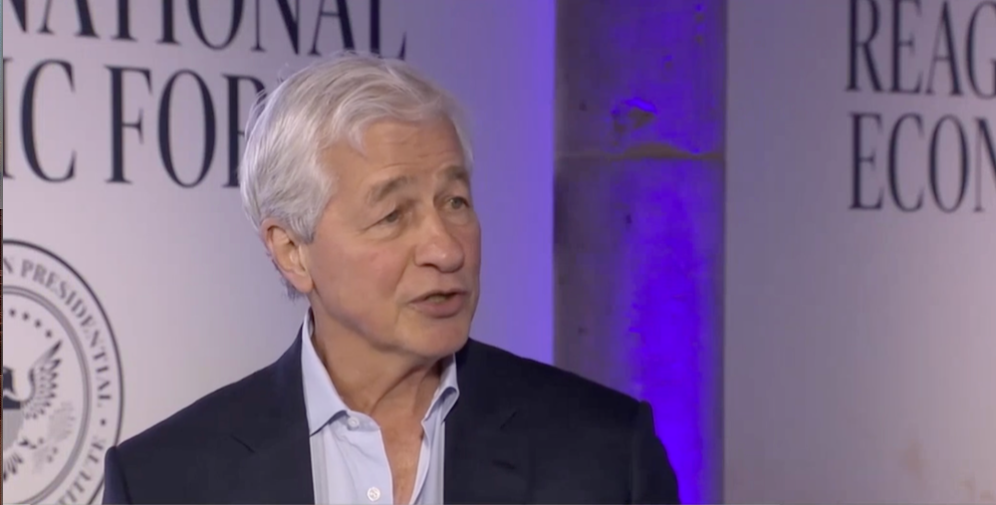
Jamie Dimon said the banking industry opposes the latest CLARITY markup. Source: Fox Business
Capital B seeks approval for $122 billion Bitcoin war chest
Bitcoin treasury company Capital B is asking shareholders to approve a sweeping expansion of its fundraising capacity, seeking authorization to issue up to 5 billion euros ($5.8 billion) in new equity and roughly $116 billion in credit instruments to finance future Bitcoin purchases.
The proposal, which will be voted on at Capital B’s June 17 shareholder meeting, would give management access to a vastly larger pool of capital than it has raised to date. According to the company, Capital B has secured about $325 million in funding so far, including a recent raise backed by Blockstream CEO Adam Back and asset manager TOBAM.
The company purchased 192 BTC for $15.2 million last month and added another 4 BTC on Monday, bringing its total holdings to 3,139 BTC.
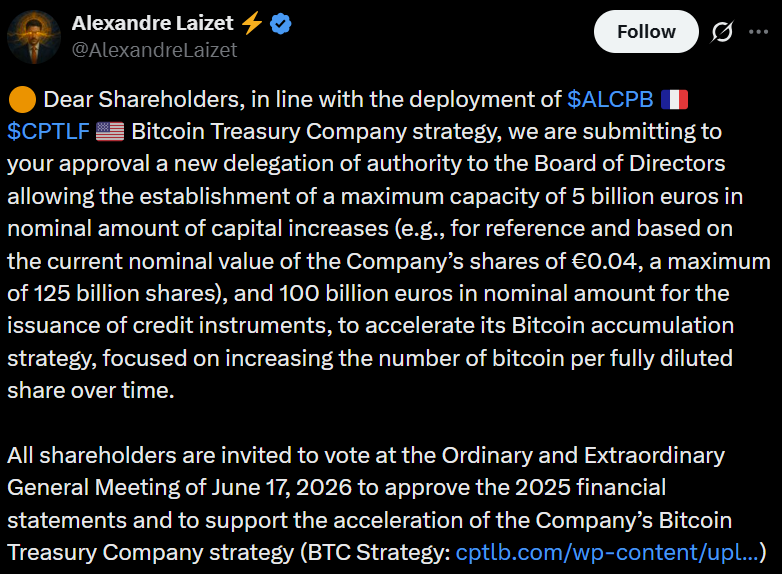
Source: Alexandre Laizet
Coinbase invests in ProShares stablecoin reserve ETF
Coinbase has invested an undisclosed amount in the ProShares GENIUS Money Market ETF (IQMM), a fund designed to hold assets that qualify as stablecoin reserves under the GENIUS Act.
The exchange-traded fund provides exposure to the cash, bank deposits and short-term US Treasury securities that payment stablecoin issuers are required to hold under the legislation. The GENIUS Act mandates that stablecoins be backed by highly liquid reserves, creating demand for investment products tied to those assets.
The investment highlights growing interest in stablecoin reserve assets as the US moves closer to establishing a federal regulatory framework for the sector. Stablecoin issuers are expected to become major buyers of Treasury bills and other highly liquid securities if adoption continues to grow.

Source: ProShares
Crypto Biz is your weekly pulse on the business behind blockchain and crypto, delivered directly to your inbox every Thursday.


