California Governor Approves Stricter Crypto Regulation Bill for 2025 Implementation
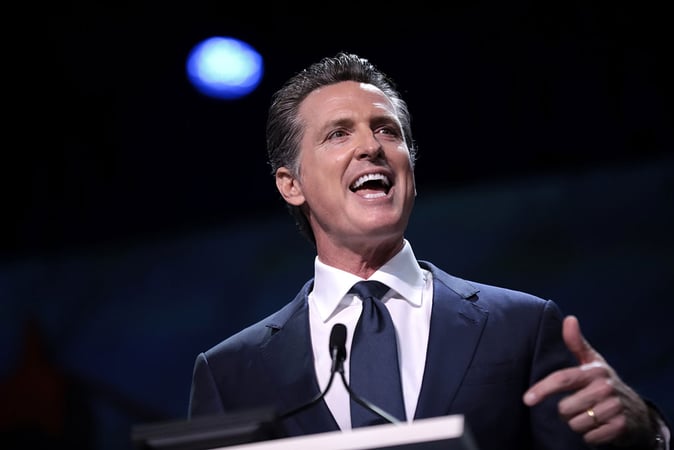
Governor Newsom’s endorsement of the crypto regulation bill represents a significant departure from his previous stance. California’s crypto industry is bracing for significant changes as Governor Gavin Newsom signs off on a groundbreaking regulatory bill expected to revamp the state’s digital asset landscape. The newly approved bill, the Digital Financial Assets Law, is slated to come into force in July 2025, bringing forth a series of stringent regulations for individuals and businesses engaged in crypto-related activities within the state. Under the provisions of the bill, all crypto entities will be…

California Gov. Newsom greenlights crypto regulation bill for 2025

California Governor Gavin Newsom has approved a cryptocurrency bill that enforces stricter regulations on businesses conducting crypto operations set to begin in 18 months.  In a statement published on October 13, Newsom declared that the bill titled the ‘Digital Financial Assets Law,’ will make it mandatory for both individuals and firms to obtain a Department of Financial Protection and Innovation (DFPI) license to engage in digital financial asset business activities. The bill is scheduled to come into effect on July 1, 2025. It draws a comparison to California’s money transmission…

G20 finance heads adopt roadmap for crypto regulation

G20 finance ministers say the document is necessary to achieve macroeconomic and financial stability goals. The G20 Finance Ministers and Central Bank Governors (FMCBG) adopted a crypto roadmap designed to support a coordinated regulatory framework for all group members. As reported by Business Standard, the roadmap called on boosting the World Bank’s capacity to support the “low and middle-income countries to meet the global challenges.” The new regulatory guidelines are based on updates from the International Monetary Fund and Financial Stability Board. According to the roadmap, jurisdictions should implement the…

G20 adopts IMF-FSB Synthesis Paper on crypto regulation

On Oct. 13, the Group of Twenty (G20) — an intergovernmental forum comprising 19 sovereign countries, the European Union and the African Union — unanimously adopted the “G20 Finance Ministers and Central Bank Governors Communique” during its meeting in Marrakesh, Morocco. G20 members accepted the crypto regulatory roadmap proposed in a joint report by the International Monetary Fund (IMF) and the Financial Stability Board (FSB) in September titled “IMF-FSB Synthesis Paper: Policies for Crypto-Assets.“ The G20 states: “We call for swift and coordinated implementation of the G20 Roadmap, including implementation of…

Crypto Regulation Bills May Depend on U.S. House GOP Battle Over Scalise Speaker Pick

The uncertainty over Scalise also keeps Rep. Patrick McHenry (R-N.C.), the stand-in speaker, from returning to his chairmanship of the House Financial Services Committee, which has been shepherding the leading crypto legislation in this session. When Republicans eventually pick a speaker, industry lobbyists have suggested McHenry may have built up some goodwill for taking the party’s reins, and he could spend some of that on getting floor votes for two crypto bills that cleared his panel. Source

Sam Altman speaks on Joe Rogan’s Podcast about crypto innovation and regulation

Sam Altman, Worldcoin founder and OpenAI CEO, discusses the potential and challenges of cryptocurrencies, emphasizing the need for a global currency while addressing concerns about regulation and privacy. The rapid rise of cryptocurrencies has elicited varied responses globally, with governments grappling to understand and regulate this burgeoning market. Sam Altman, Worldcoin founder and OpenAI CEO, recently addressed the U.S. government’s perceived aggressive stance on the crypto sector during Joe Rogan’s podcast. Labeling it a “war on crypto,” Altman expressed his disappointment in the government’s attempts to heavily regulate the industry.…

Crypto Risks Another Sam Bankman-Fried if U.S. Doesn’t Provide Clear Regulation

Japan, which heeded lessons learned from a previous crisis and put consumer protections in place, has incorporated Web3 into its national economic plan. Additionally, in June this year, the Japanese Financial Services Agency (FSA) amended the Payment Services Act (PSA). The agencies wanted to update the country’s regulatory framework for stablecoins and crypto assets. This amendment revised the definition of crypto assets, included new guidelines for crypto asset exchanges, banking and travel rules, as well as a new framework for stablecoin issuers. Source

Ukraine rolls out AI regulation roadmap

Ukraine’s Ministry of Digital Transformation presented its regulatory roadmap for artificial intelligence (AI) on Oct. 7. The roadmap was published on the ministry’s website and states that it aims to help local companies prepare for adopting a law analogous to the European Union’s AI Act. It also seeks to educate citizens on protecting themselves from AI risks. According to the roadmap’s announcement, it is based on a bottom-up approach that suggests moving from less to more, and it will provide businesses with tools to prepare for future requirements before adopting any…

Taiwan to propose crypto regulation in November

Taiwan is moving forward with plans to regulate the crypto industry by proposing a draft special law for first reading by the end of November, according to a lawmaker. Yung-Chang Chiang, a member of Taiwan’s parliament, said in an interview with The Block published on October 6 that a dedicated crypto asset act is necessary to oversee crypto firms, arguing that crypto diverges from traditional finance and requires tailored oversight. Chiang held a public hearing to discuss a draft proposal for the law. It would require all crypto platforms operating…

U.S. Crypto Regulation Irrelevant to Sam Bankman-Fried FTX Allegations, DOJ Says in Fraud Trial Arguments

“While the existence of a law might be relevant to establish a statutory duty of care, the absence of regulation is not relevant to whether money was, in fact, entrusted to the defendant’s care by his victims,” the DOJ filing said, adding that the existing criminal rulebook is sufficient. “There are prohibitions on misappropriating customer assets – they are the very laws that the defendant has been charged for violating.” Source