
The debate over whether Bitcoin’s four-year cycle is dead dragged on through most of 2025, but according to Into The Cryptoverse founder Benjamin Cowen, it was a pointless argument.
“I honestly don’t know why people keep saying it’s not the thing. I mean, Bitcoin tops when it always tops, like every cycle, it tops in the fourth quarter,” Cowen tells Magazine.
“I think that makes a lot of sense in terms of just playing out like it always does, and everyone’s going through like these mental gymnastics to figure out why it has to be different when it’s not really that different,” Cowen says.
2026 is likely a ‘bear market year,’ says Cowen
Despite all the talk about structural changes — institutional adoption, ETFs and macro catalysts — Cowen says the market is still following the same broad pattern and is already playing out in familiar territory, following its October all-time high of $126,000.
“I do think it’s a bear market year. I don’t think that Bitcoin is going to be hitting all-time highs in 2026,” he says, pointing out that the last two bear markets lasted “about a year.”
Bitcoin reached an all-time high of $126,000 in October before entering a downtrend, which saw the asset’s price fall as low as $60,000 in February, before recently bumping up above $70,000.
Cowen ponders whether the bear market is just “simply October 2025 to October 2026.”
He isn’t the only one who thinks Bitcoin may bottom around the same time. Veteran trader Peter Brandt recently predicted that Bitcoin could fall as low as $60,000 by the third quarter of 2026.
Cowen is going against a pack of big-name Bitcoin industry execs

Cowen’s view puts him at odds with several prominent industry figures, including Ark Invest CEO Cathie Wood, BitMEX co-founder Arthur Hayes, CryptoQuant founder Ki Young Ju, Bitwise chief investment officer Matt Hougan and CEO Hunter Horsley and Real Vision founder Raoul Pal, who all believe the traditional four-year cycle is dead.
Asset management firm Grayscale said in December 2025 that it expects “rising valuations in 2026 and the end of the so-called ‘four-year cycle,’ or the theory that crypto market direction follows a recurring four-year pattern.”
But Cowen, who has amassed 1.1 million followers on X, isn’t exactly some random voice on Crypto Twitter. He has a PhD in what might be the most intimidating title imaginable: “Molecular dynamics simulations of radiation damage in ceramics.”
Before becoming a crypto chart analyst, Cowen studied aerospace engineering and landed an internship at NASA. He eventually decided that wasn’t for him and later switched to a degree in math and physics.
So it’s probably fair to assume he’s put a little more thought into the four-year cycle debate than the average influencer.
Bitcoin capital didn’t rotate into altcoins this time around
If there was one key difference this cycle, Cowen says it wasn’t the timing; it was the lack of a major altcoin mania.
Cowen said this is due to “the top” of this cycle in October 2025 being “most similar” to that of the 2019 top.
Part of the comparison comes down to macro conditions, Cowen says.
Read also
“The reason you can say that is because if you look at, say, like the balance sheet of the Federal Reserve back then, Bitcoin topped out two months before quantitative tightening ended, just like it topped out right here, a couple of months before quantitative tightening ended,” he explains.
He says based on social media interest, Bitcoin topped on “apathy rather than euphoria.”
“So in 2021 and in 2017, Bitcoin topped on euphoria. And when you top on euphoria, when you have a parabolic rally, then you get a rotation into high-risk assets, like altcoins,” he explains.
“But when you top on apathy, like in 2019, you don’t get that rotation. And the reason you don’t get that rotation is that there’s just no one left to sell the altcoins to,” he adds.
Dealing with being wrong on social media
Cowen hasn’t exactly been shy about making market calls over the years. And when you’re doing that in front of a huge audience, you’re bound to cop some heat when things don’t go the way people hoped.
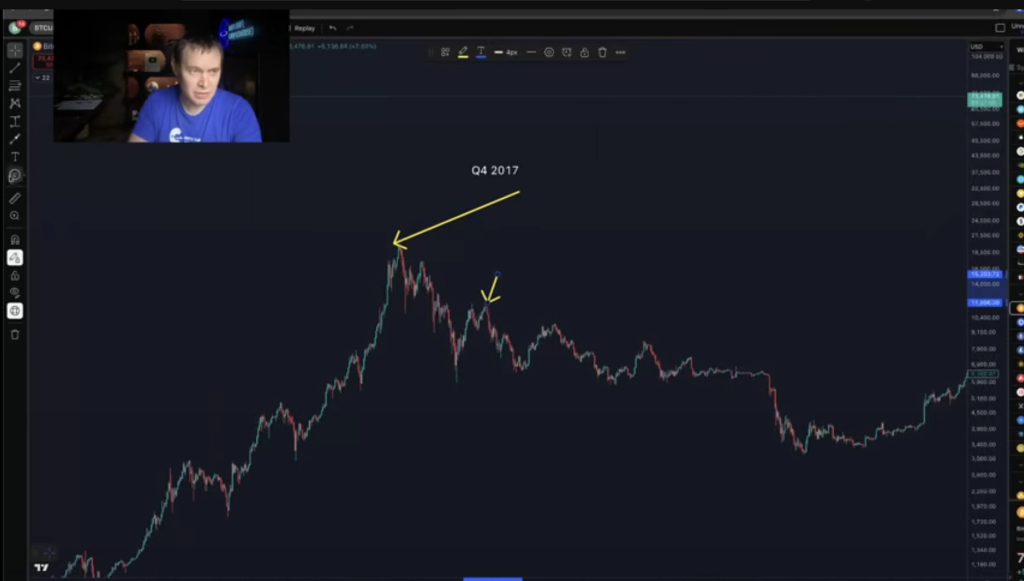
He says his biggest mistake this cycle came in Q4 2023. At the time, he expected Bitcoin to stall below $35,000 and trade sideways for the rest of the year, then resume higher in 2024. Instead, the market had other plans and broke out in October 2023.
“That ended up playing out, you know, differently than how I thought it was going to, and I kind of had to lick my wounds for a little while after that one,” Cowen says.
“When you do make a lot of public calls about larger investing themes, when they play out, it’s great; when they don’t play out, you hear about it for a long time.”
Subscribe
The most engaging reads in blockchain. Delivered once a
week.


Ciaran Lyons
Ciaran Lyons is a Cointelegraph staff writer covering cryptocurrency markets and conducting interviews within the digital asset industry. He has a background in mainstream media and has previously worked in Australian broadcast journalism, including roles in national radio and television. Prior to joining Cointelegraph, Lyons was involved in media projects across news, documentary, and entertainment formats. He holds Solana, Ski Mask Dog, and AI Rig Complex above Cointelegraph’s disclosure threshold of $1,000.
Disclaimer
Cointelegraph Magazine publishes long-form journalism, analysis and narrative reporting produced by Cointelegraph’s in-house editorial team with subject-matter expertise.
All articles are edited and reviewed by Cointelegraph editors in line with our editorial standards.
Content published in Magazine does not constitute financial, legal or investment advice. Readers should conduct their own research and consult qualified professionals where appropriate. Cointelegraph maintains full editorial independence.

