The intricacies of US monetary policy have been placed under the microscope by Jordi Alexander, CIO of Selini Capital, who today offered an incisive analysis of the potential ripple effects these policies may have on the Bitcoin and crypto market. Drawing correlations between traditional financial mechanisms and the nascent digital asset landscape, his commentary elucidates a series of complex market dynamics that every investor should be aware of.
At the crux of Alexander’s argument is his observation that the Federal Reserve’s approach to handling current economic conditions might be nearing an inflection point. As reported by NewsBTC, there are growing concerns in the bond market. Bonds with maturities exceeding 10 years have seen a decline of 46% from their highest value in March 2020. Moreover, the 30-year bonds have fared even more poorly, with a drop of 53%.
Alexander remarked, “Haven’t expressed macro views in a while – but as things are about to really start moving – its time. I spent months analyzing the endgame of US policy. The outcome I saw is now coming into view. Gradually at first.. then all at once, the Fed will poo-poo in their pampers. ”
Why QE Might Be Back Sooner Than Later
The analyst perceives the recent shifts in the bond market, especially concerning long-term bonds, as a precursor to potential policy changes. To back this up, Alexander is referencing Nick Timiraos of the Wall Street Journal who recently highlighted a specific sentiment from the Dallas Fed President Lorie Logan that is indicative of this shift.
Logan has begun to express reservations about the earlier hawkish stance of the Federal Open Market Committee (FOMC), largely due to the recent surges in Treasury yields and term premiums. Her concerns emphasize the tug-of-war between the need for restrictive financial conditions to bring inflation down and the current strength of the labor market and overall economic output.
Remarkably, Logan believes that the reasons for the tightening of financial conditions, especially those connected with the recent surges in Treasury yields and term premiums, might reduce the necessity to raise the fed funds rate.
Commenting on this U-turn by the Fed’s Logan, Alexander argues, “This is the Bat-Signal I have been waiting for. What does it mean? Why is the Dallas Fed president in the top tweet doing a big baby U-turn? Because they are starting to realize they are losing control of the bond market!”
Expanding on the nuances of the bond market, Alexander emphasized the distinction between the front and back ends of the curve. He stated, “The front of the curve, such as T-bills & 2-year bonds, are generally very responsive to rate guidance by the Fed… But the Fed never has as good control over the back end- especially 30-year bonds.” Alexander’s analysis points towards a decelerating demand for these long-term bonds, suggesting a potential loss of market control by the Federal Reserve.
This evolving bond market scenario places the Federal Reserve in a precarious situation. Alexander, elaborating on this potential dilemma, posits, “What if they agree to stop raising rates or even initiate cuts, but bond buyers still don’t show up?” He further speculated on a possible shift – the endgame – in the Federal Reserve’s approach: “Placed between a rock and a hard place, the Fed might be pushed towards Yield Curve Control,” hinting at a reversion to Quantitative Easing (QE) policies.
Drawing a parallel to the Japanese financial scenario, Alexander prophesied, “The USD could very well be the casualty of this policy direction, much like the Yen’s predicament in Japan.” He then connected these macroeconomic shifts to the digital asset space, forecasting, “Goodbye Quantitative Tightening, hello my old friend Mr. QE. The timeline is uncertain, but it is time to start paying attention to term premium, like the Dallas Fed!”
Bitcoin And Crypto Could Profit Massively
Ultimately, QE is something that Bitcoin and cryptocurrencies have benefited tremendously from in the last bull market. Alexander therefore also predicts “yes your internet coins [aka Bitcoin and crypto] could then benefit”. Remarkably, this view is shared by several analysts.
BitMEX founder Arthur Hayes recently expressed a similar view, according to which the Fed will sooner than later find itself in a bind to reintroduce QE. Hayes predicts a Bitcoin price of $750,000 in 2026.
But this perspective isn’t universally accepted. Yuga.eth from Coinbase drew on Austan Goolsbee’s confidence in the FOMC’s commitment to tackling inflation. To this, Alexander sharply responded, “Nothing about increasing the debt is helping the inflation anyway. As I wrote at the very beginning, the only way to do it properly would be to increase taxes, especially corporate.”
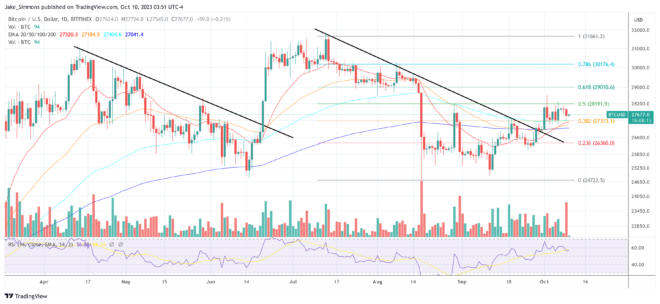
At press time, Bitcoin traded at $26,677.
Featured image from Shutterstock, chart from TradingView.com


