IRL.
This acronym has become shorthand for the regular, offline human existence in which we all participate, a realm lying outside of that new digital alternative to which investors, entrepreneurs and media commentators are increasingly drawn: the metaverse.
“In real life” evokes a place where our bodies are physically present, one in which we actually live. It also implies, by extension, that the metaverse is unreal.
That might seem perfectly logical to you. If so, Ben Hunt is here to tell you you’re wrong.
You’re reading Money Reimagined, a weekly look at the technological, economic and social events and trends that are redefining our relationship with money and transforming the global financial system. Subscribe to get the full newsletter here.
The always thought-provoking essayist, whose writings at Epsilon Theory have brought poetry, philosophy and communication theory to the analysis of economic and financial phenomena, has penned a tour de force – the first of a three-part series – that calls on us all to urgently address what’s happening with the metaverse. Why? Because it’s as real as everything and anything that defines our civilization.
Hunt tells us to focus on the narrative-building work that’s starting to give the metaverse shape in our minds. It’s related to an idea we’ve often visited in Money Reimagined’s newsletter and podcast: that the institutions that define who we are and how we live – our religions, nations, laws, identities and, yes, our money – are social constructs, the product of shared stories that we all tacitly and often subconsciously believe in. Like Yuval Harari – whose work on the power of stories I often cite – he knows that, far from being a reason to doubt their legitimacy, the collective belief in made-up ideas is what gives these institutions their power.
Still, as powerful as these narratives are, they can change. They can be supplanted by new ones. Author Neil Gaiman said, “Ideas are more difficult to kill than people, but they can be killed, in the end.” Hunt reminds us that “slavery used to be a thing. Settling your differences through dueling used to be a thing. The divine right of kings used to be a thing” and that “Littering was not a thing. Owning pets was not a thing. Privacy was not a thing.”
Heck, 30 years ago “the internet” wasn’t a thing. And by that I don’t mean the routers, switches, fiber-optic cables and Wi-Fi modems that connect computers and enable the distribution of bits and bytes. I mean the abstract “place” where public discourse happens, where new forms of communities arise, where life is monitored, assessed and acted upon. That internet is a concept we collectively dreamed into existence.
Similarly, the metaverse will come to occupy a prominent, influential place in our imagination.
This won’t happen instantaneously. Its shape, meaning and impact on our lives will evolve over time – an evolution that individual human beings can and will influence.
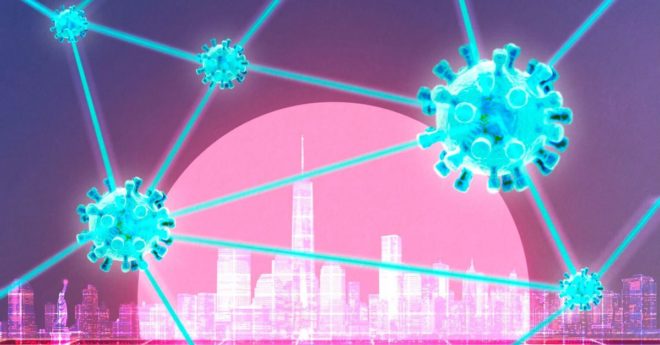
Hunt offers an analogy here: Our future engagement with the metaverse could mimic how, with the help of science, we came to accept the real existence of an unseeable “microverse:” that realm of viruses, parasites and other microbes that we’ve since learned how to manipulate, sometimes in sinister ways.
He warns of the internet equivalent of gain-of-function research, where scientists have developed the power to alter the genetic mutation of microorganisms, singling out Facebook’s Mark Zuckerberg as someone with an outsized (and unwarranted) capacity to steer the evolutionary direction of the metaverse. It’s up to us, Hunt writes, to ensure that this emerging real phenomenon serves humanity’s broad interest.
A real alien lifeform
Much of this way of thinking is familiar to me. I was lucky enough a few years back to be asked by digital media entrepreneur Oliver Luckett to be his co-author for “The Social Organism,” a book that views social media as a de facto biological phenomenon. Luckett helped me see that just as genes drive biological evolution, so, too, is the evolution of human culture shaped by memes. This is more than Twitter ideas shaping conversation. Richard Dawkins introduced the idea of memes in his 1975 book “The Selfish Gene” to posit that the spread of human ideas flows from competition between these core “units of replication.” The Social Organism argues that the internet has taken this process into overdrive.
Hunt’s essay takes that biological reference even further.
“Narratives are as real and as alive as you and me,” he writes. “When I say that narratives are alive, I don’t mean this as a metaphor. I truly believe that narratives are an alien lifeform in exactly the same way that viruses are an alien lifeform.”
Narratives are an alien lifeform? Note that Hunt is using the word “alien” to mean something that’s incomprehensible to us initially. Both narratives and viruses, he says, aren’t “observable or easily comprehensible within the human-scale macroverse – the familiar world of Newtonian physics and multicellular DNA-based organisms where all us humans, past, present and future, live out our lives.”
Just as we learned to view viruses and the microverse as real, so, too, will the metaverse eventually become part of our accepted reality. What’s at stake is who or what controls it, which is why this early narrative-forming phase is so important.
As we explored in last week’s column, whether or not blockchain technology is an integral part of this new iteration of the web, the bigger issue is whether we make the same mistakes of the “Web 2” era and allow centralized corporate entities shape “Web 3” in their interests rather than those of the general public.
Read more: A Crypto Guide to the Metaverse
Hunt zeroes his focus on Zuckerberg, whose renaming of Facebook as “Meta” should be seen as an early salvo in the battle to shape the metaverse narrative’s evolution. It seems like there may be more to come on this topic in the second part of Hunt’s Epsilon Theory trilogy, which is entitled “Narrative and Metaverse, Pt. 2: Gain of Function.”
The essayist’s take is not fatalistic. We can resist these outsized forces of control. But it is vital that we can recognize them and are ready to fight back.
“This is the battle of our lives,” Hunt writes. “This is always the battle of all human lives. The past, present and future of human freedom is not determined in the macroverse but in the metaverse, and it is here where we must make our stand. First we will write the words to see the metaverse. Then we will write the songs to change it.
“Clear eyes. Full hearts. Can’t lose.”


