2025 proved disappointing for many cryptocurrency investors, as Bitcoin’s traditional four-year cycle delivered a more muted rally that failed to spill over into the broader altcoin market. According to crypto market maker Wintermute, the shift reflects a structural change rather than a temporary pause, leaving any recovery in 2026 dependent on several uncertain factors.
In its digital asset OTC market review, Wintermute said the market’s long-standing pattern of “recycling,” in which gains in Bitcoin (BTC) and Ether (ETH) flowed into altcoins and fueled extended, narrative-driven rallies, broke down in 2025.
Instead, liquidity concentrated in a small group of large-cap assets, driven largely by exchange-traded funds (ETFs) and institutional inflows. The result was narrower market breadth and sharper divergence in performance, suggesting that capital became more selective rather than broadly rotating across the market.
As debate continues over whether Bitcoin’s four-year cycle is weakening or has fundamentally changed, Wintermute argued that the outlook for 2026 is far less predictable.
“2025 provided evidence that the traditional four-year cycle is becoming obsolete,” Wintermute said, adding:
“Market breadth narrowed significantly, with altcoin rallies averaging roughly 20 days, down from around 60 days the year before. Only a small number of tokens outperformed, while the broader market continued to grind lower, pressured by token unlock overhangs.”
For conditions to improve in 2026, Wintermute said at least one of three developments would need to occur: ETFs and digital asset treasury companies expand their mandates beyond Bitcoin and Ether; the major assets post another strong performance capable of generating a broader wealth effect; or retail investor attention returns, which is currently focused on artificial intelligence, equities and commodities.
Related: Wall Street’s crypto debate is over as banks go all-in on BTC, stablecoins, tokenized cash
The battle for mindshare intensifies
Bringing retail investors back into crypto will not be easy. Institutional participation has played an increasingly dominant role in driving Bitcoin’s price higher, while memories of the 2022–2023 bear market — marked by steep losses, high-profile bankruptcies and forced liquidations — remain fresh.
At the same time, investors have found no shortage of alternative opportunities offering stronger returns.
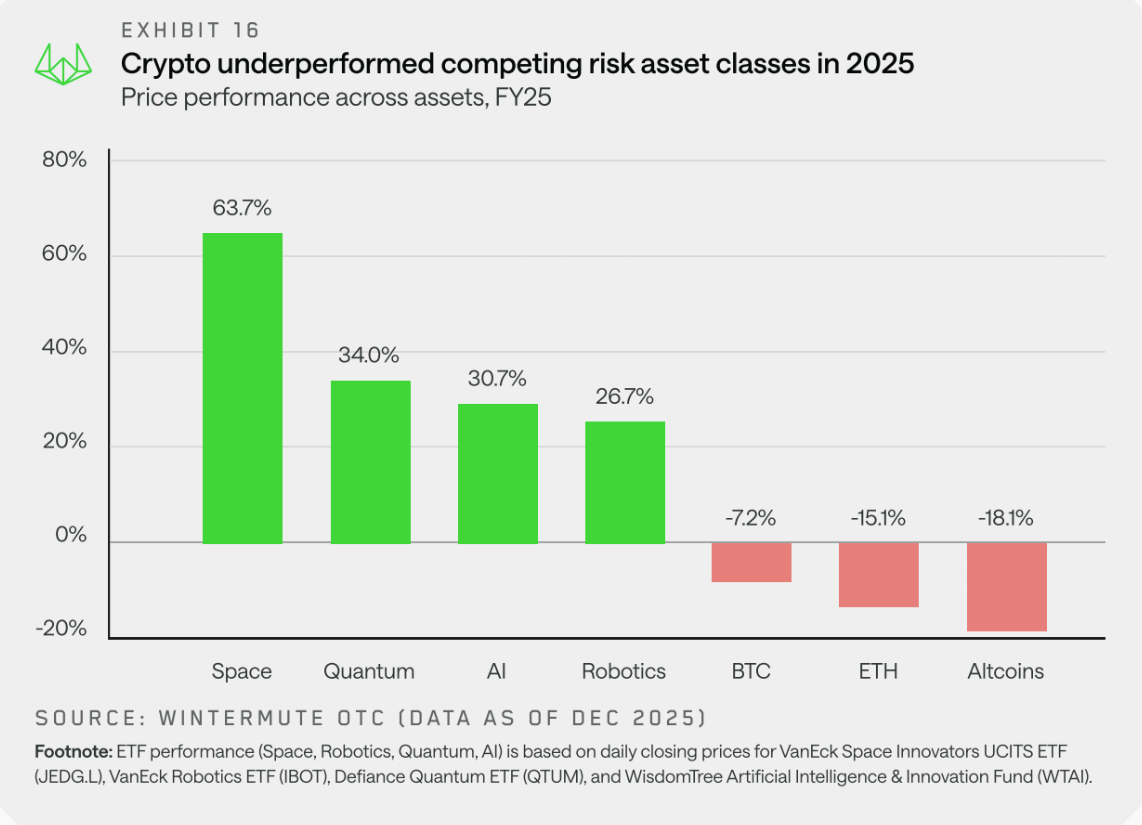
In 2025, Bitcoin and Ether broadly lagged traditional equity markets, particularly high-growth segments such as space, artificial intelligence, robotics and quantum computing. That relative underperformance has further diluted crypto’s appeal to individual investors seeking outsized gains.
Some industry observers argue that retail’s return to crypto depends less on narrative and more on macroeconomic conditions.
Clear Street managing director Own Lau said renewed participation is likely tied to how aggressively the US Federal Reserve cuts interest rates, creating a cheaper capital environment and greater risk appetite.
Fed rate cuts are “one of the key catalysts for the crypto space in 2026,” Lau said.
Markets are currently pricing in roughly two rate cuts this year, according to the CME Group’s FedWatch Tool.
Related: Retail investors can reclaim crypto’s promise through IDOs