
Bitcoin climbed above $64,000 on June 12 as improving market sentiment and bullish technical signals challenged a recent Galaxy Digital forecast that the cryptocurrency may not bottom until the fourth quarter.
Summary
- Bitcoin climbed above $64,000 as traders challenged Galaxy Digital’s warning that the cycle bottom may not arrive until Q4 2026.
- A potential inverse head-and-shoulders pattern, rising open interest, and positive funding rates point to improving bullish momentum.
- ETF outflows and Galaxy’s capitulation metrics suggest downside risks remain despite the recent rebound.
The rebound comes just days after Galaxy Digital’s head of research, Alex Thorn, warned that Bitcoin’s correction may have further to run despite recovering from its June low near $59,000.
In a recent analysis, Thorn argued that historical cycle data suggests the market has yet to experience the type of capitulation typically seen at major cycle bottoms.
“By the way, the ‘4 year cycle’ currently appears to be very, very real,” Thorn wrote on X, adding that if the current drawdown follows previous cycles, “we would expect a bottom to hit in Q4 2026.”
Galaxy’s analysis outlined several possible bottom scenarios. The firm sees a shallow bear market ending around $51,000 to $54,000, a base-case bottom between $40,000 and $46,000, and a harsher washout that could drag Bitcoin into the $30,000 to $39,000 range.
Bitcoin forms bullish reversal pattern near $65k resistance
However, current market data suggests traders are increasingly positioning for a recovery rather than another sharp leg lower.
On the 4-hour chart, Bitcoin has formed a series of higher lows since bouncing from the June trough near $59,173. Price is now pressing against resistance around $64,900, which coincides with the 0.618 Fibonacci retracement level of the recent decline. A breakout above that area could expose the next resistance zones near $66,700 and $68,500.
Market commentator BATMAN highlighted the developing setup on X, noting that Bitcoin is forming a “textbook inverse Head & Shoulders beneath descending resistance.” According to the analyst, a breakout above the neckline could trigger the next expansion higher.
Momentum indicators show early signs of stabilization. The Chaikin Money Flow indicator has moved back above zero on the 4-hour chart, signaling renewed capital inflows, while the daily MACD histogram has begun to contract from recent lows, suggesting bearish momentum may be losing strength.
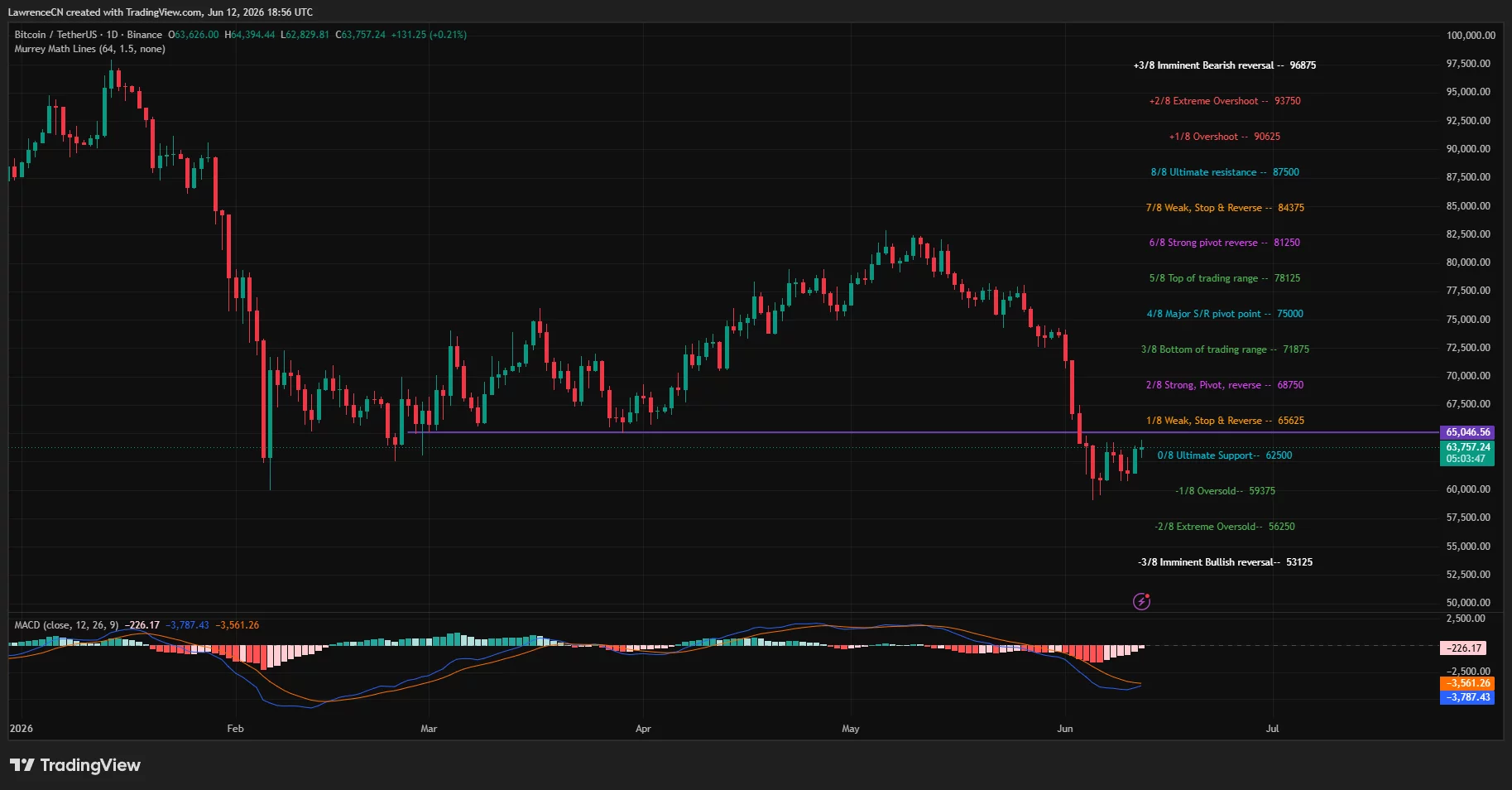
Derivatives markets are also showing growing confidence. Bitcoin’s open interest rose 0.12% over the past day to $46.13 billion, while the weighted funding rate remained positive at 0.0029%. The combination indicates traders are adding positions while maintaining a modest bullish bias rather than aggressively betting on further downside.
ETF outflows and cycle data keep the bearish case alive
Institutional demand remains mixed. According to SoSoValue data, U.S. spot Bitcoin ETFs recorded $19.03 million in net outflows on June 11. BlackRock’s IBIT attracted $30.26 million of fresh capital, but those inflows were outweighed by withdrawals from products managed by Fidelity, Ark Invest, Bitwise, and VanEck.
The ETF data partly supports Galaxy’s cautious stance. Thorn’s report argues that several historical capitulation signals remain absent, including the widespread investor losses and panic selling that often accompany major cycle bottoms.
Yet the market’s recent behavior paints a more balanced picture. Bitcoin has defended the key $59,000 support region, derivatives traders are gradually increasing exposure, and technical indicators are beginning to stabilize after weeks of heavy selling pressure.
For bulls, the immediate level to watch remains the $64,900-$65,000 resistance zone. A decisive breakout could strengthen the case for a move toward $68,500 and potentially the psychological $70,000 level.
However, failure to clear resistance would keep focus on Galaxy’s warning that the correction may not be complete and that the ultimate cycle bottom could still lie months away.
Disclosure: This article does not represent investment advice. The content and materials featured on this page are for educational purposes only.


